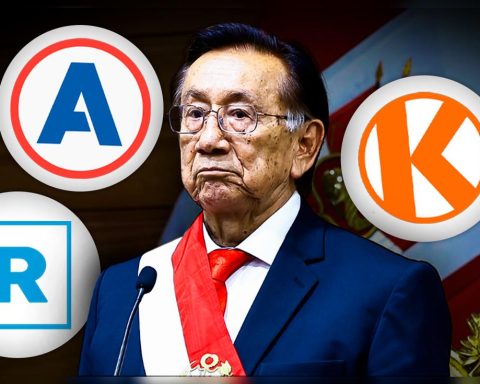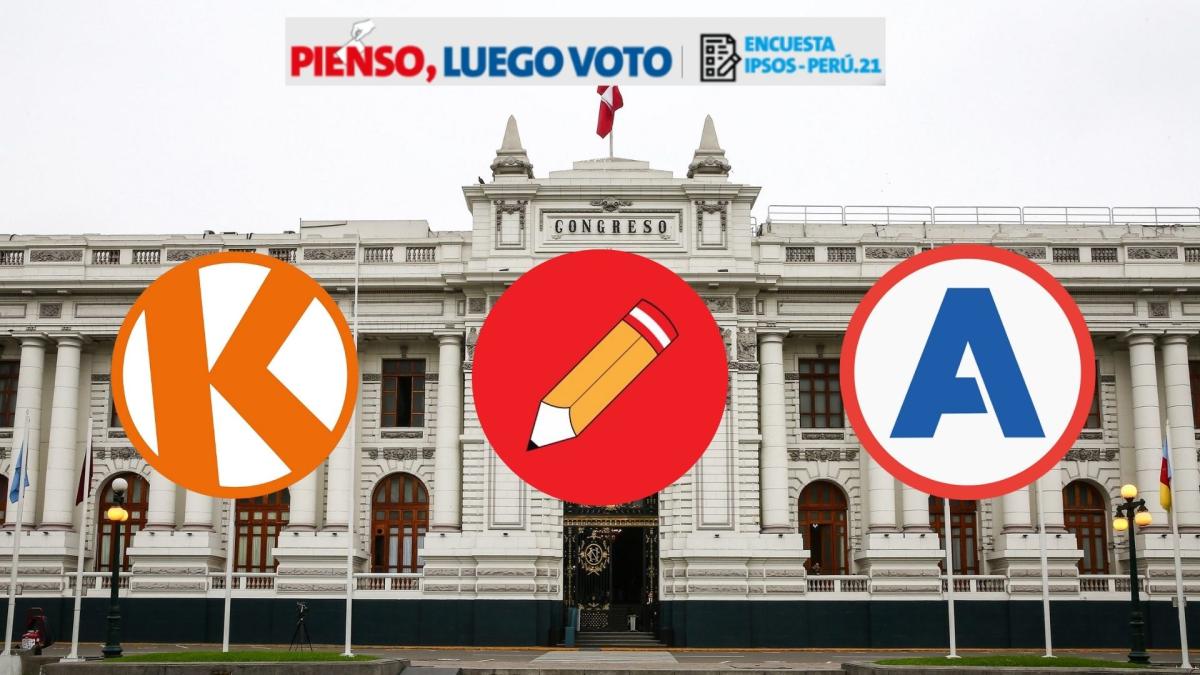
In spite of the overwhelming disapproval indices for their performance in the Congress of the Republic, the political parties that today control that power of the State insist on repeating the dish in 2026. Worse still, they rejected all kinds of electoral alliances to be recorded in the elections with their own symbol, without measuring that next year could give them not a new seat, but a certificate of extinction.
This is because, according to the Ipsos survey that publishes today exclusive Peru21Peruvians reject that claim. Popular Force, Peru Libre and Alliance for Progress (app) see the fruits of their parliamentary management: citizenship does not want them in the following congress.
In the numbers it is observed that 58% of Peruvians consider that they probably or definitely would not vote for Fujimorismo for the next parliamentary elections. In Peru Libre the indicator reaches 55% and in APPs 54%. The Executive President of Ipsos, Alfredo Torres, said that this occurs because these three groups are the ones that have integrated the board of the Parliament in this five -year period and “have a high anti -anti -to”, which is “relevant in a second round” presidential.
Regarding Popular Force, “the number of people who say that they would definitely vote” for them, which is currently 5%. The hard vote of app reaches only 2%, so Alfredo Torres infers that “it is not certain that the electoral fence passes.”
“I would say that those who have this 4 or 5% today are likely to pass the fence, but those who are in 2% or 3% have to fight it. It will depend on who the presidential candidate is so that he can drag the votes up and also who can be the head of the list for the Senate,” he told Peru21TV.
The highest rejection index for the parliamentary elections of 2026 is obtained by the APRA, which although it does not currently have congressional representation, 60% say that probably or definitely they would not vote for the star. However, only 20% do not identify them, unlike the country party for all, by Carlos Álvarez, which has a level of citizen ignorance of 50% despite being on the podium of presidential preferences.
Associations that add up and subtract
From the survey it follows that 27% would definitely vote or could vote for popular action, and this occurs because, according to Alfredo Torres, “not everyone associates children with popular action; many associate them with Congress.”
As is known, the Public Ministry investigates several congressmen, many of them of popular action, in the case of children, in which certain parliamentarians of corruption acts related to the granting of public works in exchange for political favors during the government of Pedro Castillo are syndicated.
Precisely about Castillo, Torres pointed out that the Pen of Peru Libre “is an attractive symbol” for people, but because many associate it with the ex -president imprisoned. “We don’t know if you are going to hold your base in time as people see that Castillo is not there,” he said.
In the other picture of the survey, it is observed that 46% know that Fuerza Popular integrates the current Board of Directors of the Congress. This knowledge reaches 35% compared to Peru Free, to 28% in relation to popular action, 25% in terms of app and up to 19% in reference to Somos Peru.
Alfredo Torres mentioned that this indicates that Fujimori, Peru Libre and app “are the parties that may suffer greater wear for their link to the government.”
“In the case of Somos Peru, many people do not know the current president nor know that José Jerí is from Somos Peru, so the impact is less,” he said.
In addition, he stressed that popular renewal, of the mayor of Lima, Rafael López Aliaga, does not appear linked to the board of directors, which reflects that he “is building an opponent image.”
Technical file
Receive your Peru21 by email or by WhatsApp. Subscribe to our enriched digital newspaper. Take advantage of discounts here.