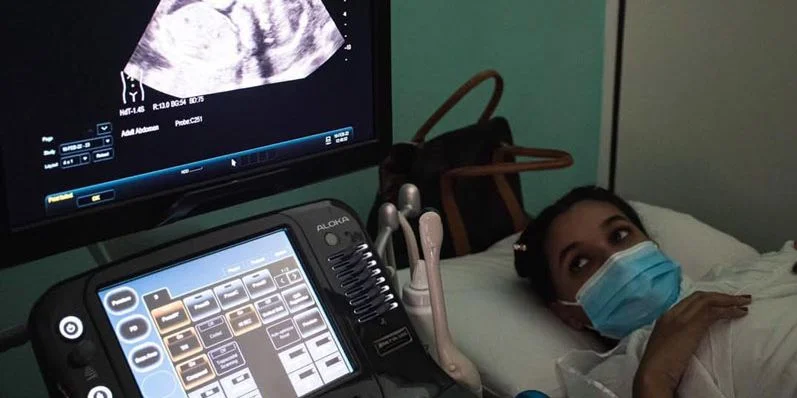
The risk of death during childbirth is four times higher for adolescents under 16 years of age than for young adults.
HOLGUÍN, Cuba. – “My friends gave birth when they were young. I see it as something normal, that’s why I decided to have a child,” says Yanelis Cruz, a 16-year-old teenager from the Alcides Pino neighborhood in Holguín.
Early pregnancy, as defined by the World Health Organization (WHO), is one that a woman conceives between the beginning of fertile age (from 10 years old) and the end of the adolescent stage (19 years old).
The risk of death during childbirth is four times higher for adolescents under 16 years of age than for young adults. In Cuba, more than 17% of births correspond to women under 20 years of age. Meanwhile, prematurity and low weight, more common in this group, contribute to infant mortality.
This northeastern province of Cuba faces a public health crisis that goes beyond statistics: the normalization of early pregnancy due to the scarcity of resources and the lack of life projects, leaves futures truncated and a chain of responsibilities.
This idea of normality spreads throughout the city’s neighborhoods. Juan Martínez, a resident of the El Llano neighborhood, observes how this acceptance becomes a pattern of behavior among the youngest women. “Little girls of 13, 14, 15 years old get pregnant because they don’t have guidance either in the family or at school and, since their friends have already given birth, they see that as something normal. They don’t calculate the risk to their health and the risk to the health of their future child.”
What is considered common on the street, however, contradicts the warnings of medical experts and the long-term social consequences. A nurse from Holguín, who asked to protect her identity for fear of reprisals, describes a situation that official reports do not always detail with the same crudeness: “Little 14-year-old girls arrive at the office with a pelvis that is not ready for childbirth, with anemia, with high blood pressure. And of course the pregnancy is cared for. For the system, the most important thing is that the child is born well, but it forgets that the person who gave birth is still a girl who doesn’t even know how to start.”
Pregnancy statistics in adolescents under 15 years of age show a clear tendency to increase fertility and also the abortion rate on the Island. reported in June 2024 the first vice minister of the Ministry of Public Health (MINSAP), Tania Margarita Cruz.
The issue came up in a meeting of the government commission in charge of analyzing the demographic dynamics of Cuba. At the meeting it was reported that on the Island, 82% of adolescent fertility corresponds to the age group of 15 to 19 years of age.
Likewise, it was learned that 18% of pregnant adolescents are under 14 years old, a phenomenon that worries experts due to its “broad social, educational and health impact.”
An analysis by the Commission for Attention to Demographic Dynamics concluded that the provinces with the highest adolescent fertility rate are in the East of the Island. Among them, Las Tunas, Camagüey, Granma and Holguín stand out. In Cuba, according to a report from the same commissionn, teenage pregnancy has become naturalized and there is little perception of the risk of its consequences for the physical and psychological development of girls and adolescents.
10 years ago, a report from Radio Angulo, a provincial station in Holguín, warned that teenage motherhood was “a health problem in the province” and revealed that in 2014, 2,218 pregnant adolescents had been treated (103 of them were between 12 and 14 years old; 1,495 between 15 and 18; and 620 were 19 years old).
Far from improving, the situation has worsened. Dr. Alberto Rubén Piriz Assa, head of the Maternal and Child Care Program (PAMI) in Holguín, confirms it with current data that shows the seriousness of the problem. In several Holguín municipalities, 25% of all pregnant women are girls or adolescents.
The national outlook is no more encouraging: in 2023, the early pregnancy rate reached 19.7%, the highest figure in recent years.
For its part, in the session of the XVIII Plenary Session of the Provincial Committee of the Communist Party of Holguín, held in September of this year, was pointed out the increase in teenage and risk pregnancies among the problems of the Maternal and Child Program.
The shortage of contraceptive methods aggravates the situation. The diary The Artemiseño reported in 2023 the increase in sexually transmitted infections (STIs) in the province of Artemisa, a situation that goes hand in hand with the limited availability of condoms in pharmacies.
Lack of access to contraceptive methods forces us to resort to the informal market, where inflation and shortages have turned condoms into an expensive good that is difficult to access for the Cuban population.