When the Cyclonic Alarm came, I was in Oriente. I had been invited to a troubadour event in Camagüey and I thought I would stay a few more days with the family.
The train ticket to Havana on October 28 was canceled by the authorities as a protection measure against the arrival of the hurricane.
Melissa had been in our conversations for days. When will it start to rise north? With what force will it reach Cuba after passing over land in Jamaica? Is it possible that it moves a little further to the west, and then yes, the hardest winds will reach Camagüey? What a tragedy to have to go through this too!
Since seven in the morning of the 28th itself, the day before the dawn when, according to the forecasts, Melissa would begin to cross the East, in the neighborhoods of Camagüey we were without electricity.
To be informed, we tried sending the word “Huracan” –without an accent– to the number 2266 that ETECSA offered for free. At three in the afternoon, after several failed attempts, we received a concise response from ten in the morning, where we learned that Melissa remained in Jamaica, now with category four.
Before the eyes of the neighbors sitting on the corner, analyzing the possible path of the hurricane, remembering that to the left of the phenomenon the winds cover less distance and reviewing storms from years ago, a man dressed in green loaded all the garbage bags on the block into his wheelbarrow.
No one asked his name, where he came from or where he was going; if someone sent him or he wandered around on his own to take care of the hygiene of the surrounding neighborhoods; no one had ever seen him.
He returned a couple of hours later, now with the empty wheelbarrow and a satisfied smile.
In Cuba we have learned to survive in times of crisis; We know of intense hurricanes. There have been many years of Civil Defense reciting protection measures on the radio and television. And we have had Dr. Rubiera as a guide in difficult moments, with that tone that seems to say: “Everything will be fine.”
I remember my childhood in Matanzas. I waited for the cyclones with the expectation of several days without school, of going to my grandparents’ house to eat cookies with mayonnaise, of listening to the wind behind the window and peeking out hidden behind a glass to watch the palms sway.
But one already knows. The storm is impious: it collapses, mutilates and kills.
At some point in the afternoon, a group of neighbors were talking about the remote possibility that the trough would push Melissa even further east.
This is how hope works; It settles from time to time in best wishes.
At seven thirty at night, even without rain all day, without wind and without electricity, the last neighbors closed their doors and windows. It was also necessary to save water, because “empty tanks are a danger with the winds.”
“Anything can be a projectile,” Rubiera repeats.
A few isolated barks broke the heavy silence. The darkness was the most extensive I had seen in these neighborhoods. Even the houses that usually turn on their power plant were in darkness.
After nine, a message arrived from my brother from Havana: he had sent it since the morning. Communication remains difficult.
After ten o’clock we managed to tune in to Radio Reloj, through a telephone number that ETECSA also provided. An announcer was reviewing the results of a Japanese League baseball game and the performance of the Cubans. Radio Rebelde broadcast special programming, with a repeated spot where a deep voice announced the alarm.
Parts of Guantánamo, Holguín, and Bayamo; A governor spoke of the importance of preserving life above all, of a tour of the areas of possible impact. Before the call was disconnected, we could not understand if the president had arrived in Santiago de Cuba.
To our surprise, the electricity came on in the early morning, almost 18 hours later. There was no commotion, only the noise of turbines and, after a while, the sound of pressure coming from some pots. As usual, three hours later the blackout returned.
At six in the morning the first whistle of a baker sounded, to begin the usual line of proclamations: hard bread, soft bread, tartlet.
The street was dry, the tank lids in place, the trees straight—the most robust and the weakest.
The neighbors who gathered on the corner talked about Melissa: “She is still in Holguín,” “it seems there are no deaths.”
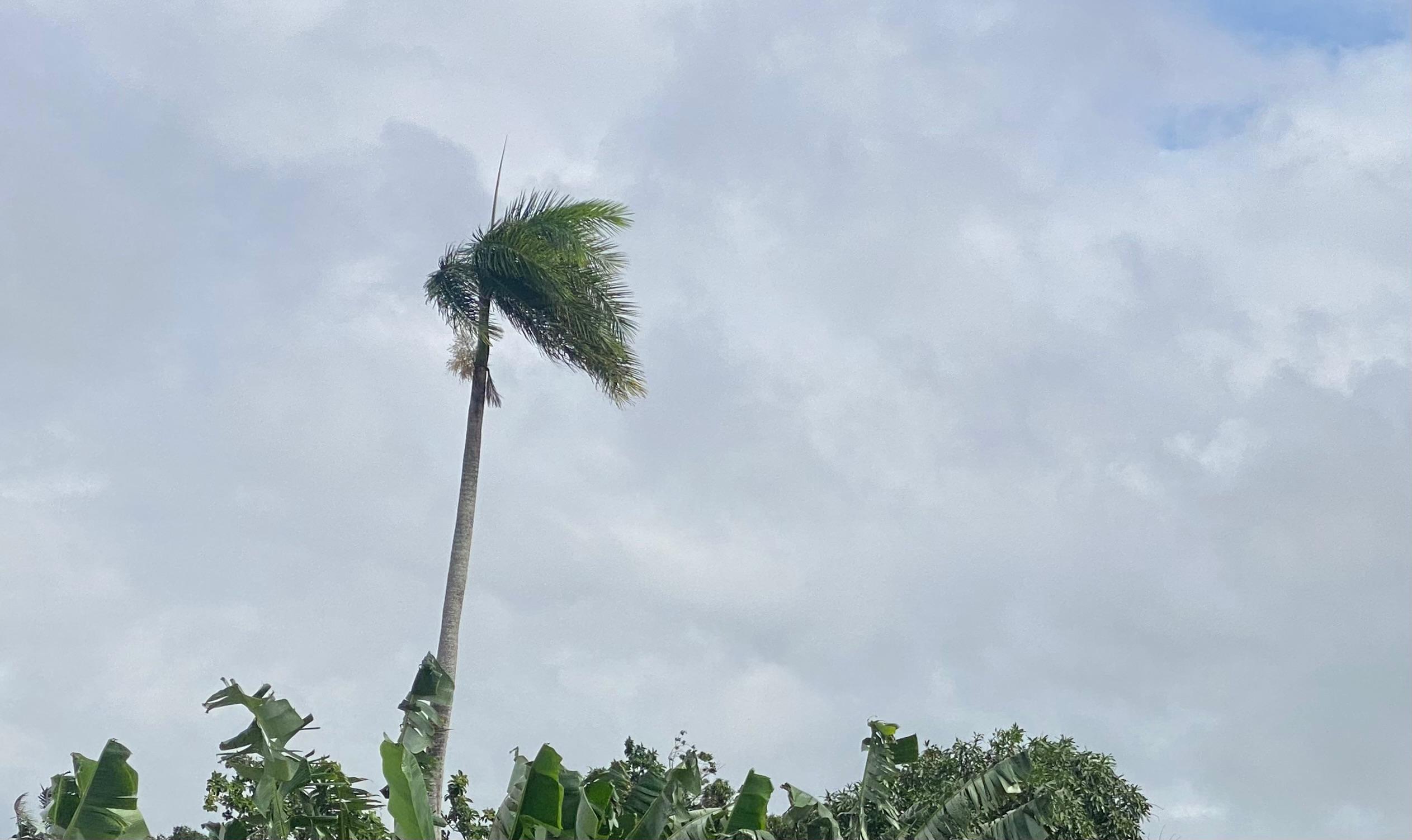
I try to connect to search for information. Meanwhile, I watch from the window how the wind—which seems normal—sways the palms.
Camagüey only knew Melissa’s left shoulder. There was no direct hit, just the warning.
The neighbors are still there. A lady cleans her porch and decides to play music on her portable speaker. It’s the same old song, the one that perhaps reminds him of his youth. Everyone is silent to listen: “Life goes on the same.”