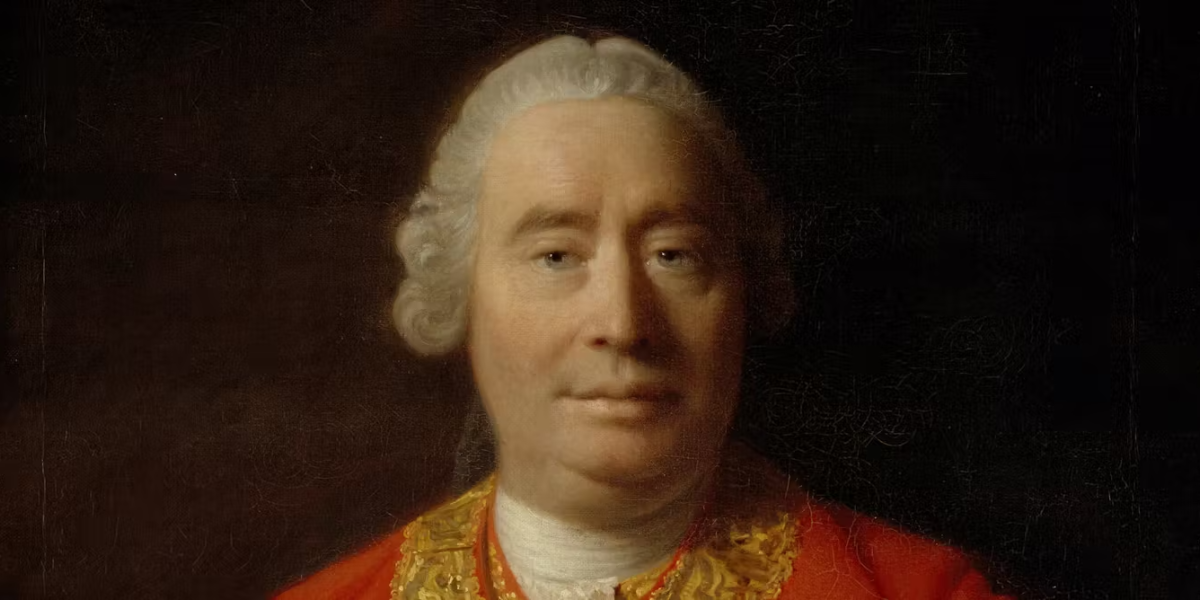
The ideas of the Scottish philosopher David Hume (1711-1776) They have powerfully influenced modern philosophy. In this article I am interested in particular for its conception of passions and for how education can limit excesses and help us be better people and enjoy a healthy inner peace.
Coherent and implacable
Hume’s life provides a powerful example of coherence with his own ideas. He was not a believer but His criticisms of religion and the denial of the existence of God are formulated in a respectful tone towards the devotees, while relentless in their arguments. About himself explained:
I was a peaceful man, controlled temperament, open, sociable and cheerful humor, capable of attachment but little susceptible to enmity and of great moderation in all my affairs. Even my love for literary fame, my dominant passion, never bracked my temperament despite my frequent disappointments. ”
His arguments around religion earned him the attacks of other thinkers, mainly believers, upset by his ideas and his rational demonstration of the non -existence of God. However, his style was always to avoid controversy:
He had set a resolution, which maintained, never responding to anyone. And since I am not very irascible, I have stayed away from all literary disputes. ”
His friend, the philosopher and economist Adam Smith, who knew him well, said of him:
His temperament seemed to be more happily balanced, if I am allowed such an expression, than that of any other man he has known. ”
As their biographers explain, Hume’s life demonstrates that religion is not a previous condition of virtue.
How did his virtuoso balance reach Hume?
In your essay About the delicacy of taste and passionHume wrote:
Nothing improves the temperament and the study of beauties, either of poetry, eloquence, music or painting. ”
In this work, the thinker argues that cultivating liberal arts and humanities generates happiness and helps develop the resilience that allows the adversities of life to face:
“Naive Didicisse Fideliter Artes, Emollit Mores, Nec Sinit Esse Feros.”
“Having faithfully learned the naive arts, softens their manners and does not allow them to be wild,” says Hume, thus following the long tradition of teachers as Aristotle, Plutarch, Seneca and Tomás de Aquinothat related the development of virtues to the knowledge of classical thinking and philosophy.
Passion and sensitivity
Hume distinguishes between two types of sensitivity, or delicacythat configure human personality. The first is passion, the degree of emotional intensity with which we react to the circumstances and events of life, whether positive or negative.
People with a more pronounced sensitivity and passion feel euphoric in happy circumstances and sink into adverse situations. These passionate beings can quickly forge burning friends and enthusiastically value honors and praise. However, they also feel greatly rejected and offended when they are criticized.
On the opposite side, the most reflective and more self -control people react moderately to the ups and downs of life. They do not rejoice excessively with good news or discourage too much with adversities.
Hume explains that it is beneficial to exercise moderation in all things since, first, we do not have the ability to control our destiny completely, and then, and especially at the end of life, we experience more sadness and pain than pleasures and joys.
The second delicacy is what hume what calls the sensitivity of taste. This quality develops mainly cultivating humanities and arts. Those who possess it are able to appreciate and enjoy good literature and music, and experience true emotional pleasure in practicing them. At the other extreme, those who lack this capacity may feel indifferent to works of art or poetry.
Control our lives
The delicacy of taste is as desirable and cultured as the delicacy of passion must be lamented and, if possible, corrected. ”
The key to this proposal is in the possibility of owning our passions and desires, of controlling our lives. Since we have no control over the future, it is preferable to cultivate the knowledge and emotions that make it easier for us to face the unforeseen events. As philosophy explained throughout the centuries, the happiness of the wisest people depends on themselves and not on luck or external circumstances.
Develop sensitivity, or delicacy of tastecan counteract the negative effects of being passionate, allowing those with anger to mold their character:
Nothing is so appropriate to cure us of this delicacy of passion, how to cultivate the highest and most refined taste (…) a new reason to cultivate the taste for humanities. Our judgment will be strengthened with this exercise: we will form fairer notions of life. Many of the things that please or afflict others will seem too frivolous to capture our attention, and gradually mold the passions, which are so uncomfortable. ”
Cultivation of being
Education and increased knowledge improves character and gives us more autonomy and freedom of thought. That said, developing our taste is a process that lasts a lifetime and requires more than reading a book from time to time or attending an opera from time to time.
Bringing a newspaper in which we comment our experiences, the books we have read, the films we have seen, the exhibitions and concerts we have attended is a practical way of further developing our cultural sensitivity.
Refine taste also improves multicultural management skills. In another of his essays, he explains:
“You will never convince a man who is not accustomed to Italian music and has no ear to follow her that a Scottish song is not preferable.”
And it evokes the classic analogy that our soul is similar to an auriga that guides a car pulled by two horses:
Our Auriga governs the couple of horses that pull the car; One of his horses is beautiful and good and of similar parents, the other is his opposite. In both ways, driving is hard and difficult for us. ”
Both Plato and Hume understood the unfathomable ability of human personality to deviate to the extremes: to commit unimaginable iniquities and surrender to vices or, alternatively, rise and behave in the most benevolent and generous way. The skill of the auriga depends on practicing virtues, cultivating education and developing taste.
In the business environment, the development of sensitivity can result in a broader look, which results in respect for diversity and promotion of individuality (compatible with the impulse to teamwork). Continuing education, particularly humanities training, can reduce anger and discomfort in work teams – especially when mistakes have been made or bad results have been obtained – and avoid the search for scapegoats, something that only hinders the initiative and innovative and business capacity.