The political dawn of this Thursday, October 23, surprised the country with an unexpected announcement, after the Government of President Gustavo Petro presented the draft of a bill to convene to a National Constituent Assembly, with the objective of modifying the 1991 Constitution.
The proposal, as explained by the Minister of Justice, Eduardo Montealegre, seeks to “break the institutional blockade” that, in the opinion of the Executive, has prevented the implementation of the social program of the first leftist government in Colombia.
Check here: Petro Government presents project to convene a National Constituent Assembly
According to what was stated in the preliminary text, the election of 71 delegates who would meet would be sought for three months, with the possibility of modifying the entire current Constitution. In addition, it would grant the President extraordinary powers for six months to issue decrees with the force of law, focused on defining the requirements and procedures for electing delegates.
Likewise, although the project clarifies that Congress would not be dissolved, but would coexist with the Assembly, an unprecedented figure in the country’s institutional history; It did not go down well at all in various political and economic sectors.
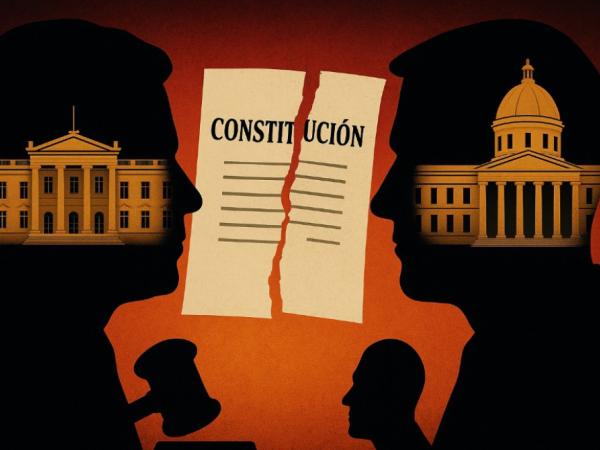
This project has generated conflicting positions among the branches of public power.
Image from ChatGPT
From Shanghai, where he was on an official mission, Montealegre presented the initiative with a speech full of symbolism in which he spoke of a “new march” of the Colombian people, comparing it with global transformation processes such as that of the People’s Republic of China.
“The people of Colombia will begin a path to achieve a leap forward in search of human dignity, without imperial impositions or foreign humiliations,” he stated in his speech, in which he described the Constituent Assembly as an inclusive space, with gender parity and representation of diverse communities, from farmers and workers to victims of the conflict and non-binary sectors.
More information: ABC of the project that proposes charges for Bre-B transactions: how it would be applied
According to the Government, the proposal does not aim to concentrate power, but rather to return it citizens the ability to decide their own destiny. Montealegre insisted that the institutions of 1991, although historically progressive, “became obsolete or were captured by retarded sectors that impede social progress” and that the new charter, he assured, would allow the State to adapt to the challenges of the 21st century, on issues such as social justice, the environment and digital rights.
Can it be approved easily?
However, analysts view the outlook with skepticism. For José Manuel Restrepo, former Minister of Finance and current rector of the EIA University, the initiative “makes no sense” and in his opinion, the project lacks political and legal viability, since “it does not have the time or the majorities necessary to be approved in Congress.”

This project has generated conflicting positions among the branches of public power.
Image from ChatGPT
This analyst added that the design of the process, based on quotas by social sectors, “copies the Venezuelan model” and distorts representative democracy by replacing the election with criteria of ideological affinity; so he concluded that “more than “A real reform, this seems like a political platform to continue dividing the country and mobilizing emotions.”
In technical terms, the legal route to convene a Constituent Assembly is narrow and complex. As established by the 1991 Constitution, the process requires that both the Senate and the House of Representatives approve a convocation law with an absolute majority (53 senators and 94 representatives).
Featured information: AI Portfolio Summit: regulation and use in Colombia
Then, this law must be reviewed by the Constitutional Court, which will decide if it complies within the limits of the current order and only after that endorsement, the country could vote in a national referendum where at least 12.9 million citizens would have to say “Yes” to enable the Assembly. Finally, if that threshold is reached, the delegates in charge of drafting the new constitutional text would be elected.
For this reason, several observers, including the Electoral Observation Mission (MOE), have recalled that there is no alternative path to that established by the Charter of ’91, given that, in other words, a Constituent Assembly by decree, as some fear the Executive could attempt, would have no legal validity and would be immediately declared unconstitutional.

This project has generated conflicting positions among the branches of public power.
Image from ChatGPT
Likewise, from Congress, Senator Angélica Lozano described the initiative as “a maneuver to open the door to presidential re-election in 2030”, since in her reading, the Executive’s proposal not only goes beyond the current legal framework, but also reproduces the logic of failed processes in the region. “It would come out like Chile: bad, in decline, more conservative than the Constitution of 91,” he wrote on his networks.
The Government, however, insists that the Constituent Assembly is the only way to reconfigure the State and guarantee social equity and figures such as Minister Montealegre have been emphatic that “the confrontation of ideas, and not violence, will be the way to rethink the country”; making it clear that the Executive seeks to present the initiative as a democratic commitment, rather than as an institutional break.
DANIEL HERNÁNDEZ NARANJO
Portfolio Journalist