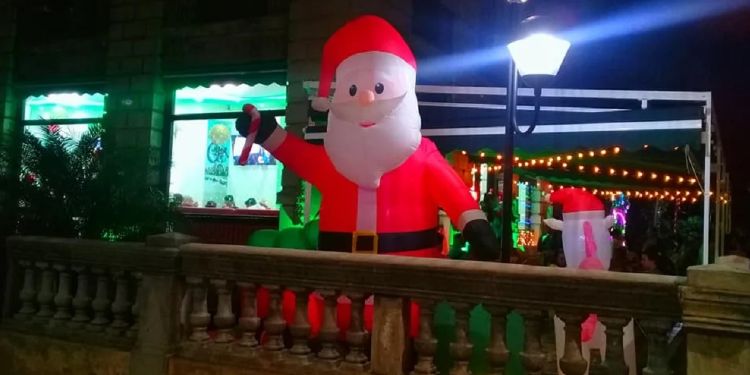
A centuries-old tradition went from being a public, familiar and visible celebration to first becoming something uncomfortable, then suspicious, then prohibited and, finally, tolerated, although always with more shadows than lights.
HAVANA.- Cuba is, possibly, the only country in Latin America where, instead of saying “Happy Christmas“, most people tell you “congratulations.” As if you had graduated, as if you had received your visa, as if you had overcome an illness – or one of the many viruses that are already part of the national flora and fauna – or, simply, as if you had survived.
But how is this phenomenon explained? What roots does it have? To understand it you have to take several leaps in time. And the first takes us to January 2, 1969.
That day, during a speech for the 10th Anniversary of the Revolution, Fidel Castro announced something that was neither a joke nor a metaphor, but a sentence: Christmas would no longer be celebrated as it was known. He said that in December most Cubans would be cutting cane and that, probably, the next New Year would be celebrated in July, along with the 26th.
From there, the history of Christmas in Cuba split in two.
A centuries-old tradition went from being a public, familiar and visible celebration to first becoming something uncomfortable, then suspicious, then prohibited and, finally, tolerated, although always with more shadows than lights.
Before 1959, Christmas in Cuba was not just a religious affair. It was a social party: street, noisy, lively.
There is no need to list endless lists of foods, sweets or drinks. But the data helps understand the context. In 1957, the FAO ranked Cuba as the largest exporter of agricultural products in Latin America in relation to its population. Translated into Cuban: the country was self-sufficient, and comfortably so.
There was beef, milk, fruits, coffee, tobacco and plenty to export. Also fish, shellfish, pork, chicken, root vegetables, vegetables and eggs. Cuba was the third country in the region in calorie consumption and had the best tropical livestock in the world: almost six million heads of beef, practically one for each inhabitant.
So it is easy to imagine—or remember—what the end-of-year tables were like.
But Christmas was not only eaten: it was seen. Since the end of November, the festive atmosphere was in the air. The large stores of Havana —The CharmFin de Siglo, La Época—and the entire San Rafael boulevard competed for who could best decorate their windows: lights, garlands, trees, nativity scenes, artificial snow, banners and offers. All this, of course, without blackouts.
In many cities and towns, parrandas were held, competitive parties between neighborhoods that lasted from December 24 to 25. The streets were filled with handmade fireworks, floats and dances around the parks. And on the 25th, after the hangover and “sleeping it off,” people continued celebrating while discussing which neighborhood had won that year.
The night of the 24th to the 25th was also the time of the Midnight Mass. The commemoration of the birth of Jesus was a solemn and central act. Families went to church after dinner, integrating the religious celebration into the family celebration.
Was there social inequality? Of course. This was also reflected in Christmas. But even the poorest celebrated. The streets were filled with trios and quartets that sang for hours. In the countryside, the gatherings could last until January without interruptions.
To say goodbye to the year, friends and couples went to clubs, cabarets or parks to dance whatever there was: danzón, guaracha, chachachá, son, rockabilly. The “perreo” of the time had other names and other rhythms.
There was even a Christmas carol famous throughout Latin America: little tree. It was recorded in Cuba in the 1950s, under the Panart label, performed by the Catalan orchestra Els Fatxendes, artists who lived and recorded in Havana during those years. Many other musicians covered it later.
And speaking of little treein 1957 Cuba had the largest Christmas tree in the world. It was built in Fontanar, on the outskirts of Havana. They called it “Seven Floors”: twenty meters high, four tons in weight, more than four thousand lights, a giant star at the top and nine thousand meters of cable. It lasted three years. Then, he disappeared.
Christmas 1959 marked the beginning of the end.
Santa Claus was replaced by Don Feliciano, a guajiro with a wide smile, guayabera and leggings. The motto was clear: “Be revolutionary happy on the Easter of Cuba Libre.” That is, be happy… but as the Revolution says.
Santa Clauses with black beards appeared in the streets, symbol of a new fashion: that of power and political fidelity.
On December 24 of that year, dozens of military trucks toured the neighborhoods distributing food: pork, nougat, candy. It was, without knowing it, the announcement of rationing. And the people shouted: “For whatever it may be, Fidel… for whatever it may be.”
Since then, saying “congratulations” instead of “Merry Christmas” is no longer a rarity. It became a way of survival.