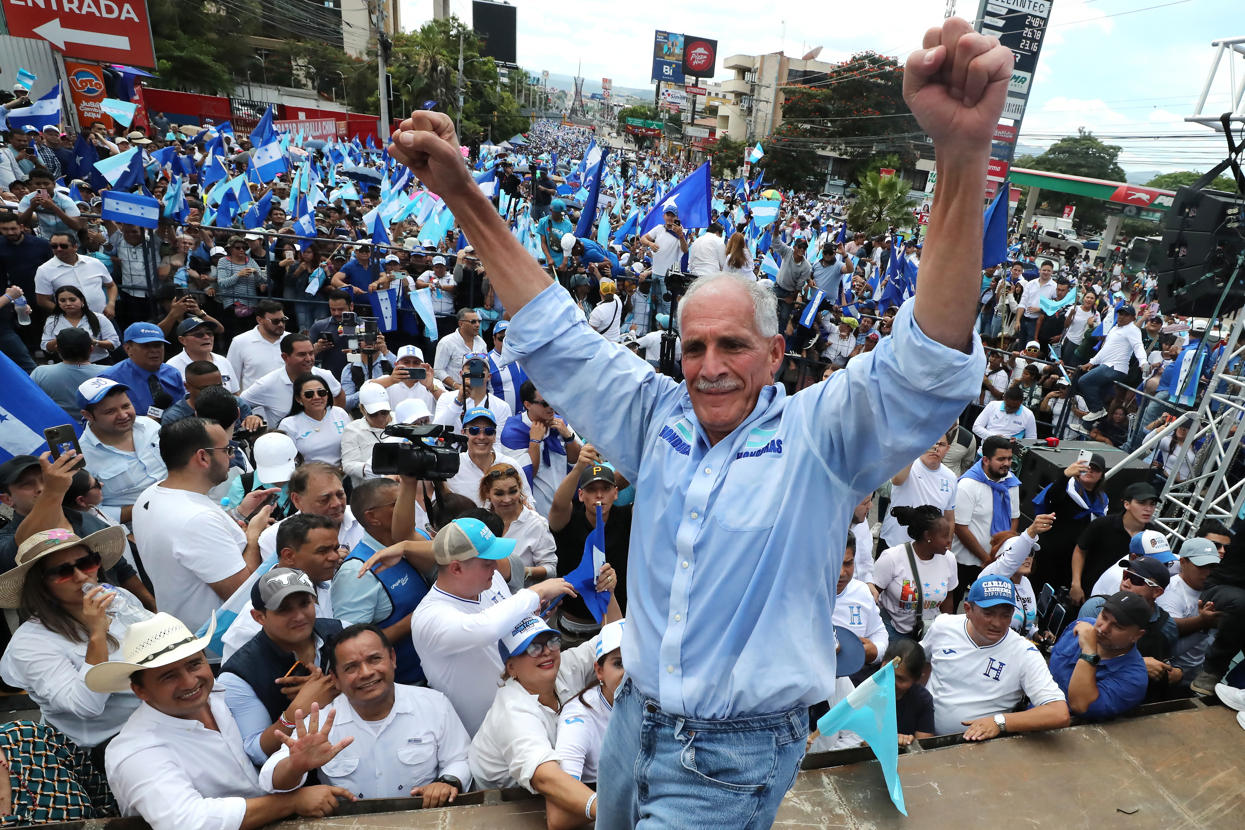
The conservative Nasry Asfura was declared this Wednesday the winner of the presidential elections in Hondurasa result that his main rivals in the elections reject.
“Tito” Asfura, candidate of the National Party and who was previously supported by Donald Trump, obtained 40.27% of the votes, according to the National Electoral (CNE) of the Central American country.
This gave him a minimal but decisive advantage over Salvador Nasralla, of the Liberal Party, who according to the official count achieved 39.53% of support at the polls.
For her part, the candidate of the until now ruling party Refundación (Libre), Rixi Moncada, reached 19.19% of the votes, according to the results. cited by cnn.
Both Nasralla and Moncada, along with other politicians opposed to Asfura, have already expressed their refusal to accept the CNE ruling, alleging irregularities and “omissions.”
The elections, which were held at the end of November, have been punctuated by allegations of fraud, political pressure and interference from the United States, based on the favoritism for Asfura expressed publicly by Trump.
Honduras: CNE declares Nasry Asfura winner of the November 30 presidential election. https://t.co/PUV0cRAfM7
— CNN in Spanish (@CNNEE) December 24, 2025
Reactions found
After the result was released, and of Tegucigalpa celebrated with his supporters and assured that he is “prepared to govern.”
“Honduras: I am prepared to govern. I am not going to fail you,” wrote in X.
“Keeping silent in the face of injustice does not give me peace,” said the liberal candidate, who, however, assured that he was not calling for “disorder or violence,” but for “conscience, respect and the peaceful defense of the vote.”
For the ruling party, Luis Redondo, current president of the Honduran Congress, also rejected the official ruling and said which, from their perspective, “has no legal value.” In advance, he had already opened the door to a recount of the votes by the parliamentary body.
For her part, Ana Paola Hall, president of the electoral body, denied that the CNE had benefited Asfura and denounced political pressure against her.
“I clarify that this certification that contains the declaration of General Elections at the presidential level was on the verge of being a political hostage; but, we have firmly defended and continue to defend that the declaration does not belong to the will of any Councilor, nor of any Political Party, it only responds to the truth of the results that reflect the will of the Honduran people,” Hall said in X.
The country where no one accepts losing: anatomy of the Honduran electoral collapse
The OAS supports the CNE
The Electoral Observation Mission of the Organization of American States (OAS) in Honduras validated the results of the CNE and stated that the declared data “reflects the will” of citizens and no “determining fraudulent elements” were identified.
The group also pointed out that the final ruling was announced in the midst of “extreme polarization and complexity” that prevented the electoral authorities from working “with the tranquility and autonomy that is typical of a democracy, even affecting their personal integrity and that of their families.” agency reviews EFE.
Meanwhile, the United States Government called on “all parties to respect the confirmed results so that the Honduran authorities can promptly guarantee a peaceful transition of power to President-elect Nasry Asfura.”
Secretary of State Marco Rubio said in a statement that Washington hopes to collaborate with the new Honduran authorities to promote “bilateral and regional security cooperation, end illegal immigration to the United States and strengthen economic ties between both countries.”
After Asfura was declared the winner of the Honduran elections, other nations also gave him their support. A group of Latin American countries with right-wing governments—among them Argentina, Bolivia, Panama, Ecuador and Paraguay—issued a joint statement recognizing the CNE result.
In addition, the European Union (EU) and the United Kingdom also congratulated the conservative politician