LIMA, Peru – The Public Ministry of Honduras announced this Friday the opening of an investigation into the possible inclusion of non-medical personnel in the health brigades sent by the Cuban regime, as well as other possible irregularities that took place during the government of Xiomara Castro.
Reports of EFE and 11News indicates that the Superior Court of Accounts (TSC) will begin an audit of the agreements. Among the aspects under review are the opacity in salaries—estimated between $1,600 and $4,700 per month per professional—and accusations about the alleged inclusion of “fake doctors” in the brigade.
The lawyer of the Medical College of Honduras, Saúl Bueso, explained that the audit will seek to determine whether the payments made were proportional to the services provided to the population, clarifying that the TSC’s function is technical and not criminal.
Opacity and allegations of irregularities
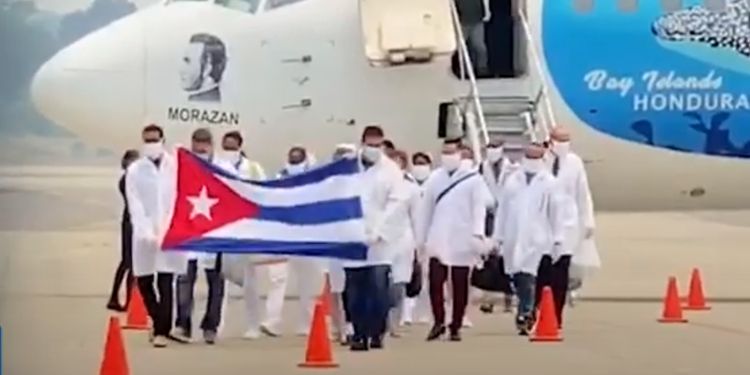
Last Tuesday it emerged that some 128 Cuban doctors would leave Honduran territory after the Government of the current president Nasry Asfura decided not to renew the health cooperation agreement that had kept them in the country for two years.
The Secretary of Communications, José Augusto Argueta, indicated that the measure responds to non-compliance with permanence requirements and lack of professional accreditation.
For his part, deputy Carlos Umaña, of the Liberal Party of Honduras, questioned that the terms of the agreement were publicly known years after its entry into force, which, in his opinion, evidences transparency failures.
In a statement published in
“The investigation will include the analysis of the contracting procedures, the corresponding documentary review and the identification of the people responsible for the authorization, management and suspension of said processes,” the statement adds.
“The Public Ministry will act with independence and objectivity, guaranteeing that, if there is merit, the corresponding criminal responsibilities will be deducted,” he stressed.
According to sources from the current Executive, some 170 Cubans worked in the country with salaries of at least $1,600 per month, in addition to benefits such as accommodation, transportation and air tickets, under a bilateral agreement signed by the previous administration.
Some salaries were higher, although the Havana regime confiscated most of them. The presidential appointee of Honduras, María Antonieta Mejía, reported that a preliminary review detected 59 Cuban doctors hired through the National Institute of Retirements and Pensions of Employees and Officials of the Executive Branch (INJUPEM).
As detailed, their salaries were around 124,000 lempiras per month (about $4,700), which is equivalent to more than $3.3 million a year for that group alone.
The Honduran authorities also indicated that part of the supporting documentation had been eliminated or destroyed, so the companies linked to the contracts were requested to deliver originals and copies to validate the disbursements.
The Undersecretary of Health indicated that the brigade withdrew immediately despite the fact that the agreement contemplated a transition period of 90 days, which forced the activation of a contingency plan to redistribute personnel and guarantee the continuity of services, including ophthalmology centers that closed after the departure.
An expanding pattern
With the measure, the Asfura administration aligns itself with United States plans to reduce the entry of foreign currency to the Cuban regime through its medical missions, which have been described as “a form of modern slavery” even by the United Nations.
Washington has in recent years intensified diplomatic pressure on countries that hire Cuban brigades, arguing that the scheme facilitates labor exploitation or “forced labor.”
The Honduran case is not isolated. In Guatemala, the government communicated that it will not renew the agreement in force since 1998 and that the retirement of Cuban doctors will be carried out progressively, with replacement by local personnel. In Antigua and Barbuda, the Government of Prime Minister Gaston Browne medical cooperation with Cuba ended last December.
Other countries have opted for a redesign of the payment mechanism instead of a total cut. Bahamas advertisement that it would cancel contracts with the Cuban Government and move to direct employment agreements with Cuban professionals present in the country, after conversations with Washington. In Guyana, the Minister of Health, Frank Anthony, confirmed that the bilateral agreement was stopped and that Cuban doctors receive direct payment in accordance with local labor legislation.
The Havana regime imposes severe restrictions on professionals on mission, including the retention of passports, political surveillance, prohibitions on establishing personal relationships with nationals of the host country, and confidentiality clauses that prevent them from discussing the conditions under which they are hired. Furthermore, in countries like Angola and Qatar The Cuban State keeps up to 94% of the salary that recipient governments pay for medical services.
In April 2025, CubaNet published a report where five Cuban health workers revealed an expropriation pattern and extreme control in the regime’s medical brigades in the Caribbean basin. Among the countries mentioned, Jamaica, Dominica, Saint Lucia, Belize, Bahamas, Venezuela and Brazil stand out, where the interviewees declared they were victims of “labor exploitation.”