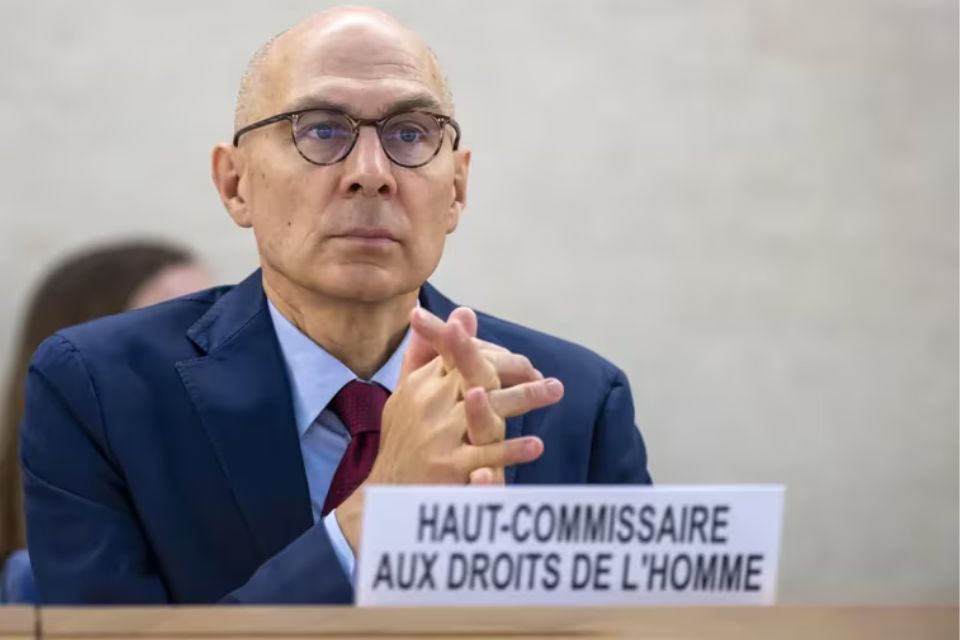
High Commissioner for Human Rights Volker Türk said that since his last update on June 27, the Venezuelan situation “has not improved,” due to the “radical” restrictions on freedom of expression and assembly, arbitrary detentions and forced disappearances, as well as the economic and social crisis facing the population.
The United Nations High Commissioner for Human Rights, Volker Türk, presented this Tuesday the 16th his last oral report of the year on the situation of violations that his office has documented in Venezuela. In his speech, the official said that Venezuelan society “needs justice” and its suffering “must end” in the face of continued arbitrary arrests, torture, forced disappearances and a growing economic crisis.
«Venezuelan society needs to heal. It needs justice and human rights to overcome polarization and repair its social and economic fabric… The suffering of the Venezuelan people must end,” Türk said before the UN Human Rights Council, where the situation in Ukraine was also evaluated.
The High Commissioner said that since his last update the last June 27 The Venezuelan situation “has not improved” due to the “radical” restrictions on freedom of expression and assembly, arbitrary arrests and forced disappearances, as well as the economic and social crisis facing the population.
He explained that the repression “has intensified, suffocating people’s freedoms” due to constant threats against journalists, human rights defenders, opposition figures and humanitarian workers “simply for doing their work.”
«Many are being expelled from the country due to intimidation and persecution. When human rights defenders and journalists leave, truth and accountability leave with them,” he lamented.
Likewise, he said that public life has become “even more militarized,” with reports of forced enlistment in the Bolivarian Militia, even of adolescents, women and older people, following the “threats” perceived by the Nicolás Maduro administration in the face of the United States military deployment in the Caribbean.
“Equally shocking are accounts of authorities inciting people to report their relatives, neighbors and colleagues through a state-sponsored mobile application. These policies generate fear, distrust and self-censorship,” said Türk.
He recalled that he does not have personnel in the country due to visa restrictions by the Nicolás Maduro administration, although he indicated that there are no “points of no return.”
“We are always open to constructive engagement and I hope that the authorities allow our colleagues to resume their activities in Venezuela,” he said.
Regarding tensions in the Caribbean, he said that he is concerned about the situation of “ordinary people” and asked the United States to use established methods to fight drugs. He also called on States that host or receive Venezuelan migrants, refugees and asylum seekers to guarantee their international protection.
High Commissioner on arrests
High Commissioner Volker Türk highlighted that a group of journalists are still detained for political reasons, as are “hundreds of people.” He indicated that the recent arrest of the general secretary of the Venezuelan Confederation of Workers, José Elías Torres, “sent an alarming signal to workers throughout the country.”
Türk denounced the increase in repression against relatives of people “perceived as dissident voices” inside and outside the country. Since July, his Office has documented the arrest of at least 17 people, “most of them women, children and elderly people, in relation to the activities of their relatives” and the whereabouts of another 12 detained for similar reasons are unknown.
In addition, he expressed his concern about the attempts to withdraw the nationality of some opponents or the detention conditions of political prisoners, due to the “persistent lack of food and medicine,” as well as the denial of family visits. “These conditions affect detainees both their physical and mental health and, in some cases, even their lives.”
The UN High Commissioner’s Office documented at least five deaths of people detained for political reasons following the 2024 presidential election. “All of these deaths must be investigated promptly and independently, including the recent death of opposition politician Alfredo Díaz, whose health reportedly deteriorated dramatically in custody.”
He also emphasized the increase in arbitrary transfers and forced disappearances of political prisoners. “In three detention centers – Helicoide, Rodeo I and Fuerte Guaicaipuro – people continue to be held incommunicado, without contact with family or lawyers, in flagrant violation of their fundamental rights.”
According to data obtained by his Office, Türk said that they have been able to verify the release of 51 people since June, including opponents, foreigners and people with health problems. Likewise, at least 23 foreigners have received consular visits.
He also urged the release of all political prisoners, including defenders Rocío San Miguel, Javier Tarazona, Carlos Julio Rojas, Eduardo Torres and Kennedy Tejeda, in addition to the four teenagers who remain under arrest after the presidential elections.
Likewise, he urged the authorities to stop forced disappearances, incommunicado detentions and unauthorized transfers.
Growing crisis
The High Commissioner said in his oral update that “while the authorities continue their repression, the Venezuelan people fight their own daily battle against poverty and hunger,” with inflation projected by the International Monetary Fund of 270% this year and a minimum wage “more than 1,000 times lower than the monthly cost of the basic food basket.”
«Families must choose between buying food or medicine. Many lack access to education and health care. And even this is an incomplete picture, since official economic data is scarce… I have visited Venezuela, I have spoken to its people and I feel sorry for them. I pity those who desperately wait for news of their loved ones; of parents separated from their children; and of all those whose tables will remain empty during the coming holidays,” he stated.
He again called for lifting the sanctions due to the “disproportionate impact” that, he said, “they have on the most vulnerable, as well as their adverse effects on the work of some humanitarian and human rights organizations.”
He also mentioned the situation of indigenous peoples, whose rights and the demarcation of ancestral territories “continues to be an objective.” He called for an investigation into the murder of several indigenous leaders such as Virgilio Trujillo, Joaquín Hernández and Cesáreo Panapera.
*Journalism in Venezuela is carried out in a hostile environment for the press with dozens of legal instruments in place to punish the word, especially the laws “against hate”, “against fascism” and “against the blockade.” This content was written taking into consideration the threats and limits that, consequently, have been imposed on the dissemination of information from within the country.
Post Views: 237