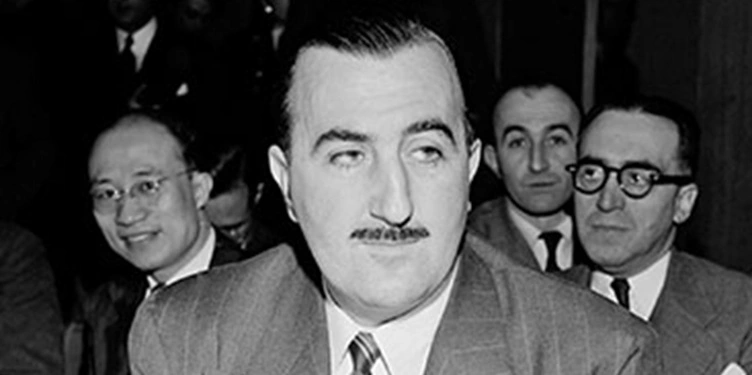
Drafter of the 1948 Declaration, Santa Cruz left a central legacy in the defense of democracy as a universal human right.
BUENOS AIRES, Argentina.- On the occasion of a new anniversary of the adoption of the Universal Declaration of Human Rights by the General Assembly of the United Nations (UN), on December 10, 1948 in Paris, and taking into account both the current state of democracy throughout the world and the decline of the ideal of human rights, the legacy of the Chilean jurist and diplomat Hernán Santa Cruz takes on special relevance.
In this regard, in February 2024 the Economic Commission for Latin America and the Caribbean (ECLAC) reissued the book that Santa Cruz published in 1993, a fundamental work for those passionate about international relations and defenders of multilateralism, in which the author offers a summary on a large number of transcendental topics that he had to address and his own memory that includes unmissable anecdotes. The book is titled “coperate or perish: the dilemma of the global community” and its three volumes are now available on the ECLAC website for free download.
In his extensive career in the United Nations, Hernán Santa Cruz Barceló (1906-1999) held several positions, including: Ambassador and Permanent Representative of Chile to the United Nations (1947-1952), President and Rapporteur of the United Nations Commission to Study the Racial Situation in the Union of South Africa (1953, 1954 and 1955), Member of the Subcommittee on the Prevention of Discrimination and Protection of Minorities (1954-1974), elected by the Human Rights Commission and re-elected six times. In 1967 he was appointed Ambassador and Permanent Representative of Chile to the United Nations and other international organizations based in Geneva and Rome, a mission he maintained until September 11, 1973, when he resigned following the military coup by Augusto Pinochet. Neighbor and friend of Salvador Allende, this Christian humanist carried out his last diplomatic mission representing Chile at a meeting of the Non-Aligned Movement.
Editor of the Universal Declaration of Human Rights
Hernán Santa Cruz was Chile’s first representative to the United Nations and one of the nine original drafters of the Universal Declaration of Human Rights. He is remembered for his contributions to the Universal Declaration on economic, social and cultural rights, but it is also worth highlighting his eloquent defense of freedom of movement that confronted him with the Soviet delegate.
Article 13 of the Universal Declaration of Human Rights establishes that: 1) Everyone has the right to move freely and choose their residence within the territory of a State; and 2) Everyone has the right to leave any country, including their own, and to return to their country. In the debate on this article, Santa Cruz had a memorable intervention, arguing that human rights prevail over the sovereignty of States.
Indeed, the Chilean diplomat recalls in his book that the Soviet delegation presented amendments to the two paragraphs and proposed adding “in accordance with the laws of the same State” and “under the conditions established by the law of the same State.” Santa Cruz argued that this would lead “to making impossible, in advance, any practical effect of those fundamental declarations.” And he added: “This principle is inherent to the human personality, prior to any form of coexistence, to any legal organization of social groups, and must be defended as an instrument of progress of civilization.”
Categorically, Hernán Santa Cruz stated that “recognizing that it is the exclusive power of the State to determine the forms and opportunities for the application of such rights would mean enshrining the implicit renunciation of an inalienable and inalienable power of the human being. Ours would not be a Declaration of Human Rights, but rather a declaration of the omnipresent law of the States.”
Santa Cruz received the support of the rest of the delegates and, therefore, the amendments proposed by the Soviet Union were rejected, the criterion prevailing that positive legislation must conform to human rights and not the other way around.
Although there are several works that address the history of the Universal Declaration of Human Rights, the chapter that Santa Cruz dedicates to the subject in the first volume of his book offers passages from what would be a diary of sessions, even detailing the voting in particular for each of the 30 articles. In this regard, the Chilean diplomat regretted that the UN had not compiled this vibrant historical debate, among other reasons because it had contributed “to the full appreciation of the scope and strength of the instrument that was sanctioned in such a solemn manner.”
Regarding the universal nature of human rights, that is, that people have rights as such that must be respected in all countries and territories of the world, Santa Cruz argued that “Only those who deny that these rights have a value in themselves and that the human being is subject to these rights, independent of the form of the State, will not be able to accept them. Nor will those who do not believe that man has rights inherent to his nature, prior to the constitution of social groups.”
Among the other drafters of the 1948 Declaration, the American Eleanor Roosevelt and the Frenchman René Cassin, considered by Santa Cruz to be the great architect of the text, are well known. Less known and even little claimed from Latin America, the Chilean emerges as a key figure in the writing of the historic text adopted in Paris.
Democracy as a universal human right
Already in the debate on the Universal Declaration of Human Rights, Hernán Santa Cruz maintained that democracy is a universal human right. Although this can be deduced from the fact that civil and political liberties are enshrined in the 1948 Declaration and that it has universal scope, the Chilean diplomat advanced in the debate in Paris that “Democracy is a system that opposes any dogmatic conception. No one can have a monopoly on the truth and common problems must be resolved through the freely expressed suffrage of all members of the community.” Subsequently, Santa Cruz would prepare a report of more than one hundred pages interpreting Article 21 of the Declaration, a contribution that establishes him as one of the most prominent international defenders of the ideal of democracy associated with respect for human rights.
Without any announcement that has a title or subtitle in his book, in chapter 1962 and ended up archived.
About this study, which It is available on the UN websiteSanta Cruz expressed that the fullness of his political thought is reflected in it: “The works on racial discrimination, on ‘Apartheid’ and on discrimination in matters of political rights reflect my own deep convictions on matters that have permanent and universal value.”
In this study, Hernán Santa Cruz interprets article 21 of the Universal Declaration of Human Rights, which recognizes the following: 1) Every person has the right to participate in the government of their country, directly or through freely chosen representatives; 2) Every person has the right of access, under conditions of equality, to the public functions of their country; and 3) The will of the people is the basis of the authority of public power; This will will be expressed through authentic elections that must be held periodically, by universal and equal suffrage and by secret ballot or other equivalent procedure that guarantees the freedom of voting.
The work prepared by Hernán Santa Cruz offers a categorical response in defense of democracy from the perspective of human rights, mainly regarding those who support antidemocratic arguments from the authoritarian extremes. That is, to the fascist or communist idea that economic-social progress can be achieved by denying political rights. On the contrary, Santa Cruz affirms that “The effective exercise of political rights constitutes a means of achieving all other rights and freedoms.” And he sums it up like this:
- The exercise of political rights is one of the most effective means of effectively protecting economic, social and cultural rights. And conversely, the full recognition and enjoyment of economic, social and cultural rights constitutes one of the best means of effectively protecting political rights.
- The exercise of political rights is, in fact, an indispensable factor for the progressive establishment of conditions that allow the full enjoyment of economic, social and cultural rights. Furthermore, the notion of economic, social and cultural rights is an essentially dynamic concept; Its scope and meaning are in continuous evolution, and only in an atmosphere of political freedom can they develop constantly and progressively.
- Without political rights there would be no assurance that people could live in the environment of freedom, legality and justice in which it is possible to enjoy economic, social and cultural rights. But, in the same way, political rights can be meaningless if respect for economic, social and cultural rights is not guaranteed. The two sets of rights are so closely related that the deprivation of one makes the enjoyment of the others incomplete, if not impossible.
There are several gems left from this brilliant study, some of which bring to mind dictatorships that exist today and that represent no less than a third of the States that make up the UN. For example:
- A relative backwardness of part of a country or a population can never justify denying – even temporarily – the political rights set forth in Article 21 of the Universal Declaration of Human Rights.
- Many aspects of the right to work affect the enjoyment of the political rights proclaimed in Article 21. For example, if a worker does not have free access to the labor market or free choice of employment and is forced to work by the authorities or is assigned a job by the authorities.
- The legislation of many countries recognizes everyone’s right to freedom of opinion and expression and to freedom of peaceful assembly and association. People of very diverse opinions participate in the government of these countries and can hold public office. However, in some countries the expression of any opinion contrary to the position of the government or that of the political party or similar organization in power is considered “subversive”.
Hernán Santa Cruz has also been recognized for his active role in the creation of ECLAC, which he proposed to the United Nations in July 1947 and whose establishment was achieved in February 1948 after an intense debate within the Organization. In honor of his contribution to the creation of the Commission and his work in drafting the Universal Declaration of Human Rights, the library at the ECLAC headquarters building in Santiago, Chile, bears his name. In 1996, Chilean President Eduardo Frei Ruiz-Tagle conferred on him the highest national honor, the Meritorious Services to the Republic decoration, for services rendered to the country.
Due to the conceptual clarity on the noble ideal of human rights and the prolific contributions in the field, the defense of multilateralism, the fight against racism and pioneering positions, such as gender equality, plus the aforementioned study on political discrimination that consecrates democracy as a universal right, the legacy of Hernán Santa Cruz is more valid than ever.