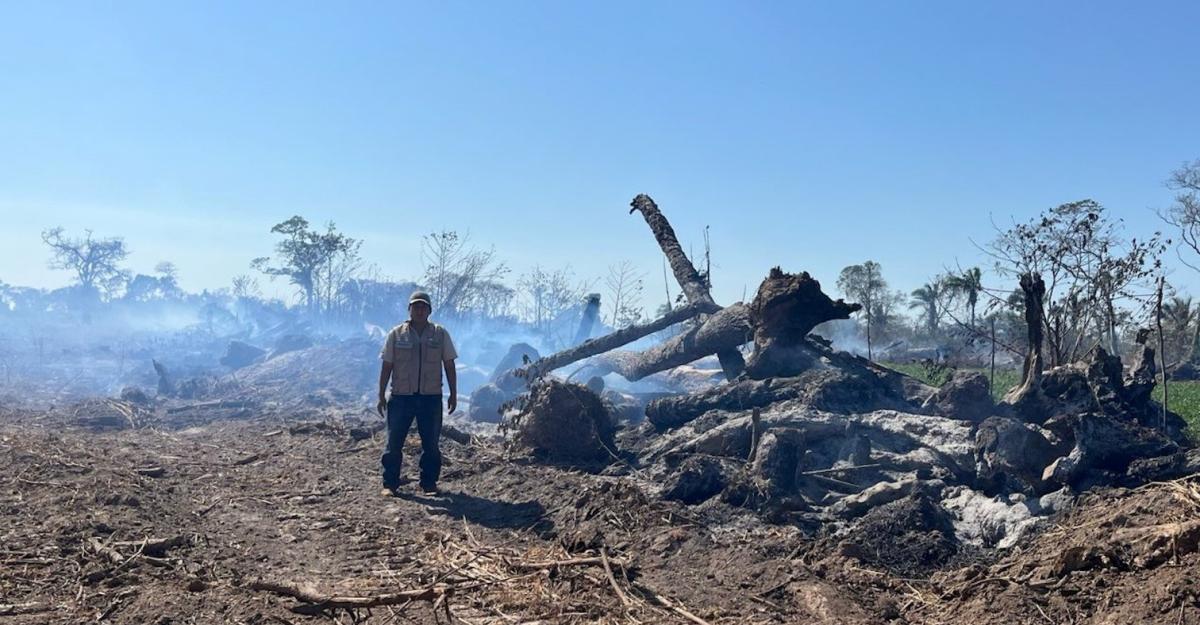
In full environmental pause, alerts jump from the increase in heat spotlights. In just three days, Santa Cruz tripled the figure, from 1,930 to 5,178 points hot; While Bolivia registered 4,358 and 37 active fires on Thursday, Most in the department of Cruceño.
Greenpeace’s satellite monitoring platform already places Bolivia among the countries most affected by fire, and positions it in second place With more heat spotlights. According to the report, this Thursday Canada headed the list of most affected countriess, followed by Bolivia, Australia, democratic republic of Congo and Indonesia.
In the case of Bolivia, the monitoring shows that Santa Cruz concentrates more than 90% of the heat spotlights, being the most affected region, followed by Beni and Pando. The most impacted areas are those with forest coverage, thickets and areas for agricultural activity.
In his latest report, the head of the Directorate of Natural Resources (DIRENA), Paulo Viruez, He recalled that the Cruzan Department is in yellow alert and warned that we are entering the critical season of fires and heat spotlights.
The early forest fire alert system (SATIF) of the Government reported On Monday, 1,930 heat spotlights, a figure that rose to 5,178 on Wednesday. For the morning of Thursday, 3,616 were already counted.
According to the accumulated data of the SATIF, so far in July 42,536 heat spotlights have been detected, compared to the 3,904 registered in June.
For its part, The Ministry of Environment reported 4,358 heat lights throughout the country on Thursday4,230 of these in Santa Cruz. In addition, 37 active fires were identified in the departments of Santa Cruz and Beni.
Of the total registered heat spotlights, 3,284 are located in forested areas, 20 in departmental protected areas, 3 in municipal protected and 1 in a national protected area.
Burns are being given in spite of an environmental pause that prohibits them in areas of high environmental sensitivity and is mandatory. In this sense, Viruez asked the corresponding authorities to monitor the necessary to apply sanctions.
This week, the Agro -Environmental Court issued a statement recalling that there is an ecological pause, initially established for protection of the jaguar and its habitat, but that extended to areas of high sensitivity, as fiscal lands not available; protected areas; Autonomous territorial entities and damping areas; National, departmental and municipal parks; native and peasant indigenous territories; and integrated management areas.
Given the increase in heat spotlights, the person in charge of DIRENA urged municipal governments to activate their emergency operations committees (COE) already allocate human, economic and logistics resources to prevent and mitigate fires.
In addition, he asked the national authorities greater inspection in critical areas and speed to investigate those responsible for causing illegal burning.
In the Chiquitania
According to official reports, the municipalities of San Ignacio de Velasco, San José de Chiquitos, San Miguel de Velasco, Concepción and Roboré are the most affected by fire.
The Tucabaca Valley Defense Movement indicated that burns were already identified in the valley of Tucabaca and in the Naranjo community. In addition, between July 7 and 15 they detected 158 heat spotlights with a high probability of becoming forest fires in the Bolivian territory.
In the same way, the Chiquitanas communities of the Alto Paragua territory, in San Ignacio de Velasco, denounced avasallala hundreds and also evidenced fire. Near the community I will confirm clearingburned areas and illegal constructions.
In Ascension of Guarayos, the person in charge of the operating unit reported that illegal cords have been detected, which have been properly sanctioned through administrative processes.
The Vice Ministry of Civil Defense, in cordination with the Armed Forces and the Social Control and Social Control Authority (ABT), carried out air operations to verify the heat sources.
The municipalities of Concepción, San José de Chiquitos, the Tucabaca Valley area in Roboré, San Matías, Puerto Suárez, Puerto Quijarro, San Ignacio de Velasco, Ascension of Guarayos and Urubichá. They identified heat points product of burned burning in private properties and bones of laces.
ABT also displaces personal to verify illegal burning in different areas. Notifications were delivered to property owners where they were burning.