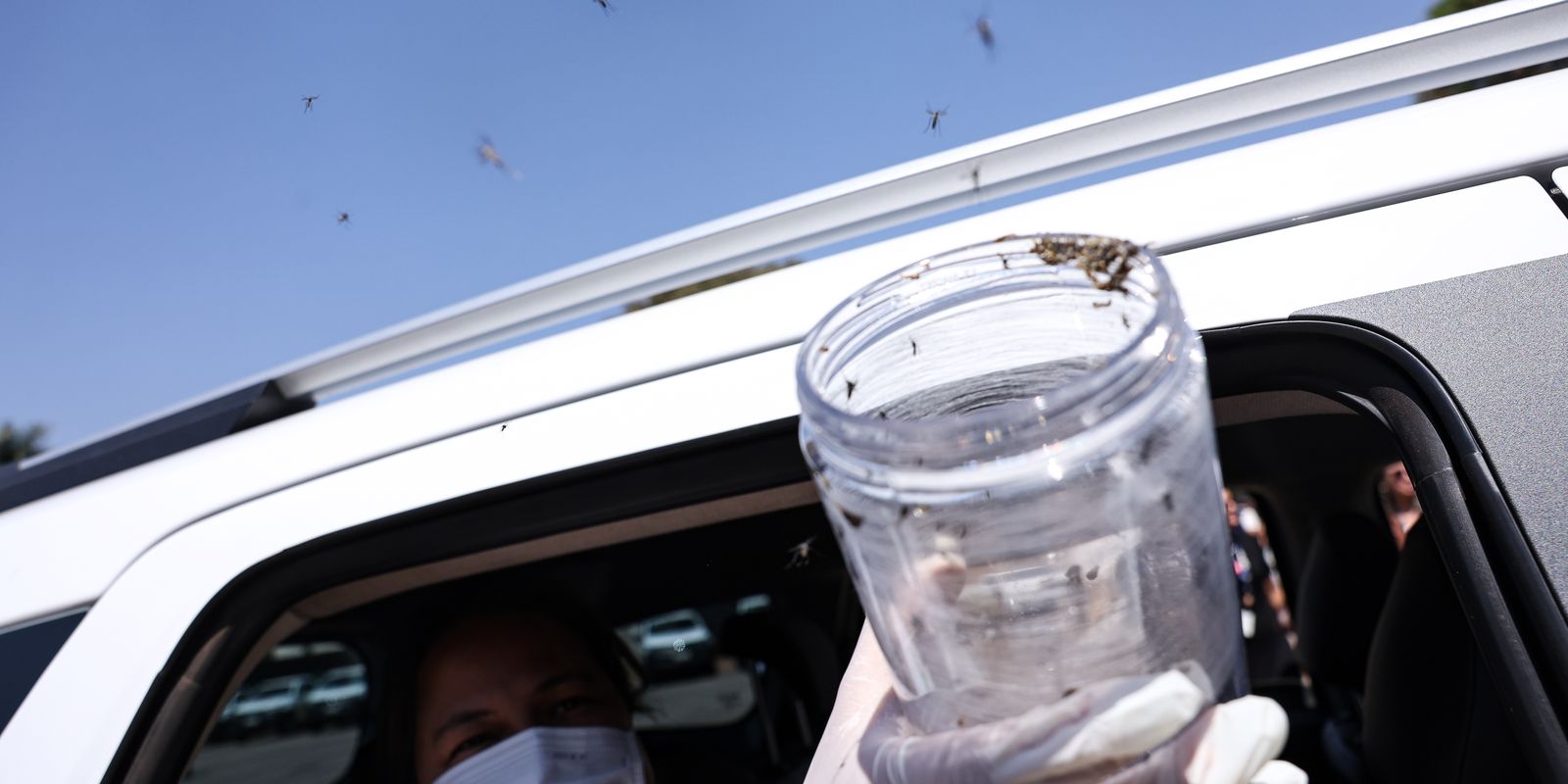
The Ministry of Health began releasing mosquitoes Aedes aegypti males and steriles in the village of Cimbres, in the municipality of Pesqueira (PE). In a statement, the ministry reported that 50,000 insects have already been released with the aim of strengthening the control of arboviruses in the region.
“The strategy prevents mosquitoes, when mating with females, from producing offspring, contributing to the gradual reduction of the vector population and virus transmission”, detailed the statement.
According to the ministry, the action marks the beginning of the application of the Sterile Insect Technique by Irradiation (TIE) in indigenous territories. For the next phases, it is planned to release more than 200,000 sterile mosquitoes weekly.
In addition to the village Cimbres, the The technology will also be implemented in the Guarita territory, in Tenente Portela (RS), and in indigenous areas of Porto Seguro (BA) and Itamaraju (BA).
The initial investment is R$1.5 million, covering production, logistics and monitoring of the strategy.
According to the ministry, the continuity and expansion of actions will depend on the results achieved and the technical evaluation of the teams involved. The data will allow us to analyze the impact on reducing cases of dengue, Zika and chikungunya.
Understand
The Sterile Insect Technique uses the species itself to reduce the population of Aedes aegypti. In the laboratory, male mosquitoes are sterilized by ionizing radiation, making them incapable of generating offspring, and are subsequently released in large quantities in so-called target areas.
When mating with females, males do not produce offspring, leading to a progressive decrease in the population of arbovirus vectors.
“As it does not use insecticides and does not pose any risks to health or the environment, the technique is recommended for indigenous territories located in conservation areas and forests, where the use of chemical products is restricted or prohibited,” highlighted the ministry.