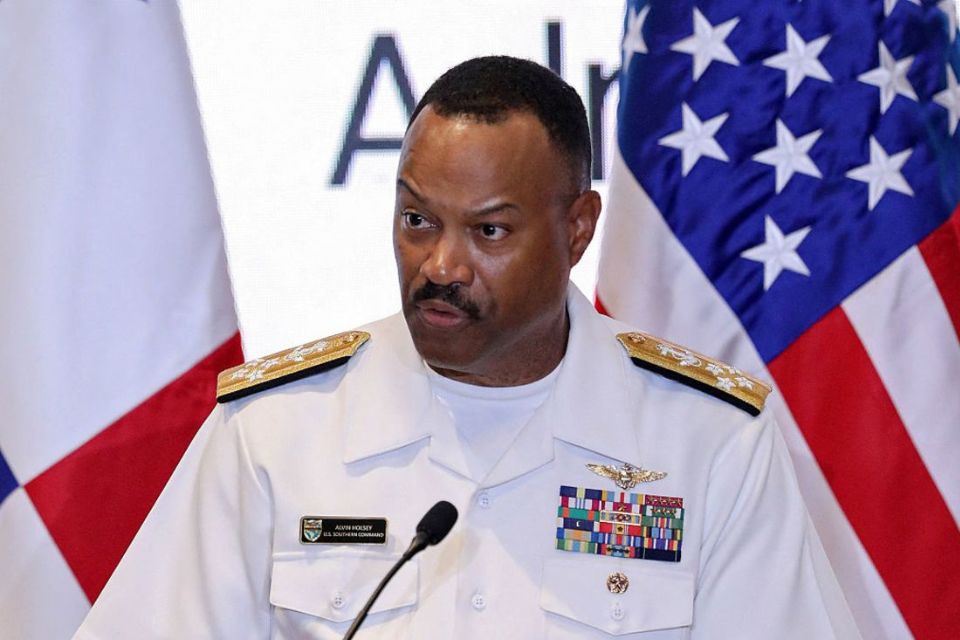
The head of the United States Southern Command, Admiral Alvin Holsey, is in charge of military operations in the Caribbean near Venezuela. In addition to meeting Prime Minister Mark Phillips, he will hold meetings with other senior officials of Guyana
The head of the United States Southern Command, Admiral Alvin Holsey, arrived this Friday, November 7, in Guyana to “promote regional security and stability.” His visit coincides with the US military deployment in the Caribbean, which has generated tensions with Venezuela.
According to the statement from the US Embassy in Georgetown, Holsey will meet with senior officials to discuss “the long-standing defense alliance” between his country and Guyana.
Also to reaffirm “US support for the territorial integrity of Guyana and collaborate to promote regional security and stability.”
Holsey, in charge of military operations in the Caribbean near Venezuela, will hold meetings with Prime Minister Mark Phillips; the Chief of the Defense Staff, Omar Khan; and senior officers of the Guyana Defense Force and the Coast Guard.
*Read also: The Associated Press reveals identities of Venezuelans bombed in “drug boats”
“The United States remains a strong partner in promoting a secure, prosperous and sovereign Guyana, and in advancing the common goals of peace and stability throughout the Caribbean and South America,” stated the note from the US Embassy.
Guyana has a long-running dispute with Venezuela over the oil-rich Essequibo territory, which Georgetown administers and Caracas claims as part of its territory.
Holsey’s trip comes after it was learned that he plans to retire at the end of 2025 after 37 years of service, as Secretary of War Pete Hegseth reported in mid-October.
In mid-October, the head of Southern Command He also traveled to Grenada, where Washington wants to install a military radar, and to Antigua and Barbuda.
While Grenada is still evaluating Washington’s request, the Prime Minister of Antigua and Barbuda, Gaston Browne, stated that he “has no interest in hosting military assets of any country.”
With information from EFE
*Journalism in Venezuela is carried out in a hostile environment for the press with dozens of legal instruments in place to punish the word, especially the laws “against hate”, “against fascism” and “against the blockade.” This content was written taking into consideration the threats and limits that, consequently, have been imposed on the dissemination of information from within the country.
Post Views: 154