Two days after Hurricane Melissa passed through eastern Cuba, most of my family and friends, residents of the city of Holguín, were still disconnected. They are still half-way; With Melissa’s damage to the network and the already persistent precariousness of the electrical service, it was logical that it would happen this way.
I know, from having experienced it, what the passage of a cyclone with these characteristics means. I can relive the echo of the sensations and the dark circles after fifteen long days without electricity, when Hurricane Ike, passing through the north of the eastern region, blew up the transformer in my neighborhood, and thus we suffered twice as much from the onslaught of that meteor.
You don’t need to remind me, but you did this time:
“Everything is very terrible,” a writer friend told me a few hours after Melissa passed, when his cell phone reached a thread of signal sent from some surviving transmitting antenna among puddles and fallen branches. He took advantage of that moment to update me on WhatsApp.
“It was gigantic terror, between 12:30 at night and 9:30 in the morning,” he wrote, “Imagine… the howling of the wind, its bestiality, it seemed like they were going to lift the house by weight, under a rain that was like closed curtains of knives, with brave blades and everything. EVERYTHING WAS SCARY!”
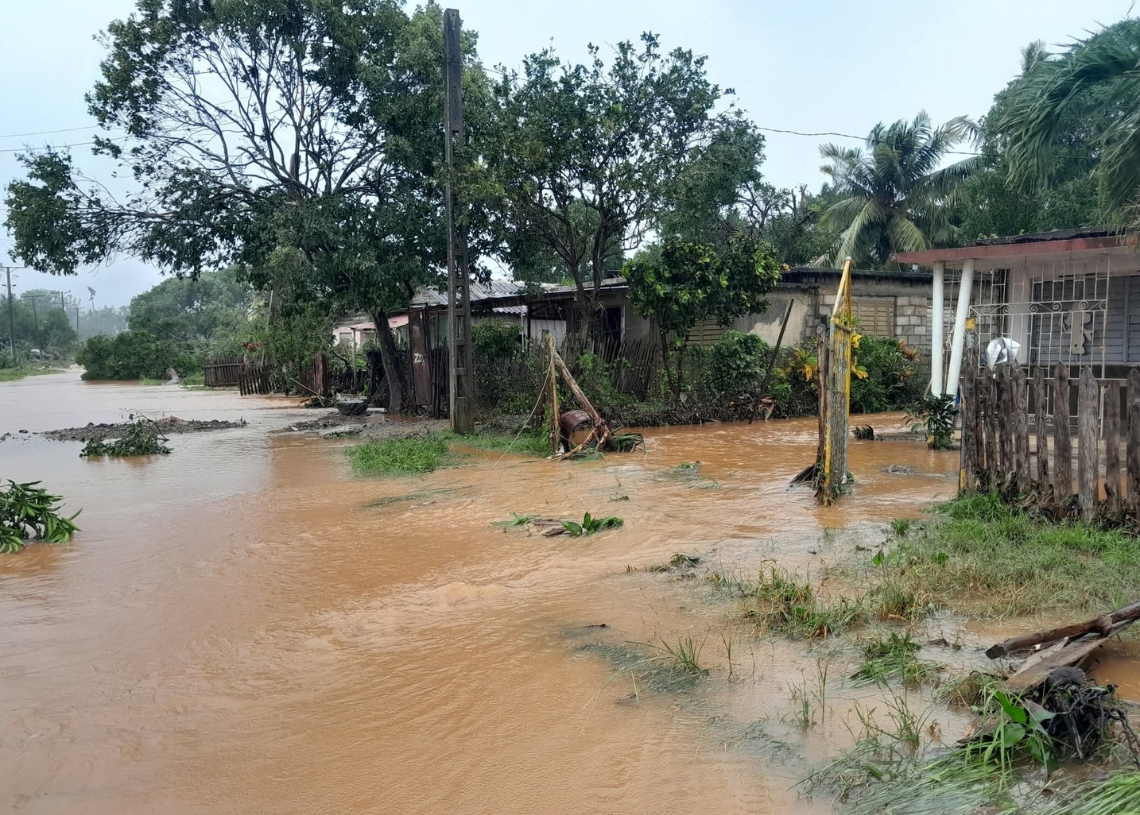
My friend lives in a high area of the city, protected by thick brick and cement walls. His house faces the Central Highway, which, seen in the small video he sent me, was a river through which muddy waters ran looking for an outlet.
The same waters, a few blocks further down, pushed the walls of my grandmother’s house in such a way that they ended up falling down. The current crossed the building—also made of brick and cement—from side to side, but it was not unscathed by the torrent when it went out of control and sought to evacuate without finding where.
The same fate befell other friends, who, due to the proximity of streams or one of the two streams that cross the city, experienced the flood.
None of them saw the walls of their home broken or had to remain on the roof for three days waiting for a helicopter to arrive with rescuers. as happened with the residents of several communities near the Cauto River.
Nor were they one of those who had to tie the roofs with ropes or wires, or spend the hours of the hurricane inside a cave (which continues to be a safe method, in the absence of solid buildings nearby, to face the onslaught of nature).
For one guy, the water reached his waist, and my father saw his street transformed into an emboldened canal that quickly dropped in level. But that same night, when everything seemed to have passed, another splash of water shook him and his neighbors in Vista Alegre again, who could not sleep because of the ghost of the flood hanging around.
I learned each of those stories many days later, because the lack of communication was still absolute, as it has been since before Melissa, during the long hours of blackout. Only this time the circumstance worsened, testing the will and also the sanity of the people.
From the Holguín newspaper—which was my workspace for some years—I learned that at the Vladimir Illich Lenin General Hospital the doctors and workers They had to bite the bullet to overcome the contingency.
Part of a wall collapsed and the generating set was submerged and unusable for at least two long days. Thus, those who were in the institution—which is celebrating 60 years of service and housed dozens of patients—found themselves in a circumstance that they could not describe without having experienced it.
Just say that, in the darkness, 22 children were born and quite a few emergency surgeries were performed, because no matter the catastrophes or the negligence of anyone: life, and what it destroys with it, does not stop. Like waters, it pushes what it finds until it finds its true channel.
It is true that no deaths have been reported from the island so far due to the passage of this hurricane – in contrast to what happened in neighboring nations such as Haiti or Jamaica – something that is appreciated for what is still working; although the Government’s management in maintaining essential services, such as electricity, is nothing short of disastrous.
If the floods and gusts of wind are catastrophic, the electrical precariousness that has been experienced for years would be enough to declare the country in a state of emergency. A situation to which many officials and the Minister of Energy himself try to minimize the seriousness with lying arguments that have not alleviated the pain of the people, whose inventiveness to survive reaches the limit, not only in deep Cuba.
He remembered that old phrase from Cuban propaganda: “In both war and peace, we will maintain communications.”
Not even those grandiloquent phrases seem to work anymore.