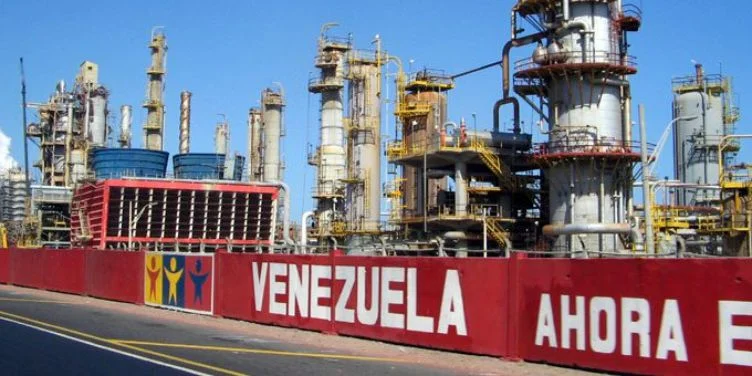
The island’s regime would have resold nearly 40,000 barrels per day to Asia, around 60% of what was supplied by Venezuela.
MIAMI, United States. – A senior official of the United States Government assured The New Herald that the Cuban Government resold in Asia most of the crude oil and refined fuels it received from Venezuela during the last year, even when the Island faced prolonged blackouts and gasoline rationing.
According to this version, Caracas supplied Havana with around 70,000 barrels per day, worth up to $1.3 billion, from approximately the end of 2024 to the end of 2025, and the Cuban regime would have resold to Asia about 40,000 barrels per day – around 60% – according to US Executive sources. The New Herald.
In that same report, a State Department official cited by the newspaper described the alleged resale of crude oil as “further proof that the illegitimate Cuban regime only prioritizes its own enrichment, while the Cuban people suffer the consequences of its corrupt nature and incompetence.” The official added: “Ordinary Cubans deserve to know the truth about why the regime hides billions in bank accounts abroad instead of investing in electricity, infrastructure, health and the basic needs of its people.”
Currently, Cuba is experiencing simultaneous blackouts that exceed 60% of the national territory, in a scenario marked by the low availability of generation and the lack of diesel for distributed generation.
The figures attributed to the United States Government contrast with calculations based on ship tracking and public data. Reuters, for example, has reported that Cuba received around 27,000 barrels a day of Venezuelan crude oil in 2025, and that those volumes covered approximately half of the island’s oil deficit, according to its coverage of the impact of US maritime operations and interdictions and the deterioration of Cuban energy supplies.
In this context, the shipping dynamics have been crossed by opaque operations to evade sanctions. Last December, it emerged the seizure of the tanker Skipper off the Venezuelan coast, which revealed a pattern in which supertankers load in Venezuelan ports, carry out partial transhipments in the Caribbean to ships that go to the Island and then continue to China with the rest of the cargo.
As Washington tightens its pressure, the focus on Mexico as an alternative supplier to Havana also grows. Currently, the Mexican Government would be reevaluating its shipments of crude oil and fuel to Cuba due to fear of retaliation from the Donald Trump Administration, at a time when Venezuelan shipments have decreased or ceased and Mexico has gained weight in the supply of the Island.
This Tuesday, the Mexican president, Claudia Sheinbaum, avoided denying reports about a suspension of shipments and defended that transfers to Cuba respond to PEMEX contracts or “humanitarian” decisions of the Mexican Government.
Last week it emerged that the Trump Administration was considering imposing a “total blockade” on oil imports from Cuba.
In parallel to the discussion about oil, the financial opacity of the Cuban military business apparatus returns to the center of the debate. In August 2025, based on financial documents obtained by the Miami Heraldit was learned that GAESA, the business conglomerate controlled by the Armed Forces, managed assets of up to $18 billion, with $14.5 billion deposited in bank accounts or financial institutions linked to the group itself, according to records.