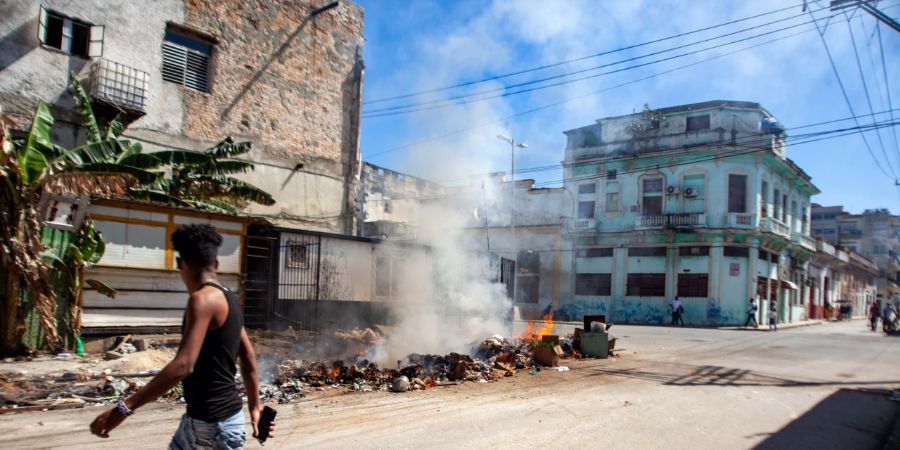
HAVANA, Cuba. – According to the agency Reutersthe accumulation of garbage in every corner of Havana is one of the most visible impacts of the United States’ commitment to prevent oil from reaching the Island. But if you ask Marbelis Suárez, she will say that, until she was 26 years old, “she has always lived among the garbage.”
“Who doesn’t know that? That’s not new,” says the young woman resident in the Colón neighborhood, in Central Havana.
For years, Cuba has lived with deficiencies and frequent delays in the garbage collection service. It is common for waste to remain for weeks, or even longer, in corners and in overflowing containers, attracting rodents, flies and infections.
According to data cited by Reuters, less than half of the city’s collection trucks are operational due to fuel shortages. The authorities also attribute this impact to the breakage of several of these trucks and the lack of spare parts; but, above all, to the US embargo.
Also for as long as he can remember, Suárez says, he has been hearing “the same story.”
“In Cuba there is nothing because of the blockade, but there are cars and fuel, for example, to repress the Ladies in White every week,” denounces the young woman, who recognizes herself as an admirer of this peaceful movement of opposition women.
Although there are no records of this type, garbage in the streets must be one of the most frequent concerns and complaints among those who live in Havana, for whom the Reuters report constitutes an offense.
“Where was that international press before Trump put more pressure on the regime? Did they never see the garbage dumps and infested neighborhoods?” [de mosquitos y roedores]”?” he asks. “The real problem has never been the blockade or Trump. They have never had enough fuel because they sold the one they were given”, he concludes, bluntly.
Although the polycrisis that the country is going through – the worst since the so-called “Special Period”— has worsened after the executive order signed by President Donald Trump on January 29, which threatened to impose tariffs on those who supplied oil to the Island, when the regime had room to undertake necessary transformations and investments, it opted for more economic obstacles and to maintain control of the population at all costs.
Raúl is a 35-year-old entrepreneur who, although he lives in the municipality of Diez de Octubre, has his delicatessen business in the Jesús María neighborhood, in Old Havana. He denounces that the garbage that accumulates almost at the doors of his establishment scares away customers and damages the image of his store.
“What I sell is food. It doesn’t matter if it’s clean and air-conditioned inside if customers have to go through that landfill to come buy. I can take care of the waste generated by my business, but not the entire neighborhood,” he says.
The younger ones are indifferent, while women like Ana are concerned about the panorama they are seeing. “The garbage is going to catch up with us,” he says.
In fact, there are already those who, not far from there, have been hit by the mountains of waste.


In the neighborhood of The Sitesgarbage mounds are part of the everyday landscape. “Microlandfills” have appeared that did not exist before. Right on the corner where an elderly couple lives, every day residents of the area leave dozens of bins with garbage. Debris has climbed up the side wall of his home, to the point that it has become impossible to open the windows.
“They have no one to look after them. They live there and the plague invades the house. There is also no awareness that they are elderly people,” laments a neighbor. “Even emblematic places in this city, either due to abandonment or because they are in danger of collapsing, have become landfills,” he adds.
One of the most repeated complaints in the area comes from the parish of San Judas, located in the heart of Los Sitios. Neighbors, faithful and representatives of the parish – an important center of religious fervor attended by the Piarist Fathers – have warned about the garbage and debris that accumulates at its entrance, and have denounced the inappropriate use of cleaning and excavation equipment, which has damaged the walls of the temple. CubaNet has collected the complaints on several occasions.
On January 23, the Piarist Fathers They complained again on their Facebook page not only because of the deterioration of its material heritage, but also because of “the profound damage” to the people who live in the area.
“We are tired of being invisible. Tired of our complaints falling on deaf ears. This is not just an aesthetic or heritage problem: it is a human, ethical and social justice problem,” they expressed.
As if garbage were not enough, residents of the capital are now faced with a new practice that puts their health even more at risk: due to the difficulties of waste collection, many people have chosen to burn waste in municipal areas, which generates smoke, causes allergies, worsens pre-existing respiratory diseases and increases local pollution.
This trend worries people like Nadia, 57 years old, asthmatic and with a bedridden mother, also asthmatic. “Sometimes I can’t even open the windows, because the smoke gets into the house, soaks into my clothes and hair,” he complains.
Teresa, a retired nurse, warns about the consequences: “Burning releases gases that affect, above all, children, the elderly and people with respiratory problems. This is already a public health issue.”

Nadia adds that she doesn’t know who awarded him the title of “wonder” to a city whose landscape has long been the sum of piles of garbage, columns of smoke and people walking around hungry.
In this scenario, which threatens all types of diseases and lung conditions, leaders have once again done what they do best: meet to talk about “problems” without proposing effective solutions, or solutions whose responsibility does not fall on the population.
According to Granmathe main thing needed to solve the problem of waste collection is “cooperation and participation of the population.” The official media of the Communist Party of Cuba (PCC) gave as an example the municipalities of Habana del Este and Boyeros, where nothing more and nothing less “a significant number of animal traction equipment, routes and maps from where garbage should be collected have already been identified.”
However, the report specified that the greatest challenge will be in Centro Habana, Habana Vieja, Plaza de la Revolución, Playa and Diez de Octubre, cosmopolitan areas with high population density and waste.