The protests in Havana, after blackouts of up to 18 hours, spread to Camagüey and Guantánamo, where the people, exhausted, shouted “Go away Díaz-Canel” and “Down with the Castros.”
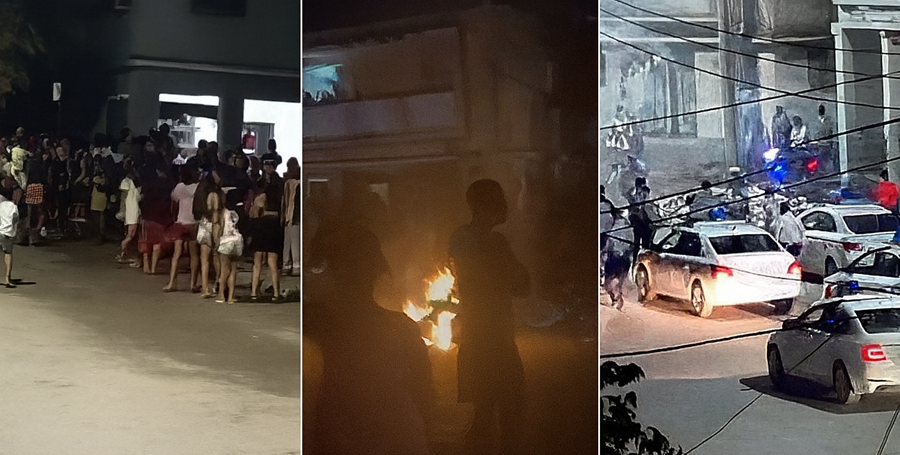
MADRID, Spain.- Havana experienced one of the longest days of protest in recent months between the night of Monday, December 8 and the early hours of Tuesday, December 9. In the dark for more than 15 hours In several sectors, residents of municipalities such as Marianao, Regla, Alamar, Diez de Octubre, San Miguel del Padrón and La Lisa took to the streets banging pots, lighting bonfires and demanding immediate solutions to the energy collapse and the deep social crisis that the country is going through.
Videos spread on social networks show groups of neighbors gathered in front of buildings and avenues, many of them with phones on as the only point of light. Banging pots and pans, shouting and demands for electricity, food and freedom were repeated in different neighborhoods of the capital, as confirmed by witnesses and activists.
In the Diez de Octubre municipality, the protests were marked by the prolonged ringing of the bells of the La Milagrosa church. Activist Adelth Bonne, a resident of Santos Suárez, reported in a video: “As you can hear, not only are the neighbors ringing the cauldrons, but the church here, La Milagrosa, is ringing its bells, after more than 12 hours of blackout.”
In Marianao, neighbors closed streets with pots and debris, while demanding the restoration of electrical service. Tension increased when police officers attempted to disperse the protesters. Independent journalist José Raúl Gallego commented on Facebook, along with images of the place, that the police ran when they started throwing bottles at him in Marianao.
«And he will run wherever people confront him, because they are not there to take a hit just for the sake of it, experiencing the same hunger and the same needs as those on the other side. And the other thing: The police are not enough when people throw themselves en masse in various places. In Cuba, the only ones who have something to defend are the generals and the hierarchs who are living like millionaires at the expense of the people,” Gallego explains in his publication.
In Alamar, in the videos broadcast, phrases such as “Go away Díaz-Canel”, “Down with Communism”, “Freedom” and “Down with the Castros” are heard.
In another video shared by Gallegoa resident of El Hueco, in La Lisa, shouts: “It’s good to put up with so much. There is my neighborhood, everyone out,” while those present chant “freedom.” In the recording, neighbors report that they have been without power for 18 hours and that they have no way to cook: “How long will Cuba be? Will Cuba react?”
At the same time, users reported internet outages in areas where large groups began to gather, a pattern that the regime repeats in times of protest to make communication and the dissemination of images difficult.
The demonstrations were not limited to the capital. At the University of Camagüey and in eastern areas such as Baracoa, Guantánamo, protests were also recorded. In the Baracoa town of Cabacú, videos They show the arrival of patrols while neighbors banged pots and pans to demand electricity and water.
While the protests occurred simultaneously, users inside and outside the country commented on networks that the multiplication of outbreaks hindered the response capacity of the security forces.
The escalation of protests occurs in a context of profound deterioration. The December demonstrations do not arise in isolation, but in an accumulated context of constant electrical failures, prolonged shortages and a climate of political pressure that has been closing the margins of daily life. The combination of endless blackouts, rising prices and the absence of official responses has led many Cubans to choose to take to the streets at night to make their displeasure heard. In this scenario, cacerolazos have become one of the most visible expressions of a citizenry that seeks channels to denounce their situation despite surveillance and censorship.
Added to this is an unprecedented record of citizen mobilization. ANDl Cuban Observatory of Conflicts reported that November closed with 1,326 protests throughout the Island, the highest number documented by the organization.
In this framework, this week’s demonstrations once again show a claim that is repeated with greater clarity: the deterioration of living conditions has led to calls for immediate solutions coexisting with open demands for political change. And although the government maintains control of the repressive apparatus, citizens continue to take to the streets to show their discontent.
Faced with the persistence of blackouts and the absence of official responses, the message becomes direct: the people ask Miguel Díaz-Canel and the ruling leadership to leave power, in a country that, as the protesters repeat, “can’t take it anymore.”