The annual vote on the resolution “Need to end the economic, commercial and financial blockade imposed by the United States of America against Cuba” is scheduled for October 29.
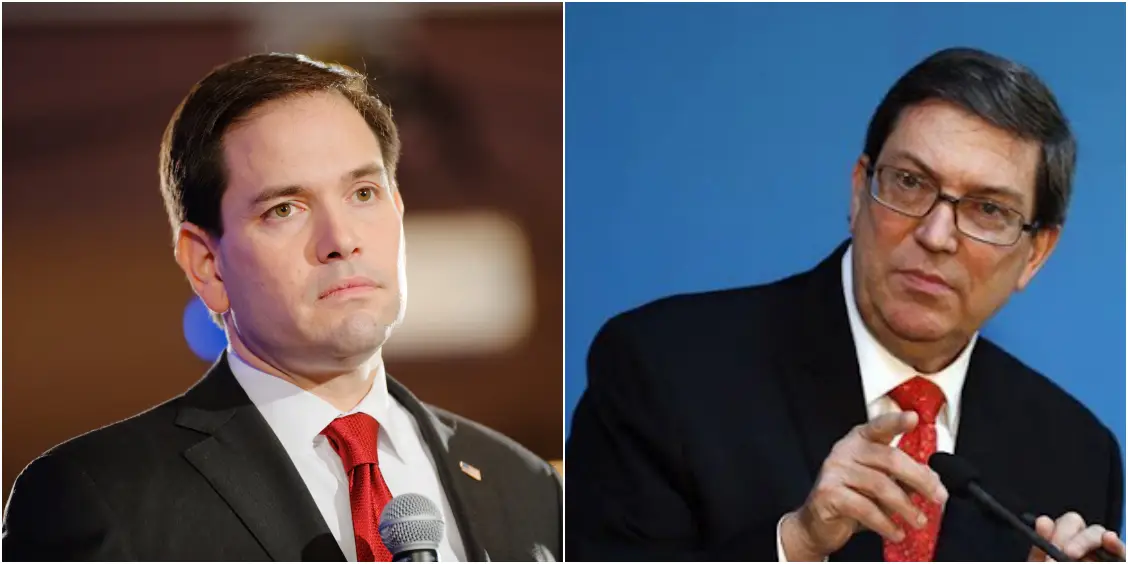
MIAMI, United States. – The Minister of Foreign Affairs of the Cuban regime, Bruno Rodríguez Parrilla, accused this Wednesday Washington to deploy “intimidating and deceptive pressure” on governments—especially in Latin America and Europe—to alter its historic stance in favor of the annual UN General Assembly resolution calling for an end to the embargo.
“We have reliable information about intimidating and deceptive pressures that the United States Government is exerting on several countries,” said the chancellor, announcing the debate and vote scheduled for October 28 and 29. According to what he said at a press conference in Havana, it is “an extraordinary, totally unusual, perhaps unprecedented display” accompanied by “a slanderous, mendacious campaign of information intoxication.”
The agenda of the General Assembly confirm that the topic “Need to end the economic, commercial and financial blockade imposed by the United States of America against Cuba” is scheduled for the end of this month.
Rodríguez assured that he will show “irrefutable evidence of this campaign that is taking place with extraordinary intensity at this moment and that comes from the last two weeks.” Among this evidence he cited “the cable dispatch from the Reuters agency” which, based “on State Department documents,” revealed “the active strategy of the State Department to coerce various governments and modify their position” at the UN.
“It was a timely revelation that included excerpts from the State Department’s communication to governments,” he said. On October 5, Reuters reported that the United States Department of State had instructed American diplomats to pressure allies to vote against or abstain on the resolution, and to justify this action with the allegation that between 1,000 and 5,000 Cubans had been recruited by Russia for the war in Ukraine.
The chancellor claimed to have in his possession two communications from Washington, dated October 8 and 17. According to his story, one of them reads that “there is no blockade against Cuba” and governments are asked to change their vote: “We urge you to reject this resolution.” “It says verbatim: ‘At the international level, Cuba actively undermines peace and security,’” added Rodríguez Parrilla, who described the texts as “mendacious and slanderous.”
Reuters, in a later notestated that Havana had firmly denied the version that there are Cuban troops fighting in Ukraine and disclosed data on criminal proceedings for mercenarism open since 2023, in response to the leaks about the US cable.
In several passages, Rodríguez raised the tone against Washington: “What the State Department, its Secretary of State, is doing [Marco Rubio]some other undersecretary, is not diplomacy. “It is not diplomacy.”
“It is pressure with arguments that no one believes in and that no one will believe, to try to alter the debate,” to “prevent the international community from focusing on the serious violations of the human rights of Cuban men and women that the blockade constitutes,” said the official.
The chancellor also vindicated his thesis that sanctions are the central factor of the crisis: “We are willing to debate this issue (…) to demonstrate that yes: the blockade is the main cause of the problems of our economy, and the main obstacle to our development.”
However, this statement contrasts with the cable itself cited by Reuters, which attributes Cuban internal problems to “government corruption” and not to sanctions, an argument that is supported by the United States.
Rodríguez dedicated a section of his statement to transcribing passages from a letter that, he assured, was sent to foreign ministers and ambassadors of several countries, with “direct threats” that would link the vote at the UN with “trade tariffs”, “visa deprivation sanctions” and other bilateral issues.
“It ends the most direct threat I have seen in this brutal gunboat campaign,” he read: “I hope that you will give full and adequate consideration to this letter (…) in accordance with applicable statutes, regulations and legal authorities.”
The head of diplomacy of the Cuban regime also rejected the alleged chapter of the US document that presents “Cuba [como] a threat to international peace and security,” and questioned the use of the Ukraine issue to justify pressure.
“The big lie of Cuba’s supposed involvement in the conflict in Europe (…) says: ‘Up to 20,000 Cuban citizens have been recruited.’ Everyone knows that is a lie,” he said.
However, Cuba would be, after North Korea, the country that has contributed the most personnel to the Russian forces in the war against Ukraine, with up to 7,000 nationals deployed as mercenaries, according to a report of Washington Times. The figure is part of estimates cited by the newspaper, which also states that nearly 20,000 Cubans would have signed contracts to fight for Russia, although not all would have been sent to the front.
The media reports the statements of Ruslan Spirin, special representative of Ukraine for Latin America. It also specifies that the majority of those recruited have been assigned to support areas, although a growing number fight on the front lines.
Ukrainian estimates place the Cuban deaths between 200 and 300. For Spirin, the hook has been economic: “Russia has recruited young Cubans and deceived them with false promises of work and citizenship. Many have ended up as cannon fodder on the front lines,” he declared. The newspaper adds that the promised pay would be around $2,000 per month, an “overwhelming” figure compared to an average salary on the Island of about $300 per year.
Havana has denied that sending nationals is part of state policy. Even so, Spirin stated: “The Cuban government insists that it is not involved. However, the facts show that the network continues to operate and that Cubans continue to arrive at the Russian front.”
Washington Times points out that the social media activity of Cubans in the service of Russia seems receptive to Moscow’s propaganda stories. He cites, for example, a television scene in which a Cuban recruit writes “Hasta la vista, baby” on ammunition destined for Ukraine.
The report also mentions cases such as that of Michael Valido, a 31-year-old Cuban who died in Ukraine, who aspired to travel to Brazil or Nicaragua to, ultimately, migrate to the United States.
Last September, advisors to the Ukrainian Government and legislators in kyiv denounced that some 20,000 Cuban citizens had been recruited by Russia to fight in the war against Ukraine.
Vladyslav Vlasyuk, advisor to the president Volodymyr Zelensky Regarding sanctions, he stated: “Currently we are talking about at least 20,000 Cuban mercenaries fighting against Ukraine.” And he added: “We have been able to physically identify more than 1,000 of these mercenaries.”
For its part, MINREX assured in a statement dated last October 11 that the Cuban Government had no participation in the armed conflict between Russia and Ukraine.
“Our authorities do not have precise information about Cuban nationals who, on their own, have participated or participate in the military forces of both parties in the war,” the official note states.
According to Havana, it is “irrefutable” that none of the Cubans identified in Ukraine “has the encouragement, commitment or consent of the Cuban State for their actions.”