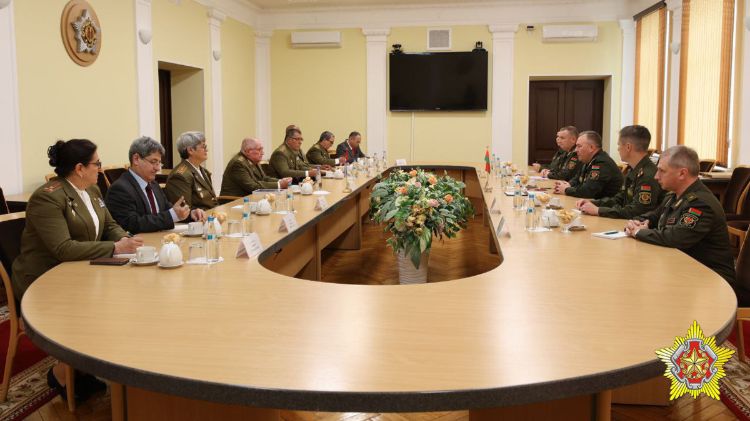
The head of the Belarusian General Staff, Pável Muravéiko, ordered the organization of practical bilateral activities with the Castro regime.
LIMA, Peru – The Belarusian Ministry of Defense reported that the Belarusian government and the Castro regime have agreed to increase military cooperation during the visit of the Chief of the General Staff of Cuba, Roberto Legrá Sotolongo.
a report from the EFE agency shares information from the Defense Telegram, which ensures that both parties plan to “increase cooperation across the entire spectrum of directions of mutual interest.”
Major General Pavel Muravéiko, Chief of the General Staff of the Belarusian Armed Forces and First Deputy Minister of Defense, spoke about the upcoming organization of practical bilateral activities and Minsk’s interest in moving beyond the proposed plans towards the development of “new directions of cooperation.”
According to the Spanish media, Legrá Sotolongo ended his visit with the inspection of an arsenal and a command of the Air Force and Anti-Aircraft Defenses, in addition to visiting the memorial complex of the Brest Fortress, the first to confront the troops of Nazi Germany in June 1941.
The general visit of the Cuban Army was part of a sequence of bilateral military contacts that has gained momentum since 2023, when both parties agreed on a draft of cooperation and a plan of events for 2024. In August 2025, Pável Muravéiko was received in Havana by Legrá Sotolongo himself, according to official media from both countries.
This same week, the meetings of the Cuban regime with the Belarusian Minister of Defense, Víktor Jrénen, were proposed as a step to “activate bilateral cooperation in the military sphere.”
“During my visit to Liberty Island [en enero de 2024]the signing of an interdepartmental agreement on military cooperation and placing our interaction on a planned basis laid the foundation for deepening and expanding our bilateral contacts,” Jrénen said.
He also added that, “currently, among the most promising directions of cooperation, which represent mutual interest, are the air forces and air defense troops, communication, military medicine, radio-electronic warfare and engineering assurance.”
The current geopolitical context adds relevance to the rapprochement: Belarus is a close ally of Russia, allowed the use of its territory as a launching pad for the invasion of Ukraine in 2022 and, together with Moscow, carried out the strategic exercise “Západ-2025” in September with the aim of testing the defensive preparation of the “Union State” and the coordination of its armed forces.
The complaints about the sending of Cubans to fight for Russia and the sustained Minsk-Havana military rapprochement since 2023 place the visit under special scrutiny.
In 2023, the Ukrainian Government presented a list with 253 passports of Cuban citizens supposedly recruited to fight for Russia. In parallel, Havana announced the dismantling of a trafficking network with 17 detainees linked to that recruitment and stressed that “Cuba is not part of the war in Ukraine.”
Most recent reports from the media and non-governmental organizations, as well as Ukrainian politicians, put the number of Cubans who have been recruited by Russia to fight against Ukraine in the thousands.