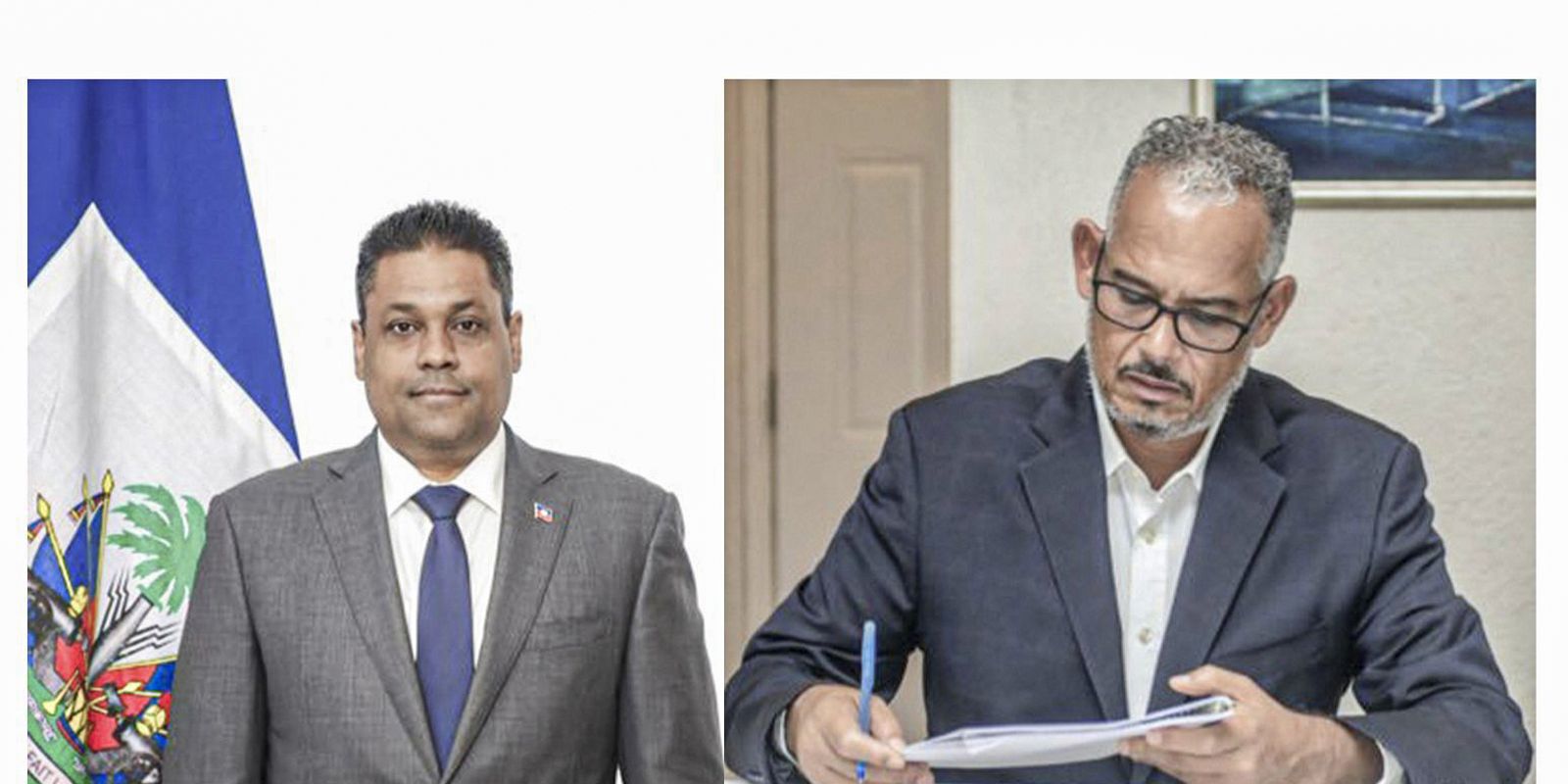
Haiti’s Presidential Transitional Council (CPT) ended its two-year term as head of the country, this Saturday (7), after the United States (USA) threatened to intervene in the Caribbean nation if Power was not maintained with the cabinet of Prime Minister Alix Didier Fils-Aimé.
At a ceremony in Port-au-Prince, the president of the CPT, Laurent Saint-Cyr, stated that the Council ends its participation in the Executive branch without leaving Haiti in a power vacuum.
“On the contrary, the Council of Ministers, under the direction of the Prime Minister [Didier Fils-Aimé]will guarantee continuity. The watchword is clear: security, political dialogue, elections and stability. I leave my duties with a clear conscience and convinced of having made the fairest choices for the country”, said Saint-Cyr.
With the country having not held elections since 2016, the CPT took office in Haiti, in April 2024, to carry out a transition in the country after the resignation of Prime Minister Ariel Henry, who had been in Power since the assassination of President Jovenel Moïse, in July 2021.
Formed by nine advisors from different social sectors, the CPT took command of the nation with the mission of preparing general elections and retaking areas controlled by armed gangs that came to take over entire regions of the capital Porto-Principe.
The possibility of appointing a president to, alongside the prime minister, lead the Haitian State was also discussed. However, there has not yet been a consensus on a name for the position.
US threats
On the eve of ending its mandate, the CPT announced its intention to dismiss Prime Minister Alix Didier Fils-Aimé.
Appointed by the CPT, it was expected that Fils-Aimé would be responsible for leading the Executive until the promised elections, scheduled to take place between October and November this year.
The threat of Fils-Aimé’s dismissal led Donald Trump’s government to send three warships to Port-au-Prince Bay to guarantee the prime minister’s stay.
“Under the direction of the Secretary of War, the USS Stockdale, USCGC Stone and USCGC Diligence arrived in Port-au-Prince as part of Operation Southern Spear. Their presence reflects the U.S.’s unwavering commitment to security, stability and a better future for Haiti,” the U.S. embassy in Haiti said.
The Washinton representation in Port-au-Prince added that any attempt by the CPT to change the composition of government would be seen as a threat to the stability of the region and “will take appropriate measures accordingly”.
Scam
Retired professor of international relations at the Federal University of Santa Maria (UFSM), Ricardo Seitenfus, one of Brazil’s leading experts on Haiti, told Brazil Agency that there was a final attempt to remove Fils-Aimé as head of the ministerial cabinet.
“As the prime minister demonstrated a certain ability to articulate, they wanted to stage a coup to remove him, before the end of their term, so they could choose another one,” said the expert.
Professor Seitenfus was in Haiti for ten days to launch his new book about the Caribbean nation, having left Port-au-Prince last Wednesday (4).
He assesses that the security situation has improved, highlighting that the government managed to regain control of much of the territory that had been occupied by gangs in recent years.
“I went everywhere. The neighborhoods, little by little, are being freed from the gangs, who will, at some point, take refuge in other places. This is going quite well”, he assessed.
For the international relations analyst, elections should be the government’s priority. “There has to be an election as quickly as possible. Because elections don’t solve everything, but without elections nothing will be solved”, he concluded.
Security forces
Since the assassination of President Jovenel Moïse in 2021, the Haitian government has been announcing measures and partnerships to establish minimum security in Haiti to hold elections.
One of the measures was the agreement for an international mission of police officers led by Kenya to assist the Haitian National Police.
Last year, the UN Security Council approved the creation of the Multinational Gang Enforcement Force, absorbing and expanding the previous Kenyan-led mission. At the same time, the government turned to foreign mercenaries to combat armed gangs.
*With the collaboration of journalist Thaís de Luna