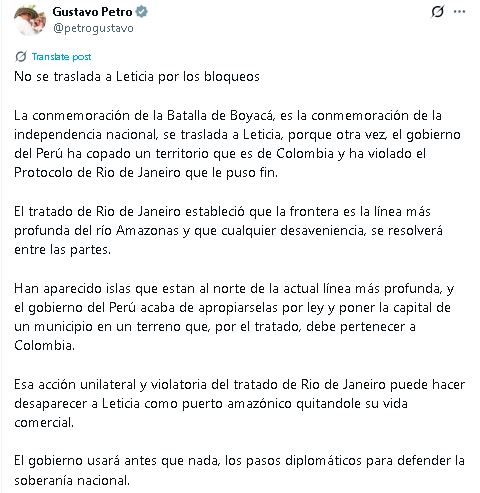
The president of Colombia, Gustavo Petrohe denounced al Peru government of, supposedly, having “copied” part of the territory of the Amazon in their country and violating the Rio de Janeiro protocol of 1934in which the binational borders were set following the line of the Amazon river. Through its official X account, Petro accused Peru to appropriate islands located north of that line and to install a municipality in Leticia.
“That unilateral and violation of the Treaty of Rio de Janeiro can make Leticia disappear as Amazonian port, removing her commercial life,” he published.
However, in 1993, a study by Hydraulic Studies Laboratory of the National Universityhe reported that the Amazon flow was diverting towards Peru and warned that 70% of the river flowed through Peruvian channels, while 30% in Colombia.
You can see: Boluarte travels to Japan in the midst of conflict with Petro, who denounces that Peru took Colombian territory
Consequently, the phenomenon would directly harm Leticia, capital of the Department of Amazonas. It was also estimated that by 2030 the river would stop passing through the city.
Along the same lines, the house of studies concluded that 30% of flow in its country was reduced to 19.5% due to the lack of technical intervention and sedimentation processes, despite the fact that in 2006 there were viable proposals to prevent said event. “The consequences are serious. Many indigenous communities depend on fishing in lakes such as those of Yahuarcaca, which have a very high productivity. Fish will stop arriving and fishing will disappear.
The territorial debate was afloat prior to the commemoration of the day of the battle of Boyacá, which will be held on August 7 in the city of Leticia. The Head of State mentioned that the celebration will be held in said capital to defend national sovereignty.
Congress approved in June the creation of the Santa Rosa district in Loreto
Despite the accusations of the president of Colombia, in June of this year the Congress approved the creation of the Santa Rosa district And, a month later, on July 3, the Government promulgated the norm.
In Law 32403 the new town was formalized and the territorial limits and borders with Brazil and Colombia were established.
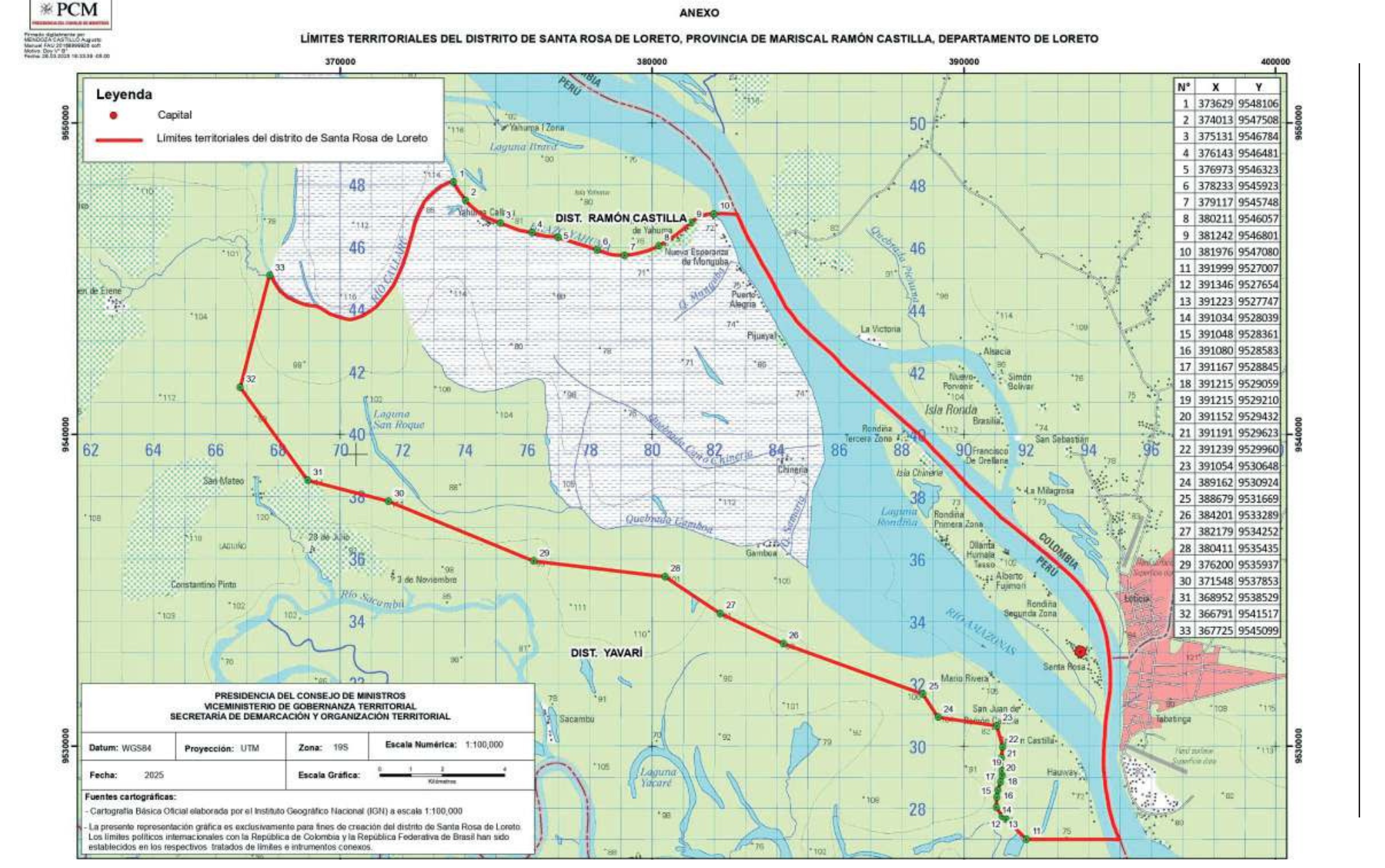
Gustavo Petro accuses Peru for Colombian territory: this is the triple 3D border
The triple border between Colombia, Brazil and Peru They cover three border districts: Leticia, Tabatinga and Santa Rosa de Yavarí, respectively, according to the 3D images of Google Earth.
Government rejects Gustavo Petro’s statements
Through a statement, the Peru’s government rejected President Gustavo Petro’s statements On the territorial integrity of Peru and supported Congress for the creation of the new district of Santa Rosa de Loreto.
“The Government of Peru expresses its strongest and most energetic protest regarding the statements of the Government of Colombia in relation to the sovereign rights and acts of jurisdiction that Peru legitimately and legitally exercises by Peru in a public and permanent manner more than a century of integrity of its national territory,” he said.
What is the Rio de Janeiro protocol?
The protoColo de Río de Janeiro from 1934 It is the diplomatic agreement that formalized the Peace, Friendship and Cooperation Treaty between Colombia and Peru, after the Colombo-Peruana War (1932-1933). Signed on May 25, 1934 and mediated by Brazil, this protocol definitively defined the border between both countries in the Amazon region, giving Colombia the sovereignty over the city of Leticia and several islands of the Amazon River. In return, Colombia recognized the rights of Peru in other border areas, thus establishing a peace agreement.
One of the fundamental aspects of the protocol is that the border would be established along the deeper channel of the Amazon River (the Thalweg line), which implies that the boundary between the two countries would adapt to the natural route of the river.