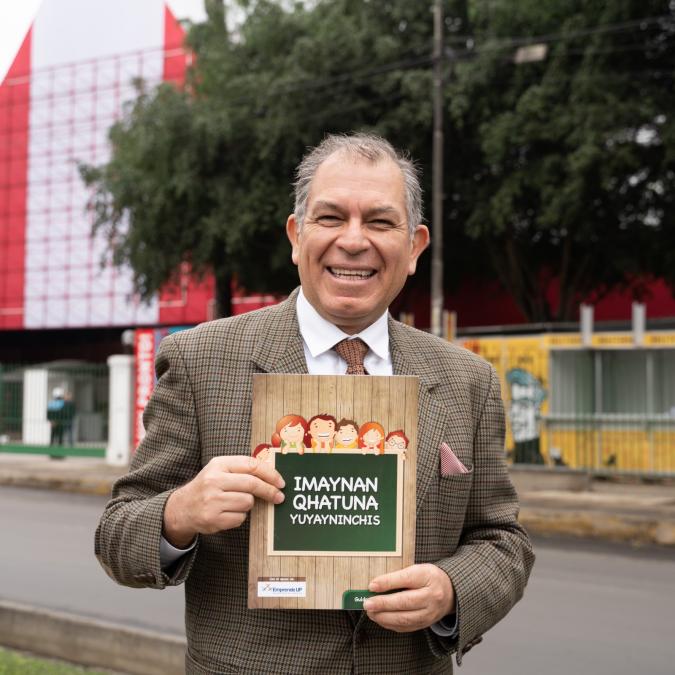
Guido Sánchez, the author of “Plan B”, a manual for entrepreneurship in times of crisis, speaker and host of the program “Emprende si o si”, on Perú21TV, tells us about one of the verticals of his business, which is entrepreneurial education in schools.
How did the entrepreneurial education program that you bring to schools come about?
About 16 years ago, the Villa María de la Planicie school called me and told me that they want to teach entrepreneurship to their students. They tell me that they are participating in a program that they wanted to replace and they had mentioned that I could be the person who could help them. I asked them what they needed and they told me: “We need three things: method, strategies and content.”
Why does an entrepreneurial education program need these three elements?
They explained to me that the program they wanted to leave only had the strategy part, but no content or method. Which ended up being an interesting, nice contest, but not educational, because it wasn’t for the entire room. Only one team was selected and that group was the one that participated. Generally, there were between five and ten students involved in a class of 30 students.
How did you take the challenge?
I found the challenge fascinating, but more fascinating the great opportunity as an entrepreneur for someone to come and ask you for help. Thus, the first thing that occurred was a co-construction of the program with them. So, we started and I prepared a method that is key for us: the SYSA method, which has three fundamentals.
What are the fundamentals of the SYSA method?
The first is Feel. Connect with your purpose, with empathy, with emotions. Because if it doesn’t excite you, you don’t start. It is easier to start when you are excited, because one of the most important emotions is passion. And passion always breeds cravings for difficult things, because only the difficult brings out the best in us. This is something that education in general has lost. Education has never worked on the emotional and emotional part.
What is the second foundation of this method?
The second foundation is that every emotion generates a reaction. And in order not to have reactions that could lead us to regret, we filter the emotion with thought, knowledge and reason. So the second foundation is Think, use knowledge, analysis and strategy. For example, imagine you want to create a business magazine, because that really excites you. Very good. Now put the filters: knowledge, investment, your team, strategy. You must put the knowledge into your project to land it.
The third?
Feel, Think and then Act is the third foundation. They are those three steps that we have instilled. And actually the SYSA method of entrepreneurial thinking and behavior began to work so well that, in 2017, at SYSA we were lucky enough to have an economist in the United States apply for the Fulbright Scholarship in which he proposed doing an impact evaluation of the Entrepreneurial Schools program in Peru, which was our project. He won the scholarship, did the impact evaluation for the North American Government and for his university, and found evidence that the work we did was fundamental because we worked on 11 characteristics that distinguish successful entrepreneurs.
How are these 11 characteristics used?
When a boy enters the program, he is given a psychometric evaluation in which the 11 entrepreneurial characteristics of the SYSA method are evaluated: resilience, self-esteem, among other skills. The idea is that the teacher, at the end of the year, takes the test again and sees how the students are changing. The results allowed us to verify that the method is working and that the teacher adopted entrepreneurial behavior. That is, those who put emotion into what they do.
What was the program expansion process?
I started with exclusive private schools. Then the Añaños come and tell me: “Hey, why are you doing it in exclusive schools? Let’s go to public schools.” They told me: “I buy the program and donate to public schools.” So, when I arrive and teach this to the teachers, they tell me: “What they pay us is not enough for me, that’s why I have a family business, and what you are going to teach me helps me, my children and my students.” So the project works.
How many schools have you already been working with?
We work in two modalities: the private school, which is the one that puts the books that we give to the students on the list of supplies, and with the public school, there are institutions that buy the program from us to donate it to these schools. And within these buyers we have banks, mining companies, regional governments, municipalities. We are just doing a pilot program with the Municipality of Urubamba, for Works for Taxes.
We have between 260 and 270 public and private schools served in Peru, more than 2,000 teachers trained in these years, and all the impact that I have been creating among young people and adults.
Receive your Perú21 by email or Whatsapp. Subscribe to our enriched digital newspaper. Take advantage of the discounts.
RECOMMENDED VIDEO