Fabiola Martínez and Alma E. Muñoz
La Jornada Newspaper
Saturday, December 20, 2025, p. 3
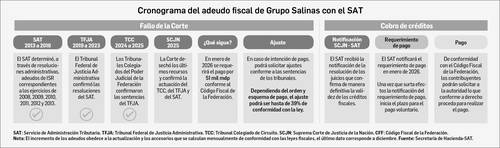
In January of next year, Grupo Salinas must pay the treasury 51 billion pesos, although once it expresses its intention to settle this tax debt it could be subject to “adjustments” (discounts), said the director of the Tax Administration Service (SAT), Antonio Martínez Dagnino.
When exposing the timeline of the matter at the National Palace press conference, he pointed out that “the adjustment may be up to 39 percent in accordance with the law.”
President Claudia Sheinbaum Pardo said that the resources obtained in this way will be used to increase the scope of social programs, such as scholarships; The Mujeres Bienestar pension – for example – has a budget of 59 billion next year. “The truth is, I hope they pay,” he said.
He stressed that the topic was brought up in the morning because it was a recurring question; It is, he said, a legal procedure, not a personal or political one.
“It’s the law, it’s the law. That is, the resolutions of the courts… What did the Court resolve? The Court resolves that the amparos are not appropriate. So, what remains fixed? The resolutions of the courts in that sense.
“As we have always said,” he added, “there is no personal or political issue here, or anything, but simply what the law says. So, it is not that the President or the director of the SAT are doing anything particular.
“Why are there 51 thousand now? Because the law also says that it is being updated, that is what the law says, that is what the court resolution says, and we have to comply with the law.”
The president highlighted the right of companies to request “discounts, let’s put it that way, in accordance and in accordance with the Tax Code. It is notified in January and we hope it is paid, it’s that simple. If they don’t pay, then another process is coming, which would be a later topic.”
Two journalists insisted on the right to obtain discounts or pay in installments, when the owner of Grupo Salinas has harshly criticized his government.
She insisted that it is a procedure established by law, which establishes the way to access the benefits, “I’m not going to give an opinion on the rest; the truth is, I don’t think it’s worth it.”
End to condonations
On the other hand, he indicated that the country has increased collection in recent years because there are no longer condonations like those that were authorized on a discretionary basis, based on corrupt practices.
He attributed the positive result in that area to three factors: first, the measure promoted by former President López Obrador, to bring to the constitutional level the prohibition of condoning on a discretionary basis; second, “there is no corruption,” and third, the transparent destination of resources – and not the dark practice, he said, of supporting only those at the top, as happened in the Fobaproa era –, to generate resources and allocate them to social programs and strategic work.
“Look, today the Dos Bocas refinery, which they criticized so much, how they criticized it!, the Olmeca Refinery is producing 300 thousand barrels a day of gasoline and diesel that were previously imported. So, yes, there is a change, there is a profound change.”
The Salinas Group debt case began because the tax authority determined that the corporation (of Ricardo Salinas Pliego) had balances payable corresponding to the six-year fiscal years (from 2008 to 2013); The loss reports issued by their companies were found to be inadmissible.
Then came a chain of challenges that concluded with the final decision of the SCJN, from which the SAT has the obligation to collect, a diligence that will be carried out in January 2026: “the payment of 51 billion pesos will be required in accordance with the Federal Tax Code,” Martínez Dagnino pointed out.
Once the notification of the requirement takes effect, the period for voluntary payment begins.