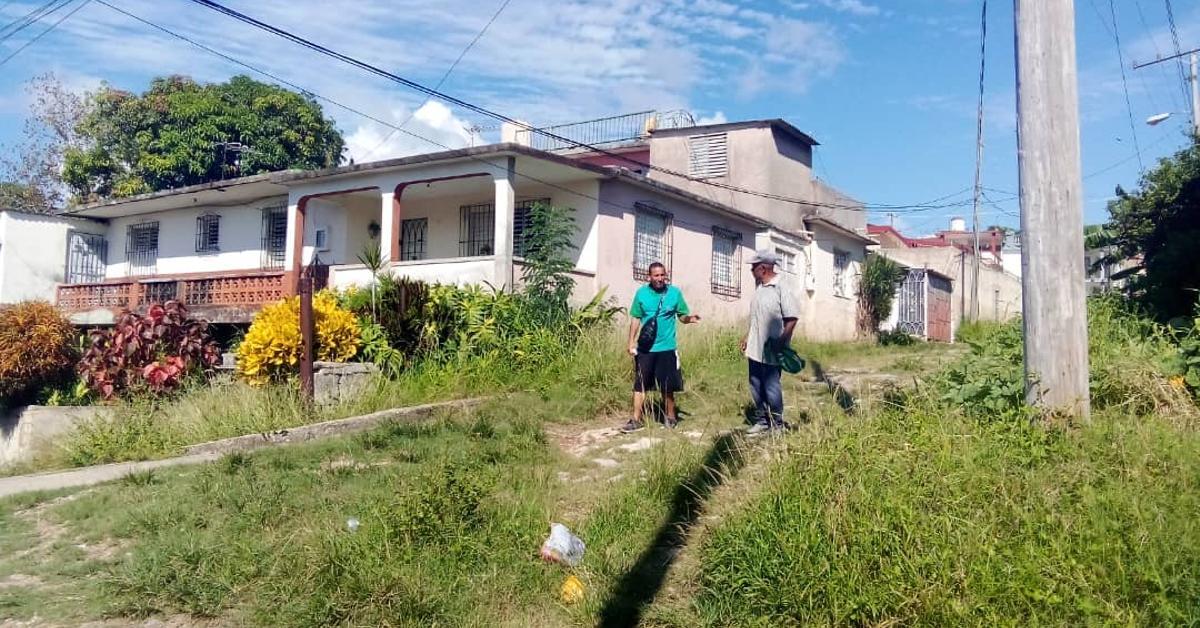
Matanzas/In times of high fevers and painthe people of Matanzas not only look with anguish at the mountains of garbage that accumulate on the corners. They also fear the grass that advances, silently, through the parks and streets, covering the edges of the sidewalks and hiding stagnant water traps where the mosquito finds fertile ground to multiply.
A few blocks from the Maternal and Oncological hospitals, the residents at the end of Glorieta Street have the strange sensation of living in the country, even though their address says the Versalles neighborhood. “This issue has been raised at various levels of the Government over the years, without it having been resolved until now,” laments Nancy, fearful that the dirt will end up reaching her door.
The fear has become more real with the expansion of arboviruses, which have found in Matanzas the ideal setting to spread. “I have my son with a very high fever that nothing can bring down. I have called everywhere to see if they are fumigating a little. A Public Health official told me that they would send a bazooka to fumigate. That was yesterday and I am still waiting for them,” he says, while observing how the weed, previously just a piece of vacant land, now extends along the entire street.
This week, Andrés Lamas Acevedo, provincial director of Hygiene, Epidemiology and Microbiology, assured that the epidemiological situation in the province could improve “around the end of October”, when the drop in temperatures limits the proliferation of the mosquito. However, he warned that efforts must be made to redouble hygiene, especially because serotypes 3 and 4 of dengue, in addition to other viruses, circulate in the territory.
For years he wrote letters to the provincial newspaper and spoke with Party leaders. “I realized I was wasting my time.”
Nancy, however, has seen no signs of that effort. “The first medical student has not yet passed by here doing an investigation. A truck stops from time to time to collect the garbage that piles up in front of the combine, three blocks down, but no one is capable of helping those of us who live on this hill,” he protests. His claim is not new: for years he wrote letters to the provincial newspaper and spoke with Party leaders. “I realized that I was wasting my time. Although they listened to me, no one paid attention to me.”
Like garbage collection, keeping grass at bay is a task that falls on the city’s Community Services, but the lack of personnel, supplies and fuel greatly limits the actions of that state entity. The squares, common areas and streets far from the center suffer more from abandonment and neglect.
Neighbors remember broken promises: throwing stones, bringing a bulldozer, leveling the street. Everything was left in meeting minutes and in words that were carried away by the wind. “After six in the afternoon we have to close everything tightly because of the number of mosquitoes that come out of the weeds. We have to scare them away or get under a mosquito net to stay warm in the middle of the blackouts,” says Nancy.
A little further up, Pablo pushes his bicycle with effort along the sidewalk. “If the bushes continue to grow, we are going to have a mountain in the middle of the town,” he says, dodging nylon bags and debris that form insect breeding grounds. “When it rains, the humidity is unbearable. If you don’t get sick from mosquito bites, you can easily get a respiratory illness. In the rainy season I go to my daughter’s house in Pueblo Nuevo. Because of my lung problems I can’t be in humid environments. This is like a punishment,” says the 64-year-old man.
Despite repeated complaints, the residents of Glorieta Street know that the asphalt will not arrive soon. “We do not belong to the historic center. There is no hotel nearby and we do not even have a reputation for being conflictive like the La Marina neighborhood. We are condemned to be absorbed by the filth or leave here, because we are not a priority for those who make decisions at the government level. That is the hard truth, even if they put the blockade sign on it,” says Pablo.
The grass has begun to open cracks in the sidewalks, pushing against the cement as if reclaiming its land. Only pedestrians dare to walk on the street, taking care not to trip over a hole or a loose stone. “I’m thinking about selling my house. I’ve had people interested, but they quickly give up when they find themselves trapped in this place, from which you can’t get out by motor, much less by machine. There is no option to make garages. Practically, not even those of us who have bicycles can live on this block,” confesses the old man, as he opens the door to his home with difficulty. A swarm of mosquitoes comes out to greet him.