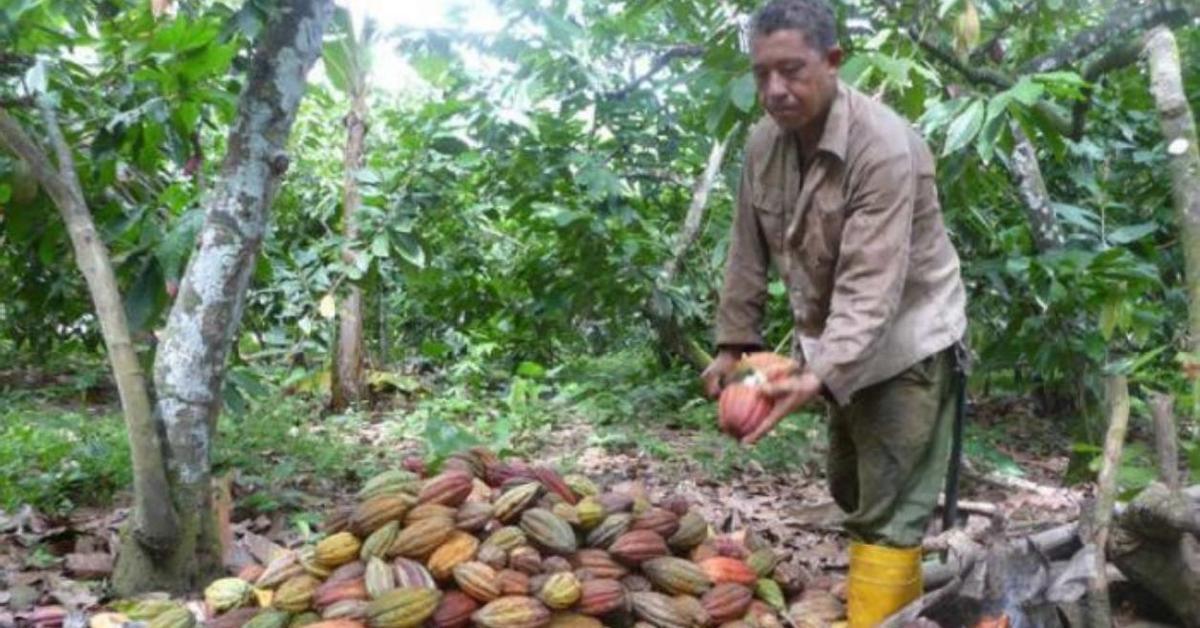
Madrid/The scapegoat of the day is cocoa producers. Yes in the First part of the report Posted by Granma On this industry in Baracoa, Guantanamo, he accused the MSMEs of having taken advantage of the hundreds of tons that accumulated in the state warehouses during an eternal repair of the chocolate factory, Today touches them. Cocoaoters are declared guilty of selling to those who paid them, and also at a better price, in the public trial of the Official Gazette.
Raúl Matos Pérez, director of the agroforestry and coconut company in Baracoa, admits – involuntarily – that the debts of the State, both in national currency and in freely convertible currency (MLC) that had been promised as a stimulus, they pushed farmers to look for life. “A private segment that is dedicated to processing cocoa in small quantities began to propose tempting payments for the raw material and dangerously compete, with what the company pays. Of course, deliveries to the state began to decide,” he reveals.
The authorization that the MSMEs had obtained to devote themselves to the production of cocoa, says the manager, “unleashed a dominated effect between a group of cocoa to which they had not yet been paid everything that should be paid for their productions of previous crops.”
The medium reproaches the producers to breach “their commitments to supply cocoa to the agroforestry and coconut” and put it “in private hands”, avoiding another rampant breach: that of the state
The medium reproaches the producers to fail “their commitments to supply cocoa to the agroforestry and coconut” and put it “in private hands”, avoiding another rampant breach: that of the state to pay cocoa in a timely manner.
To get to this point, the core, Granma He has reviewed the story already narrated in the first part of the report: in summary, that the chocolate factory should have risen in less than a year and it was delayed to five, that the harvest accumulated in the company’s warehouses and that it was contemplated to export it but it was better chosen, better, to sell it to six authorized MSMEs. The conclusion that the medium had reached Wednesday is that the private ones ended up staying with more than 100 tons that, if exported, would have given currencies to the needy country.
Of all this balance, new data transcends today. One of them is that the agroforestry sold cocoa to the private ones neither more nor less than twice the state company of cocoa derivatives. Granma Today identifies the administrator of one of the MSMEs, Néster Machado Matos, who declares with relative regret – put the editor – to have paid such money for a product that “was spoiled in the stores and had no one who bought it.” His mipyme is the one located in Paso de Cuba, which according to yesterday’s text was made with most cocoa, 45 of the 101 tons.
According to Ogli Pérez Pérez, economic director of the state, these companies paid 100,000 pesos per ton, which in the case of Machado Matos would be 4.5 million pesos (about 187,500 dollars to the official change). Cocoa derivatives would have paid 55,000 pesos and a small amount in MLC, having been operating.
Knowing the amounts, this Thursday Granma The alternative no longer judges so severely. “The client, a new and duly instituted economic actor, had a contract with the supplier, a condition that opened the way to the legal sale,” he says. Although he also doubts that prices could begin to inflate there, and not in duplicating the cost to the private ones. “The ‘ball’ of inflation, while rolling, grew, leaving earnings multiplied to their managers, while –’magia ‘of prices – discharged the final and stronger blow on consumers,” says the medium.
These companies paid 100,000 pesos per ton, which in the case of Machado Matos would be 4.5 million pesos (about 187,500 dollars to the official change). Cocoa derivatives would have paid 55,000 pesos
To the agroforestry, who believed to have closed a good business with the sale, he must have surprised that the authorities called it chapter to stop selling the product to the MSMEs. Mayelín Frómeta Alayo, mayor of Baracoa, takes care of the measure, which occurred from the complaints of cocoa derivatives, and having warned the work management that he could not allow the accounts to make chocolate, something that he considers “illegal trade”. “We stopped that process; we knew what it represented,” he alleges.
It does not serve at all, as a pretext, to Granmawhich continues to consider that it was a late reaction that starts from erroneous and exculp decisions – repentinely – to the private ones, who were properly approved. “The inexplicable and irrational begins much earlier, with the business inertia of allowing cocoa to deteriorate, to age and mortgage, to lose properties to be exported in time when its value climbed in the international market … All that could have been avoided and it was not done, why?” The newspaper continues.
Matos Pérez defends himself and argues that he acted thinking in the short term, because cocoa deteriorated in the stores. Until eight years, he says, he came to be. And it is at that time when Granma It links with the discredit to the producers.
“At this point it was no longer about the raw material with years of waiting; the private ones who make derived products began to enter a cocoa finished harvesting, but left the plantations by a rear door. With the chain reaction, the loss has moved to the cocoa, to start a clandestine and harmful crossing for the local economy,” the text concludes affair.