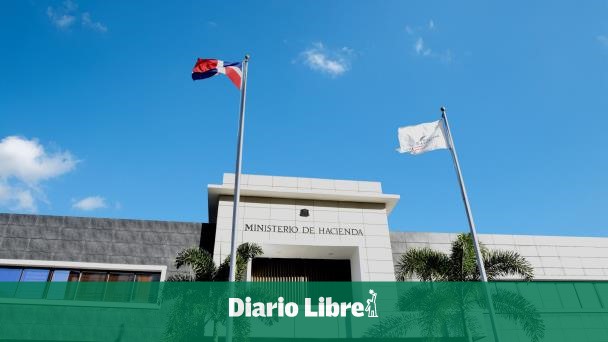
He Dominican governmentthrough Ministry of Finance and Economicssubmitted to the National Congress the project that modifies Law 80-24, which approves the General State Budget by 2025.
The initiative raises the application of a Countercyclic fiscal policyaimed at mitigating the effects of the international situation and protecting the dynamism of the national economy, through an increase in capital spending, prioritizing the public investment as an engine to boost economic activity and promote sustainable growth.
In total, the estimated income for 2025 ascends to 1,277,364.7 million pesosequivalent to 16 % of the Gross Domestic Product (GDP) projected.
In terms of expenses, there is a net increase of 69,740.2 million pesos (4.7 % more than initially approved), with an expansion of 20 % in capital spending, equivalent to 35,548.25 millionthat is, 0.4 % of GDP, as detailed by a hacienda press release.
-
These additional resources will mainly be used for public investment projects that will be in charge of the Ministry of Public Works and Communications, the Ministry of Housing, the Office for Transportation Reorganization, the National Potable and Sewers Institute, the National Health Service, the Presidential Commission for Provincial Development and local governments, among other institutions.
Also, the increase in spending includes the attention of Health priorities, national security and Social programsin addition to additional resources for constitutional bodies.
Among them, actions are highlighted to improve the conditions of health centers and support the Police reform.
As a result, an increase in fiscal deficit, which will go from 3.0 to 3.47 % of the estimated GDP by 2025. However, this increase will be funded mainly with surpluses of previous budgetary exercises, which ensures that no additional pressures on public debt are generated.
This project guarantees compliance with the fiscal rule established in the Law 35-24 of Fiscal Responsibilityensuring that the expansion of spending is carried out in a balanced way, without compromising sustainability or macroeconomic stability.