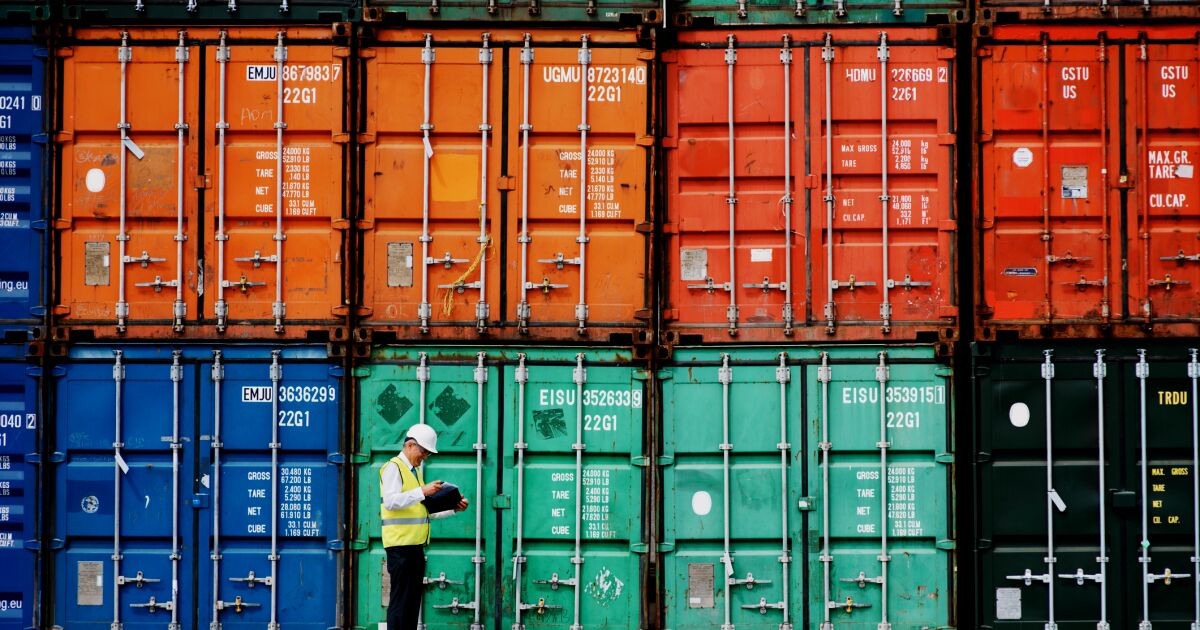
The forecast occurs at a time when customs became one of the country’s main sources of income. About 30% of tax revenues come from them, which places them as a pillar of federal collection.
The 3,496 million pesos that are expected to be captured in 2026 for these uses are practically equivalent to the budget proposed for the National Customs Agency of Mexico (ANAM), with 3,468 million pesos, 1.8 times more than in 2025.
Since 2022, the ANAM operates as a decentralized organ of the Ministry of Finance, after separating from the SAT during the Sexenio de López Obrador. This with the amendment to monitor foreign trade, raise efficiently and close the door to smuggling, corruption and drug introduction.
Sheinbaum promises that in 2026 the country will have an integral modernization of customs operations. The plan includes the incorporation of cutting -edge technology for illegal detection, non -intrusive inspection systems, digital traceability of goods and real -time video surveillance. The goal is to speed up the flow of goods and people, reduce waiting times at border crossings and maritime ports, and make dispatch processes more efficient.
These changes are part of the strategy to promote transparent and competitive foreign trade, which increases collection and supports economic growth. The ANAM, through its program “Customs Operation Control Services”, seeks to ensure that the fulfillment of tax obligations is easier for taxpayers, while strengthening the inspection and control of goods that enter and leave the country.
Reform of customs law, sharp teeth
On September 9, 2025, the Federal Executive presented an initiative to reform customs law, included in the 2026 economic package. The project seeks to harmonize the powers between the SAT and the ANAM, completely digitize operations and allow technological collaboration agreements with the Digital Transformation Agency and Telecommunications.
Its main changes include more severe sanctions for customs offenses, the extension of assumptions of responsibility for customs and customs agents, and the integration of latest generation electronic systems for inventory control and traceability of merchandise. The objective is to stop tax evasion and smuggling, problems that generate millionaire losses every year.
The real challenge: corruption and security
However, the challenge is not just technological. Alejo Campos, regional director for Latin America of Crime Stoppers, warns that without political will and fighting corruption, investments in technology are not enough.