SANTO DOMINGO.- The Dominican Government placed a red alert from Greater Santo Domingo to Pedernales, and also suspended teaching for secondary and university education. Likewise, work in the public and private sectors was suspended from 1:00 p.m. this Tuesday, due to the advance of tropical storm Melissa, which is causing heavy rains in much of the national territory.
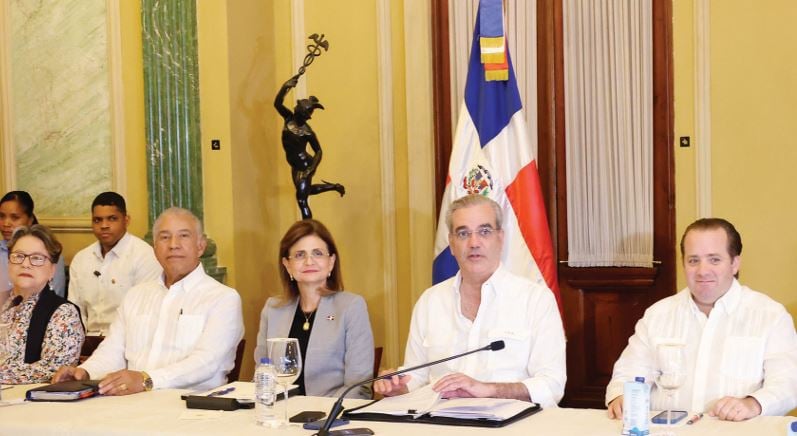
These measures were announced after President Luis Abinader, together with Vice President Raquel Peña, General Juan Manuel Méndez, director of the Emergency Operations Center (COE), engineer Gloria Ceballos, director of the Dominican Institute of Meteorology (Indomet), and various ministers and directors, held a meeting in the Green Room of the National Palace.
Mendez speaks
“The Operations and Emergency Center (COE) issues a red alert level for Greater Santo Domingo, including the National District, as well as for San Cristóbal, Azua, Peravia, San José de Ocoa, San Juan and Pedernales,” said the director of the COE.
Likewise, teaching and work, both public and private, is suspended in the provinces.
mentioned and that are under red alert. Juan Manuel Méndez explained that the Government, through the
Ministry of Public Administration (MAP) ordered the suspension of work starting at 1:00 in the afternoon today and tomorrow, Thursday.
He added that, to the extent necessary and alerts change in other provinces, these measures will be replicated as appropriate. Emergency agencies will continue in permanent session to save lives.
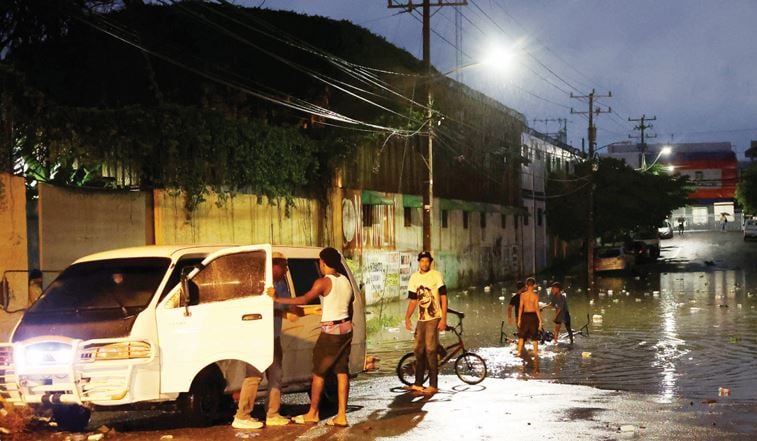
The director of Indomet, engineer Gloria Ceballos, stated that yesterday afternoon an accumulation of 62 millimeters was recorded in La Feria, the largest in the National District, where the rains were most intense.
Regarding the forecasts, he indicated that the accumulated ones, according to the American and European models – the latter more optimistic – could reach 165 millimeters in the capital, 205 millimeters in San Cristóbal and 300 millimeters in the southwest region.
However, the American model estimates that 400 millimeters or more could be recorded in the southwest area. “We are managing both models, but
We always work considering the most pessimistic scenario, to prepare for the worst, even if the best happens,” said the official.
The president’s call Before concluding, President Luis Abinader urged citizens in vulnerable areas to take the necessary measures: “What we want is to save lives.
The Government and all agencies will be in permanent session to help, especially with food and medicine.”
Likewise, he invited families who are at risk to go to shelters to protect their lives:
“I repeat, the most important thing is that not a single life is lost. The projections indicate intense rains.”
Other actions
The 911 System makes all its coordination and video surveillance resources available to the Emergency Operations Center (COE), as well as the Remote Manned Aircraft Division (911 Drones). Likewise, together with the Military and Police Commission (COMIPOL) of the Ministry of Public Works,
The Mayor’s Office of the National District (ADN), INTRANT and the General Directorate of Traffic and Land Transportation Security (DIGESETT), the main communication routes, tunnels, elevated and overpasses are monitored in real time, with the purpose of preventing incidents in the face of adverse conditions.
The National Health Service (SNS) also reported that they activated the Emergency and Disaster Plans and Committees in all hospitals, as well as the installation of situation rooms in the Regional Health Services. In addition, instructions were given to guarantee the availability of water, cleaning materials, medicines, supplies and fuel, review of the operation of power plants and the safeguarding of medical and computer equipment and important documents.
Figure
24 Provinces.
They are under the different alerts placed by the Emergency Operations Center.