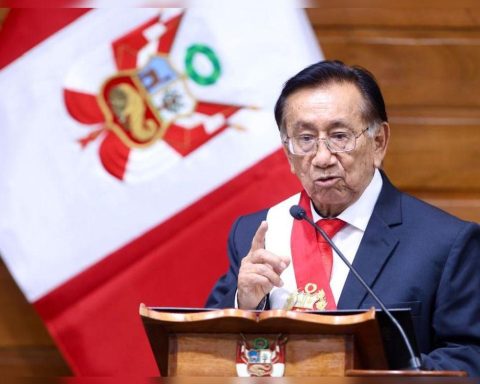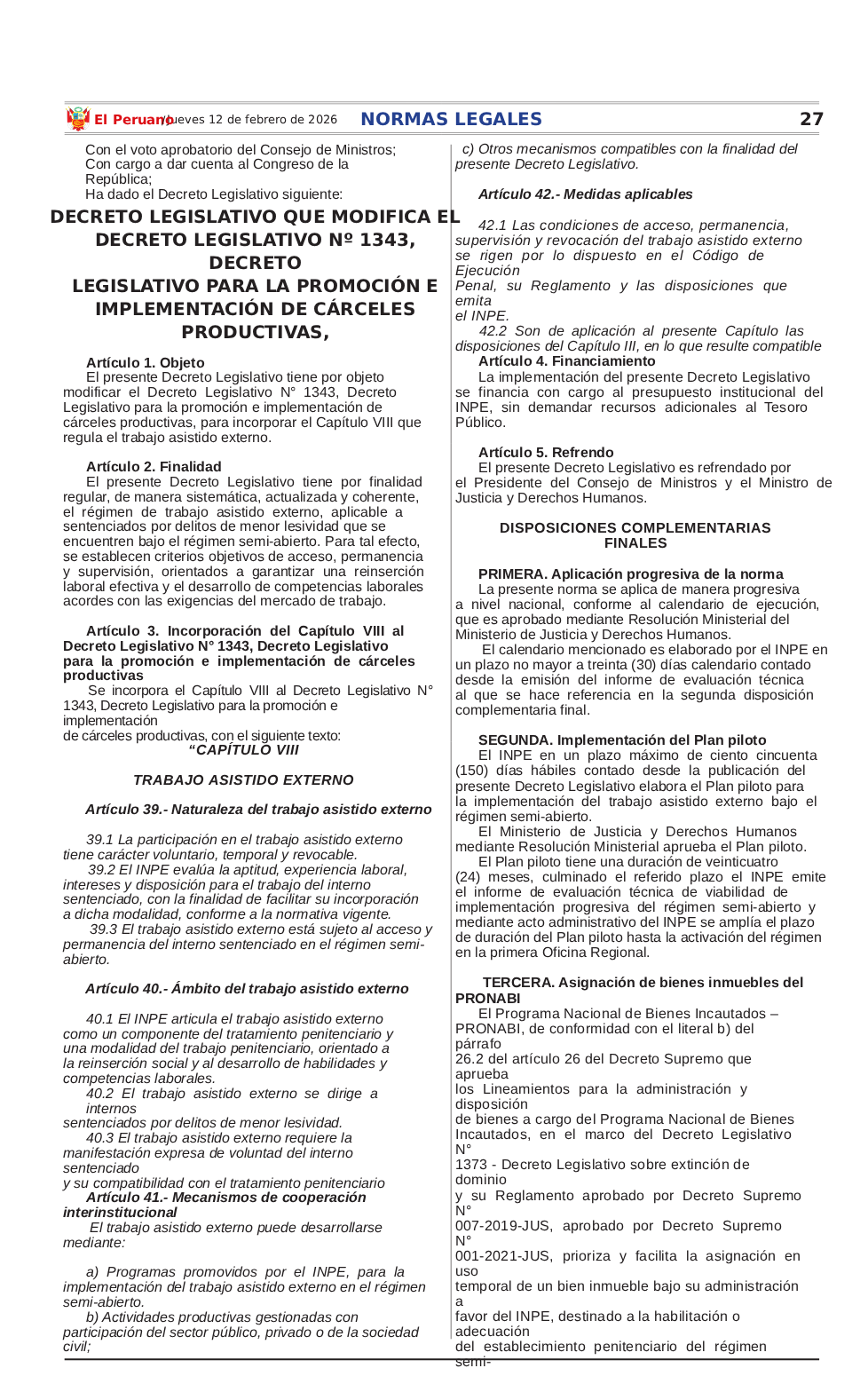
He Government of José Jerí approved the legislative decree that establishes that prisoners sentenced for common crimes can work inside and outside prisons under the semi-open regime. The measure was made official this Thursday, February 12, by the president himself, the prime minister, Ernesto Alvarezand the head of Justice, Walter Martinez.
In accordance with DL 1736, inmates may work voluntarily, temporarily and revocably. Likewise, the National Penitentiary Institute (INPE)—now the National Superintendency of Infrastructure and Penitentiary Reform (SUNIR)—will evaluate the aptitude, work experience, interest and disposition of each person so that they can take on the job.
YOU CAN SEE: Carlos Tubino minimizes underage pregnancies: “Not always with rape, sometimes they are nights of pleasure”
The purpose of this provision, the document specifies, is the social reintegration and development of work skills and competencies of the inmate.
External assisted work may be developed through programs promoted by INPE, productive activities managed with the participation of the public, private or civil society sectors, among other mechanisms that are compatible with the approved standard.
“The inmate is subject to periodic evaluation to estimate his permanence in said regime or regression, as appropriate,” the document reads.
It is necessary to highlight that the implementation of these tasks will be financed with the INPE budget and not from the public treasury.
YOU CAN SEE: Pedro Castillo asks the Jerí Government to requisition Vladimiro Montesinos’ cell and transfer him to Challapalca
Requirements for inmates
The Government established requirements so that prisoners can benefit from this type of work:
- That the conviction of an effective custodial sentence is no longer than six years.
- Having served half the sentence.
- That there is no pending process with an arrest warrant.
- Have paid the fine days set in the sentence.
- Have paid half of the civil reparation established in the sentence.
- Have three consecutive favorable semiannual evaluations.
- Affidavit of personal work commitment.
- Certificate of good conduct issued by the prison authority.
- Affidavit of family commitment with express identification of family members
According to the Legislative Decree, people convicted of an intentional crime considered to be repeat or habitual offenders will not be able to benefit from this benefit. Neither can those whose confinement is a consequence of the prior revocation of the personal electronic surveillance sentence and whose confinement is a consequence of the revocation of any alternative sentence to deprivation of liberty.
Complementary provisions for the work of prisoners
According to the legislative decree, this new modality of work for prisoners will be applied progressively at the national level, in accordance with the execution schedule approved by the Ministry of Justice. This work route will be prepared within a period of no more than 30 days after preparing a technical evaluation report.
Likewise, the INPE will have 150 business days to develop a Pilot Plan for the implementation of external assisted work. After that, the Minjus must approve said plan. The Pilot Plan will last 24 months. At the end of that period, the Penitentiary Institute issues a technical evaluation report to see whether or not said provision is expanded.
One of the objectives of this provision is to reduce the incidence of crime in prisons by creating work spaces inside and outside of them. In addition, provide skills and abilities for the development of productive activities inside and outside the prison, in free and post-penitentiary environments for effective labor reintegration, maintaining or increasing the training, creation or conservation of work habits of the inmate to favor their possibilities when returning to life in freedom.