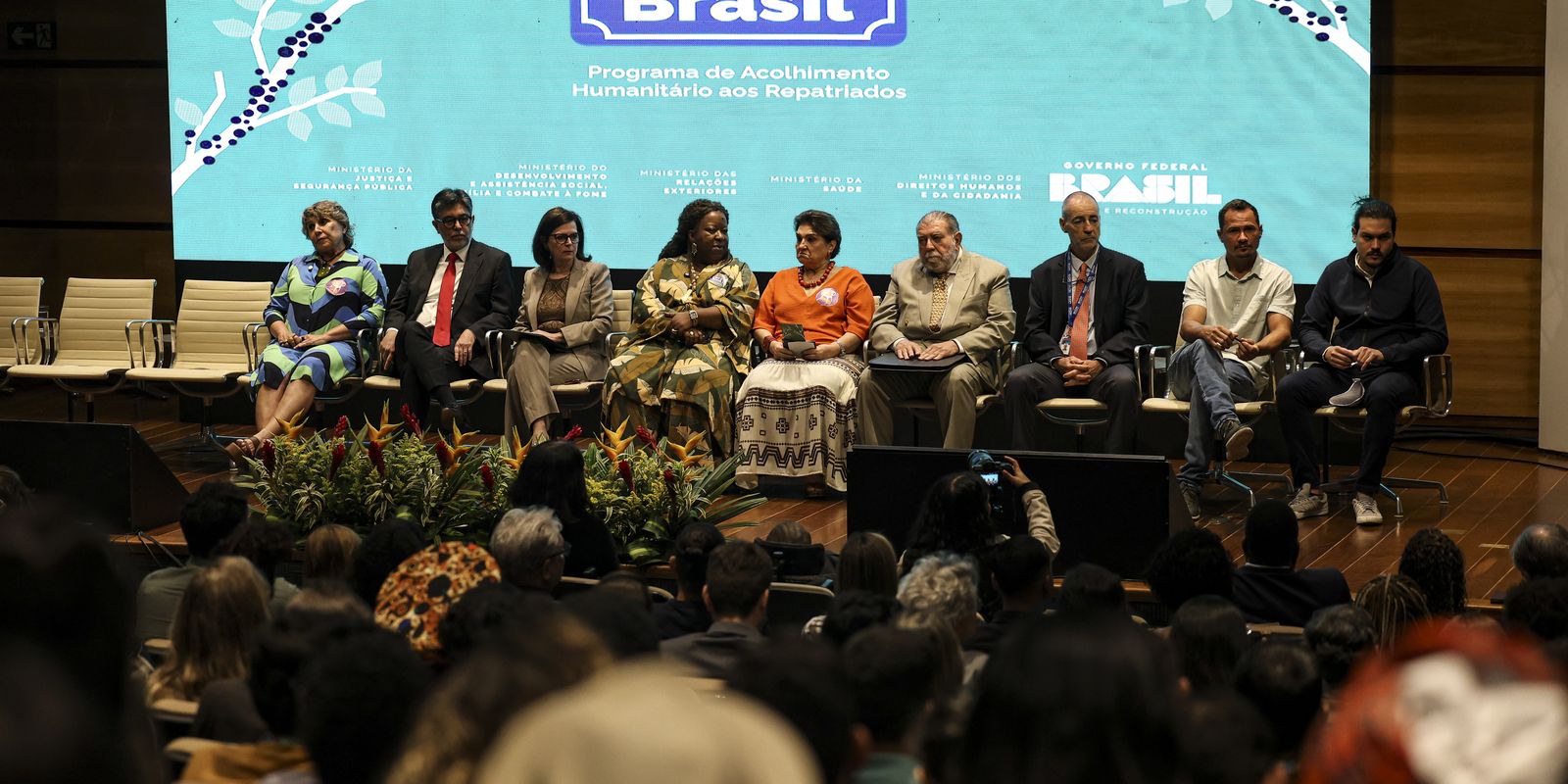
The federal government launched on Wednesday (6) the program here Brazil in response to the deportation and forced repatriation of Brazilians abroad, including recent cases registered in the United States by the government of Donald Trump. Humanitarian reception operations, according to the Ministry of Human Rights and Citizenship (MDHC), aim to offer a resolution coordinated to the immediate and medium term needs of repatriated Brazilians.
“Given the growing challenges faced by Brazilians abroad – especially in the context of the hardening of US migratory policies – the Aqui is Brazil program guarantees structured reception, protection and promotion of repatriate autonomy.”
The action offers psychosocial care, health care, shelter, food, transportation and documentary regularization, from landing to reintegration, ”said the ministry in a statement. The program is coordinated by the folder in articulation with the Ministries of Foreign Affairs, Development and Social Assistance, Family and Fighting Hunger, Health and Justice and Public Safety.
Also participating in the initiative are state governments, Federal Police; Public Defender of the Union (DPU); National Land Transportation Agency (ANTT); and international organizations such as the International Organization for Migration (IM).
Understand
According to MDHC, the here Brazil program operates through structured actions on four strategic axes:
- Humanized reception, protection and emergency response at airports, focusing on immediate support, screening and identification of specific needs;
- Support for social and economic reintegration, including documentary regularization, labor market insertion and family reunification support;
- Strengthening of migratory governance, through interministerial coordination, strategic data generation on the profile of the returned and formulation of public policies based on evidence;
- Promotion of strategic partnerships and multisectoral cooperation, integrating actions between federal, state and municipal governments, private sector, civil society and community organizations, with a view to the implementation of lasting solutions.
With an expected duration of 12 months, the initiative also involves the signing of a decentralized execution term between the portfolio and the Brazilian Cooperation Agency (ABC) in the amount of R $ 15 million.
“We will sign, with the Ministry of Labor and Employment, a concierge for the issue of referral to the world of work,” anticipated the Minister of Human Rights and Citizenship, Macaé Evaristo, during the release ceremony of Aqui é Brazil.
“We are negotiating with the National Education Council, with the Ministry of Education. Soon, we will have a resolution that guides the education system about the welcome of children daughters of these repatriads and also the immigrant population, which is also a matter in our country. And work, employment, in short, everything necessary to ensure the full inclusion of these people,” he concluded.
Repriatic profile
Ministry figures indicate that since February, Brazil has received more than 1,200 repatriaries in operations organized by the federal government, focusing on the safe return of vulnerable Brazilians abroad, especially in the United States.
Data collected until the last flight, held on July 25, show that of the total repatriates (1,223), 949 are men, 220 women and 54 did not have the genre informed. The most prevalent age group is 18 to 29 years (35%), followed by 30 to 39 years (29.6%) and 40 to 49 years (23.6%).
Also according to the ministry, 89.13% of people arrived alone, while 10.87% were accompanied by family members. After landing, 61.39% were welcomed by family members; 31.59% went home or rented; 4% stayed in homes of friends; And 1.8% went to some public shelter.
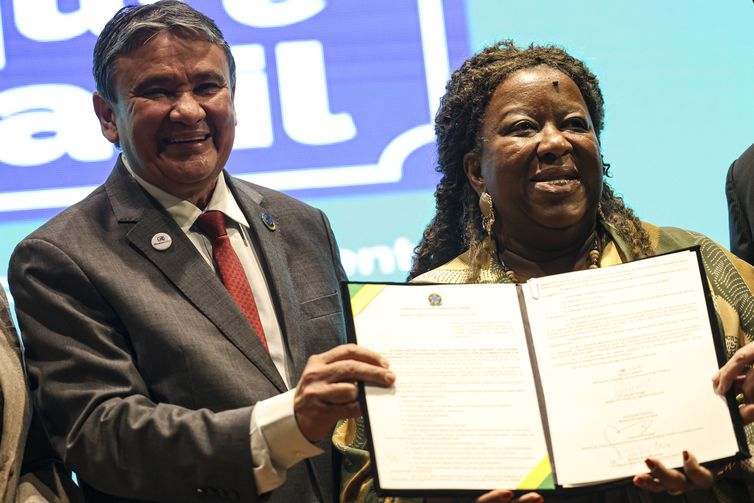
The Minister of Social Development, Wellington Dias, and the Minister of Human Rights, Macaé Evaristo, during the launch of the program “Here is Brazil”. Photo: MARCELO CAMARGO/AGENCY BRAZIL
Minas Gerais is the state of destination that received the most repatriates, followed by Rondônia, Sao Paulo, Goiás and Espírito Santo. Almost all states, according to the folder, received at least one less person except Piauí, Roraima and Amapá, who were not informed as a destination by the repatriads.
Also according to the survey, 74.2% of the repatrias intend to work in Brazil; 18.3% want to reconcile work and study; and 4.97% aim to dedicate themselves exclusively to studies. Most have complete or incomplete high school (53.39%), 26.2% have complete or incomplete elementary school and 15.84% have complete or incomplete higher education.
Most of the repatients lived for short periods in the United States, especially in the states of Massachusetts, Texas, Florida and New Jersey – regions that, according to the ministry, concentrate migrant Brazilian communities.
The numbers indicate that 81.53% of them worked eight or more hours a day, in often precarious contexts, while 6.68% reported not working or studying and 5.83% worked on hours of less than eight hours. There are also 3.65% that reconciled studies with work and 2.31% who were dedicated only to studies.
Regarding family ties abroad, 35.67% left no relatives in the United States, 21.13% said they left at least one family member and 14.88% reported having left five or more relatives in the country.