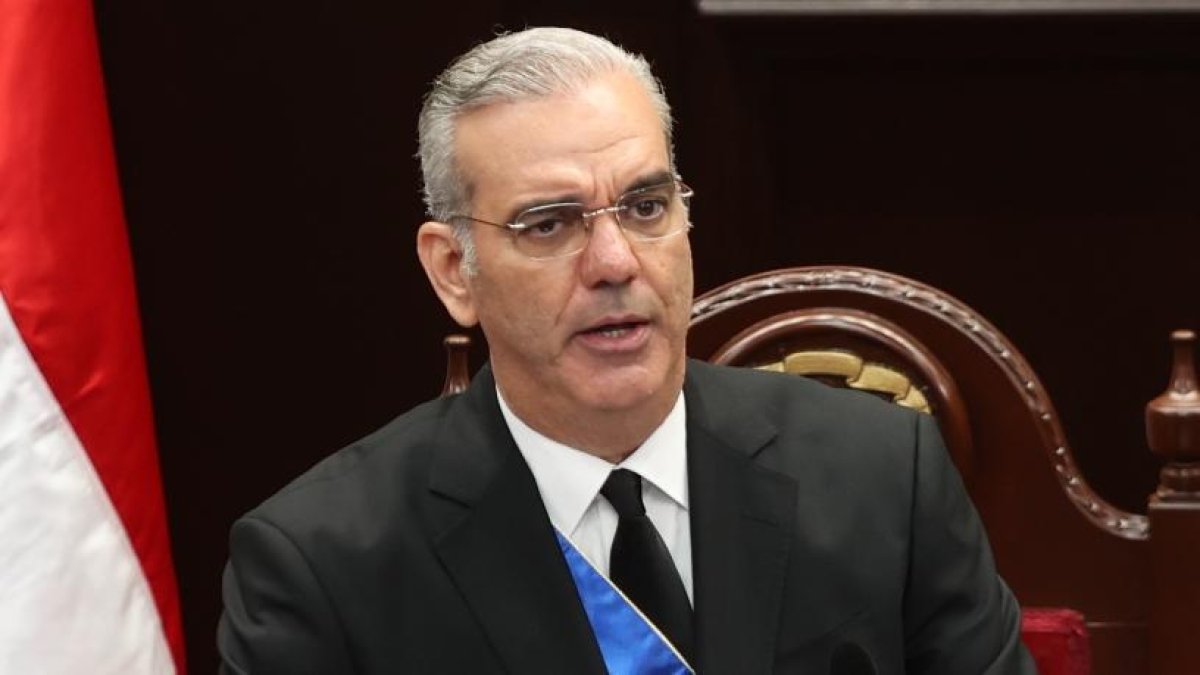
The president of the Republic, Luis Abinader, warned yesterday that his Government “does not negotiate” nor does it give up in the face of corruption and that the reforms that are being introduced to criminal justice seek to build a State that does not tolerate impunity.
He assured that for him, the fight against corruption is not just another declaration of this Government, “it is its backbone, its immovable moral compass.”
“And let no one have any doubts: I have friends, but not accomplices and this Government does not back down, does not negotiate and does not give up in the face of corruption, no matter what it costs me. That is my unconditional commitment to my country, to my father and to God,” he stressed.
In the case of Senasa, the only one he specifically referred to in the accountability speech before the National Assembly, the president assured that the guilty parties will not only have the full weight of the law, but that they will have to return every peso of what was stolen.
“In this Government there are no untouchables. There are no protected people. There are no excuses. No one is above the law…”, he emphasized.
He stated that modernizing the State is not only about digitizing procedures or simplifying processes, it is also about strengthening its institutional foundations, “ensuring that the law is complied with, that the rules are clear and that no one is above the legal order.”

In that sense, he said that so that the justice system has the real capacity to rigorously investigate, judge and punish, “without privileges or exceptions” those who violate the law, the Government has made structural decisions.
He highlighted, among them, the replacement of the old Penal Code, which, he said: “For a long time it limited the capacity of the State to confront complex crimes that affect the security and trust of the people.” He also referred to the substantial modification to the Criminal Procedure Code (CPP), “to eliminate unnecessary obstacles, strengthen the protection of victims and prevent the passage of time from becoming an ally of impunity” (with the prescription of trials).
He added that to solidify a rule of law, the Executive Branch also promoted or supported other important regulatory modifications, among which he cited the new Public Procurement and Contracting Law and its implementing regulations. “And with the creation of the Ministry of Justice we organized the system, respecting the separation of powers, so that the Public Ministry can fully concentrate on its essential task: prosecuting crime,” he stressed.
Judicial effectiveness
He noted that the Dominican Republic advanced in the pillar of judicial effectiveness, going from 176th place to 64th, according to the Heritage Foundation’s Economic Freedom Index.
Likewise, he highlighted that in the Transparency International Corruption Perception index, it also improved for the fifth consecutive year, going from position 136 in 2020 to 99 in 2025.
“And I want to say it with all the clarity that this moment demands, before this Assembly and before the entire country: as long as I am President of the Republic, there will be no hiding places, there will be no complicit silences and there will be no power that is above the law.”
Violence and gender equality
The president said that judicial processes derived from these actions made it possible to obtain 1,568 favorable, preliminary and final sentences for women victims of violence. He indicated that families affected by femicides received 4,888 social services, “reinforcing support for girls, boys and adolescents in vulnerable situations, and incorporating 632 new families into the Economic Reparation Program.”
He added that 1,210 people were immediately protected from the Shelter Homes, including women, girls, boys and adolescents and that 84 victims of trafficking were cared for in the specialized shelter.
Likewise, he said that the Government has clearly assumed that equality between men and women is not an ideological concession, but rather a moral duty of the democratic State and reported that in 2025 a comprehensive public policy that articulates prevention, protection, education, economic autonomy and cultural transformation will be consolidated.
“We strengthened comprehensive care services throughout the national territory, providing almost 100 thousand services to women in situations of violence, including more than 67 thousand legal advice and 24 thousand psychological assistance and the *212 Emergency Line intervened in 7,079 cases.”