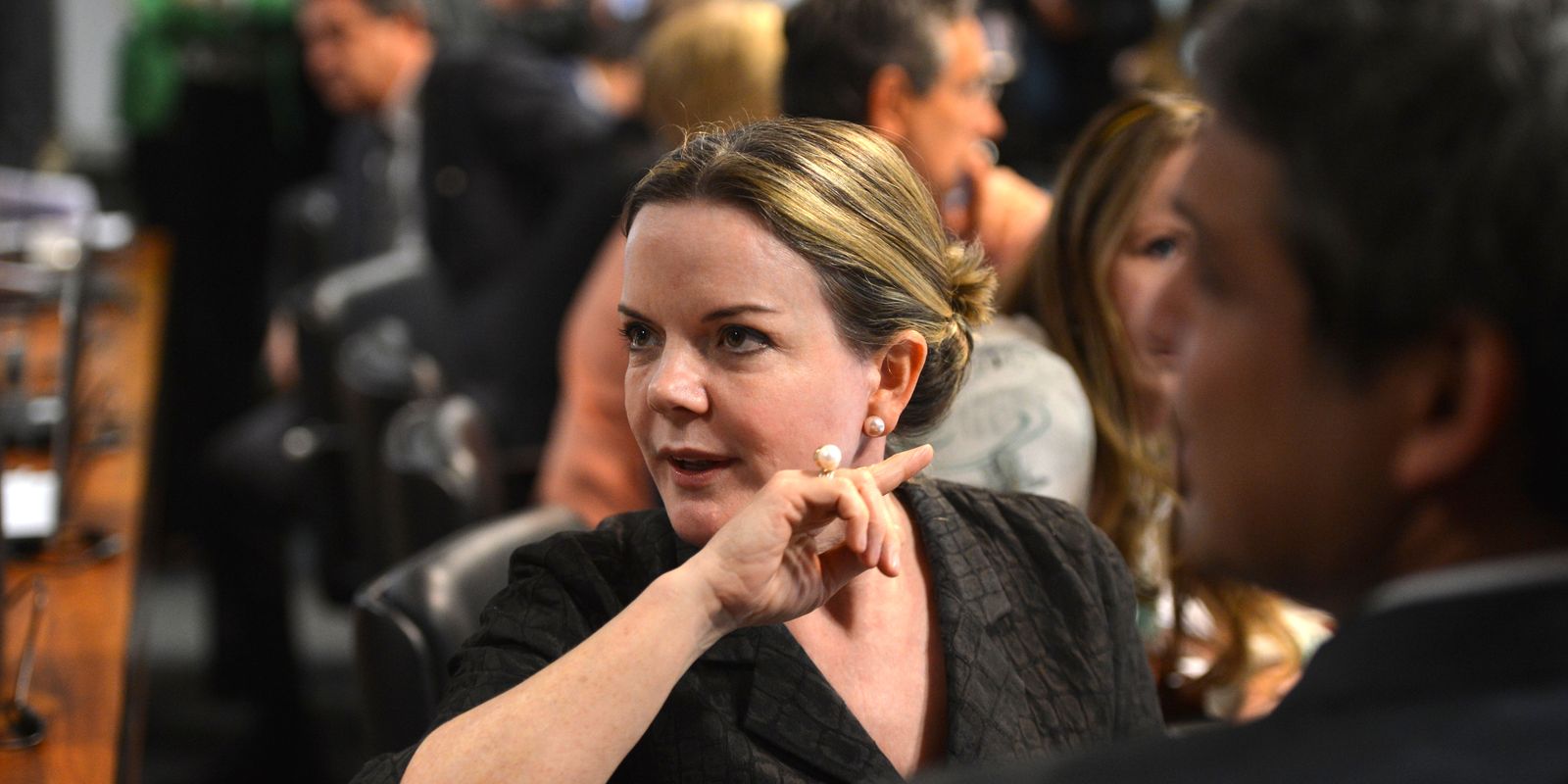
The chief minister of the Secretariat for Institutional Relations, Gleisi Hoffmann, blamed this Monday (22) the basic interest rate, the Selic, as being most responsible for the increase in the country’s public debt and not government expenses. Selic is currently at 15% per year, the highest level since 2006, when it was set at 15.25% per year.
On a social network, the minister said that the high level of the Selic “sucks” resources from the Budget for investment and compromises “the provision of public services, social programs and government investments for the country’s development”.
The minister criticized the news, without citing sources, which point to a 5% growth above inflation in government spending as responsible for the increase in debt and which ignore that interest rates are 10% higher than inflation.
“These stratospheric interest rates, which make credit more expensive and limit growth, are what make the public debt grow. By sucking resources from the Budget, the interest on the debt also compromises the provision of public services, social programs and government investments for the country’s development”, he wrote.
On Friday (19), the National Congress approved the 2026 Budget Bill (Ploa)which foresees total expenses of R$6.5 trillion. Of this total, R$6.3 trillion is directed to the fiscal and social security budgets, 28% of which will be allocated exclusively to the payment of interest on public debt, which is equivalent to R$1.82 trillion.
The minister’s criticisms also come in the wake of the decision by the Monetary Policy Committee (Copom) to maintain, for the fourth time in a row, the basic interest rate at 15% per year.
This Monday, the Central Bank (BC) Focus bulletin updated forecasts for key economic indicators. Market analysts estimate that the basic interest rate will fall to 12.25% per year by the end of 2026. For 2027 and 2028, the forecast is that the Selic will be reduced again to 10.5% per year and 9.75% per year, respectively.
In relation to inflation, measured by the Broad National Consumer Price Index (IPCA), the official inflation reference in the country, Focus reduced the inflation projection for this year from 4.36% to 4.33%.
It is the sixth week in a row that this year’s inflation forecast has been reduced, reaching the target range for price changes that should be pursued by the BC.
Defined by the National Monetary Council (CMN), the target is 3%, with a tolerance range of 1.5 percentage points up or down. In other words, the lower limit is 1.5% and the upper limit is 4.5%.
For 2026, the inflation projection also fell from 4.1% to 4.06%. For 2027 and 2028, forecasts are 3.8% and 3.5%, respectively.
The survey, released weekly by the Central Bank (BC), presents the expectations of financial institutions for the main economic indicators.
In November, official inflation closed the month at 0.18%, a result that makes the Broad National Consumer Price Index (IPCA) accumulate 4.46% in 12 months, according to data released by the Brazilian Institute of Geography and Statistics (IBGE).
Despite the decline in inflation expectations, the BC maintained, during the Copom meeting on the 10th, the rate Selic at 15%.
THE decision was expected by the financial market. In a statement, the Copom gave no clue as to when it should start cutting interest rates. As in the last meeting, he repeated that the current scenario is marked by great uncertainty, which requires caution in monetary policy, and that the BC’s strategy is to maintain the Selic rate for a long time.
“The committee assesses that the current strategy, of maintaining the current interest rate level for a very long period, is adequate to ensure the convergence of inflation to the target. The committee emphasizes that it will remain vigilant, that future steps of monetary policy may be adjusted and that, as usual, it will not hesitate to resume the adjustment cycle if it deems it appropriate”, highlighted the statement.
Selic is the BC’s main instrument for keeping official inflation under control, measured by the Broad National Consumer Price Index (IPCA).
In November, the IPCA was 0.18%the lowest level for the month since 2018. As a result, the indicator accumulates an increase of 4.46% in 12 months, returning to within the ceiling of the continuous inflation target.
For the new continuous goal systemin force since January, the inflation target that must be pursued by the BC, defined by the National Monetary Council, is 3%, with a tolerance range of 1.5 percentage points up or down. That is, the lower limit is 1.5% and the upper limit is 4.5%.
In the continuous target model, the target is determined month by month, considering the inflation accumulated over 12 months. In December 2025, inflation since January of the same year is compared with the target and tolerance interval.