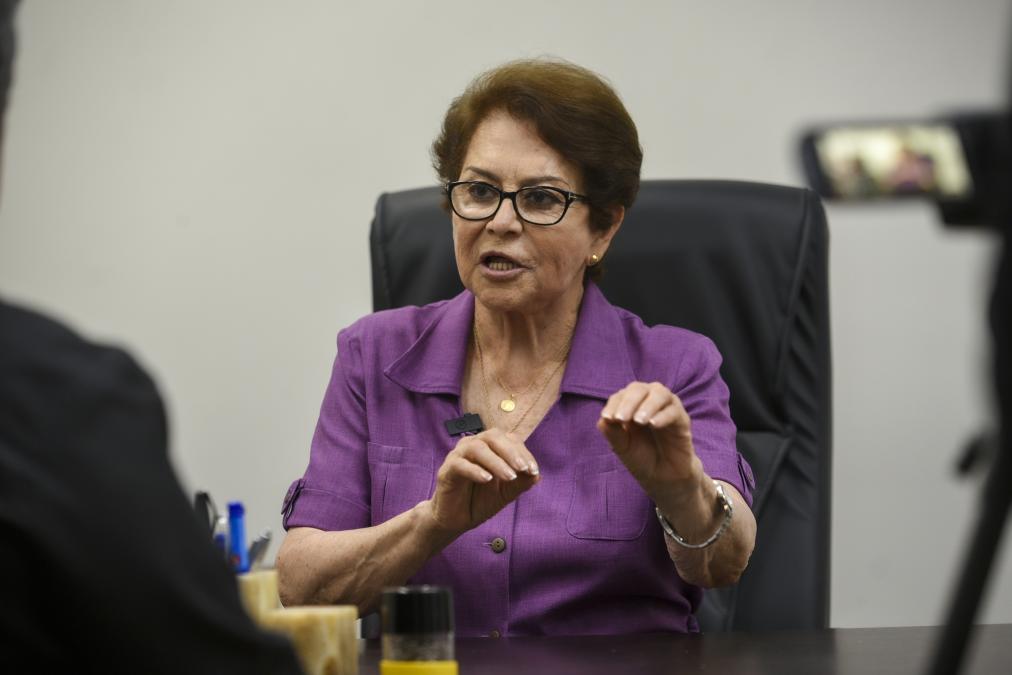
As a proposal against crime, Gladys Echaíz proposes that hitmen can be preliminarily detained for up to 15 days.
How do you see the dissolution of the Special Teams?
Those special teams should have been gone for a while. For many reasons. Those of us who have worked in the Public Ministry know the structure of the institution. We know her very well. Anti-corruption, organized crime, human rights. And we know that within these subspecialties, more specialized ones were created for specific types. And that couldn’t be. Even more so, because an organic structure was created with an important human resource that took away the opportunity for greater performance of the subsystems.
The special courts were created in the 90s. And then, the special prosecutors’ offices.
But they were in general. Not to see a certain company or person. As if it were the organization of the world, as if it were international… Hence, the very structure of the subsystems generated some situations that I call “professional deformations.” Because the coordinators, having a national level of competence, began to consider that they had functions and powers almost like those of a supreme authority. And that was wrong. So much so that they overflowed and challenged the very authority of the nation’s prosecutor. And that affected the order, the maintenance of the entire system, the entire institution. Because when the principle of authority cracked a little, the institution in general became unbalanced. A kind of Pérez-Vela syndrome occurred, in which they went to the press and called out any person or official.
There are antecedents. Fernando Olivera was secretary of the nation’s prosecutor, Javier Ortiz de Zevallos.
Sure, but he didn’t do the things we’ve seen so far. It was not the prosecutors or the nation’s attorney. He was an administrative official who sought prominence. And that he used the position as a springboard.
Didn’t José Peláez Bardales become politicized with APRA? It was defensive, not offensive.
I have been in the institution since April of 1982. Almost founder. The authority of the nation’s prosecutor was full and no one dared to do what was recently seen. Who is going to challenge the prosecutor? There is a very fine thread that can be crossed if the prosecutor is not a professional who knows how far he goes. José Antonio was always credited with working in favor of A or B, because only one case was seen. But the resolutions that were issued in other cases were not seen. I have never seen a situation like this.
It proposes detaining criminals for up to 15 days.
That is in certain cases. The Constitution currently gives the Police a period of 48 hours to investigate. It is very little when it comes to complex crimes. For example, in extortion, in hitmen, in kidnapping. You have to see cell phones, get information… 48 hours are not enough. So, a project was presented so that, as in terrorism, the deadline would be 15 days. On issues of drugs, terrorism, hitmen. And thus be able to have a little more complete investigations that reach the prosecutor. And that we do not have to read news that they released a detainee because the police information was not enough to deprive a person of their freedom, even if they were found in some compromising scene.
And how to deal with fear? Because sometimes they are released due to threats.
It’s a people issue. That is why he supported the professionalization of judges and prosecutors.
In opposition to provisionality.
Not just provisionality. Because a lawyer applies, he can pass the interview and be appointed. But the first day he sits down he doesn’t know what he’s going to do. Because he was never in that role.
She is very critical of the so-called “pro-crime laws.” There is a false narrative there.
Criticism of criticism. Because not all laws are “procrime” as the narrative says. Where is the “procrime”. You can look for my vote. In some yes, in others no, of course. In some I abstained because, although I wanted something to be modified, I was not in favor of the wording of the text.
Of course, they want to sell everything to us as a package. You have to look at law by law. And see if there is cause and effect.
For example, the law of effective collaboration. How are they going to say procrime? Procrime was the previous one. In a case where there is a person who comes to testify and acknowledge that he has committed a crime and to say “this is the evidence of the commission of the crime and that A, B and C have participated in it.” Does it take 8 or 9 years to complete? It’s not logical. While the process has the same period or even less. What does it lead us to think? Rather, effective collaboration was being exploited for political purposes. It kind of happened and there are complaints against some prosecutors for that. In the raid it is not as it is said. The raid can happen, they do not need any lawyer. Once there, everything is immobilized and the person is told to call their lawyer. In the event that you do not have a lawyer or cannot arrive, there is a public defender.
What do you think of Tomás Gálvez’s management as interim national prosecutor?
He knows the institution well, without a doubt. Some who criticize were not observed. Some have remained there for too long. Gálvez is trying to put a stop to these things to gradually recover the institutional image.
Do you trust María Teresa Cabrera, new president of the JNJ?
The members of the JNJ are those who have been selected by the council made up of those who made the constitutional reform. Let’s start by giving him the trust that every official demands, as long as we don’t see him commit something that is reprehensible. The members of this JNJ have arrived at a difficult time.