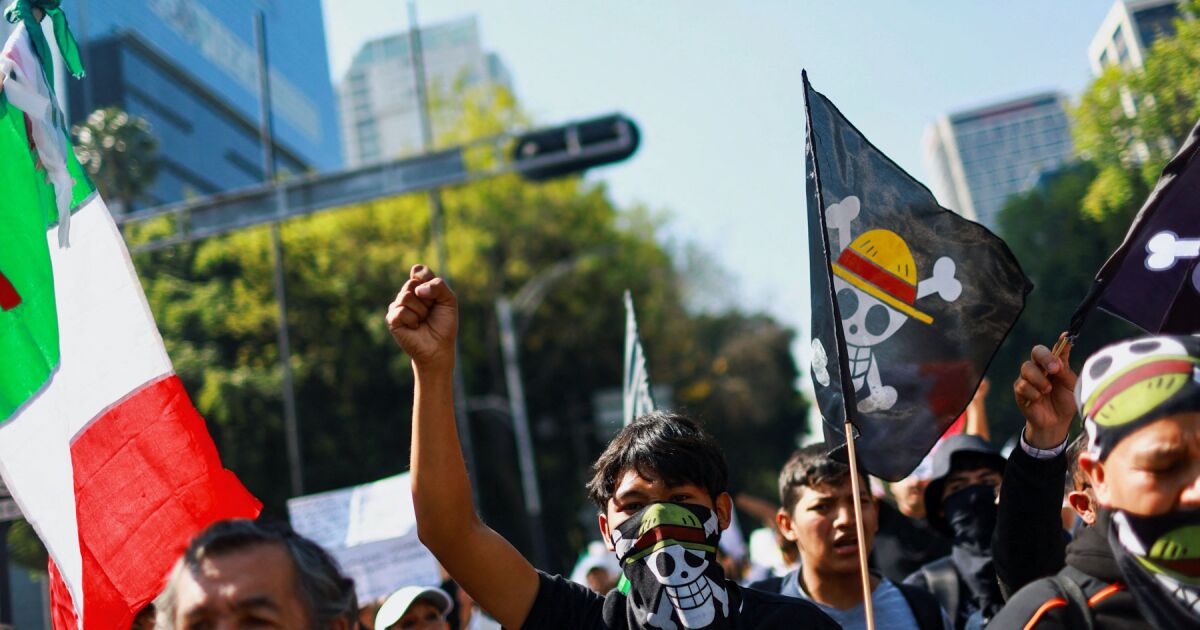
A non-partisan movement, but not apolitical
The Generation Z movement is not apolitical, but to gain strength it must remain nonpartisan.
Telésforo Nava explains that it cannot be apolitical because human beings are political beings and what young people are doing by demonstrating is politics.
“Human beings, man, are a political animal, we always do politics without realizing it. It was a political reaction to call for the march,” he says.
However, he considers that the important thing is to ensure that no party appropriates this movement. “The young people have already distanced themselves as a movement from any political organization. The PAN would be happy if those in the movement turned to see it. This movement has character, the more they attack them, the more they will grow,” he says.
Jacques Coste, political analyst and columnist for Political Expansionmaintains that the government was uncomfortable with the youth demonstration because unlike the Pink Tide, it brought together young people from different social classes.
“Unlike the Pink Tide, which was a mobilization of upper middle classes and elites focused on a more or less abstract cause without electoral traction—“defending democracy”—Saturday’s demonstrations showed a more interclass character, they brought together various dissatisfied sectors with different federal government debts and these issues could have electoral potential,” he stated in his column Why did Saturday’s marches bother Morena so much?
The challenge of generation Z: leadership
In addition to not allowing partisan ties that delegitimize Generation Z, experts consider that one of the challenges it faces is having strong leadership.
“It must be a strong leadership, it must maintain its positions in the face of the demands that the government is making and try to give more coherence and strength to the responses,” considers Telésforo Nava.
Although the demonstration caused annoyance to the government, analyst Coste affirms that it cannot be considered a watershed for its management.
“On the one hand, the president maintains high approval numbers and Morena has broad social traction; on the other hand, one swallow does not make a summer: for a mobilization to influence the national political direction, it must be sustained,” he adds.
Aldo Muñoz Armenta maintains that if the movement does not have leadership and legitimation, its proposals will be minimized, and proof of this is that those in power have insisted on questioning the spontaneity of the mobilizations.
“The government put a lot of emphasis on wanting to discredit the movement. It is part of its strategy to point out that they are opposition, to point out that they have a partisan brand, which means that their complaints, that their demands are not civil society complaining and that in reality the people are on the side of the government,” he adds.