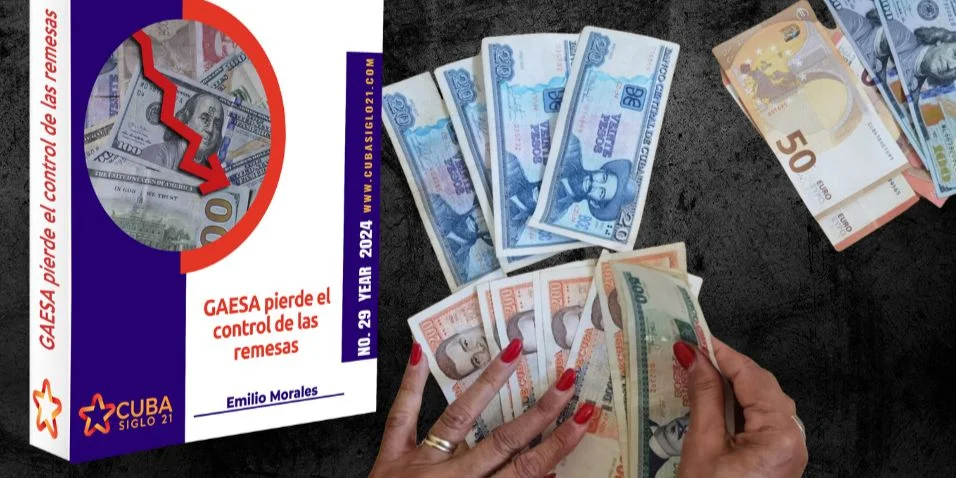
Miami.-The economic crisis in Cuba has reached a critical point with the collapse of remittances, the partial dollarization of the economy and new restrictive measures against The MSMEs And self -employed (TCP), according to the recent dossier “The hidden cause of Gaesa’s offensive against MSMEs and TCP” Posted by the Laboratory of Ideas Cuba Century 21.
The remittances, the main source of income in the government of the Government, fell 43% in 2024 compared to the previous year and 70% compared to 2019. Despite the massive exodus of Cubans in recent years, the amount of money sent to the Isla remains in a minced, reflecting a growing trend: exile prioritizes family reunification outside Cuba instead of continuing to sustain the economy of the regime.
The report emphasizes that Gaesathe military conglomerate that controls a large part of the Cuban economy, has seen its income reduced and has responded with an aggressive strategy to recover control of the dollarized retail market. Among the measures imposed on MSMEs and TCP include price stops, tax increases, import restrictions and the creation of the National Institute of Non -State Economic Actors (INAENE), in order to nationalize private entrepreneurs.
“The regime has lost control of remittance flow and the dollar retail market. His response is an offensive against the private sector to restore Gaesa’s hegemony, ”says Emilio Morales, author of the report.
In response to that catastrophe, the Government launches the “partial dollarization of the economy” policy, a measure that, far from resolving the crisis, which is seeking is financially underpinning Gaesa. However, the lack of confidence in the state banking system has led to 92.68% of remittances entering the country through informal channels, further weakening the finances of the regime. That is, from the Gaesa billionaire business with remittances, it was reduced to $ 81.6 million that received directly in 2024.
The report warns that this situation could trigger a new social outbreak in Cuba, given the growing citizen discontent in the face of the food, medicine, blackouts and repression crisis. As a solution, it proposes to completely release productive forces, allow direct private investment – including that of Cuban exile – and disassemble the Gaesa monopoly.
* Author: Cuba XXI Century