Obituary services in Cuba are part of the citizen capitalism that governs the operation of state benefits: the salary of public employees must come from the pocket of whoever requires the service.
HAVANA, Cuba.- Last week a well-known and loved neighbor died in Lawton. Died due to complications from a arbovirus. But this work will not be about that. Today I am going to refer to the grotesque phenomenon that the funeral services of the largest of the Antilles have become.
My neighbor died at the Miguel Enríquez Hospital, popularly known as La Benéfica. Beyond the painful loss, the first shock for the family occurred when the personnel in charge of the corresponding procedures at the health center informed them that the funeral home did not have the capacity to receive the body.
Spurred by desperation, one of his grandchildren applied himself to the task of presenting himself at the funeral establishment. And what was his surprise when he arrived and found that all the chapels of the facility were completely empty. The only thing they had to do was pay 8,000 pesos in national currency “for the left” and that’s it, they now had a place to look after their grandfather.
As for cleaning and dressing the deceased, that was another story. This sensitive step was entirely up to the family members, since there was no employee in charge of this task on site. They were not provided with utensils or materials with which to do it, but rather they had to ask some friends who lived nearby for some water and cloths. However, this did not prevent them from charging them 2,000 pesos to provide them with a cubicle where they could moderately clean their bodies.
The third crash occurred when the deceased was being transported to the cemetery. Of course, there were no hearses available. Finally, it was possible to resolve, also “on the left”, a small panel that would take him for 7,000 pesos. By the way, it turned out that the “generous” driver intended to make a killing by convoying the trip with another deceased, but he held back due to the angry protests of my neighbor’s mourners.
It is worth highlighting that, according to the website Cubaprocedure updated on November 11, 2025the wake and preparation of the body, including the coffin, are absolutely free. Aside from this, obituary and funeral services in Cuba, like so many others, seem to have been swallowed up by that kind of citizen capitalism that for some time has governed the functioning of the Island in terms of state benefits, so that the salary of public employees must come from the pocket of whoever requires the service.
Situations like the one described do not occur sporadically, but have become commonplace for some time now. Unfortunately, this is not the only aspect in which the sad matter becomes evident. Quite the contrary. For example, when the death occurs at home, the ambulance that must remove the body does not have a time to arrive. Surely many will remember the sad case of the beloved actor Carlos Massola, whose remains were not collected until seven hours after his death, or, more recently, that of the renowned actress Miriam Learra, whose relatives reported a wait of more than ten hours.
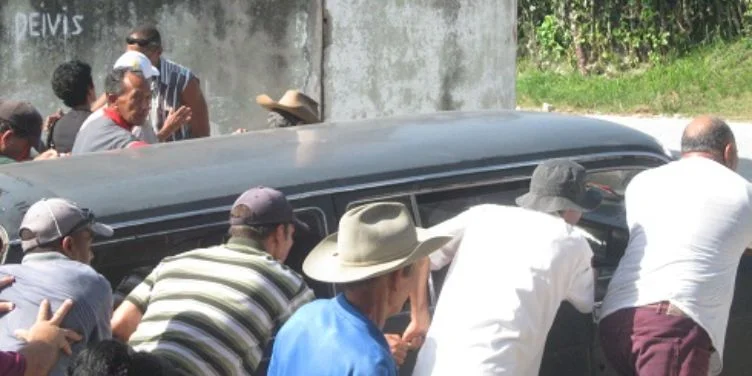
These are only two cases of public figures, but dozens of citizens have reported the same contingency on the networks, and it is assumed that it has happened to many others who do not reach cyberspace. The absence of hearses, for its part, has also been denounced on more than one occasion by mourners and activists, especially in rural areas, where after hours of useless waiting, not a few deceased have had to undertake their final journey in alternative vehicles precariously and hastily adapted for that purpose, in horse carts, even in wheelbarrows. And there have been no shortage of those who have had to be carried on the shoulders of relatives or neighbors.
The paralysis of the system is also evident in the ruinous state of the necropolises from Cape San Antonio to the point of Maisí. The collapse is not limited to local and municipal cemeteries, but has also taken hold in a location as central and emblematic as the Colón Cemetery. Called upon by its victims, the island’s government promises to “rehabilitate” cemeteries and crematoriums. It remains to be seen if he fulfills it. It would be the first time. Meanwhile, the collapse of our final resting place reminds us that after death we will be as helpless and abandoned as we are in life.