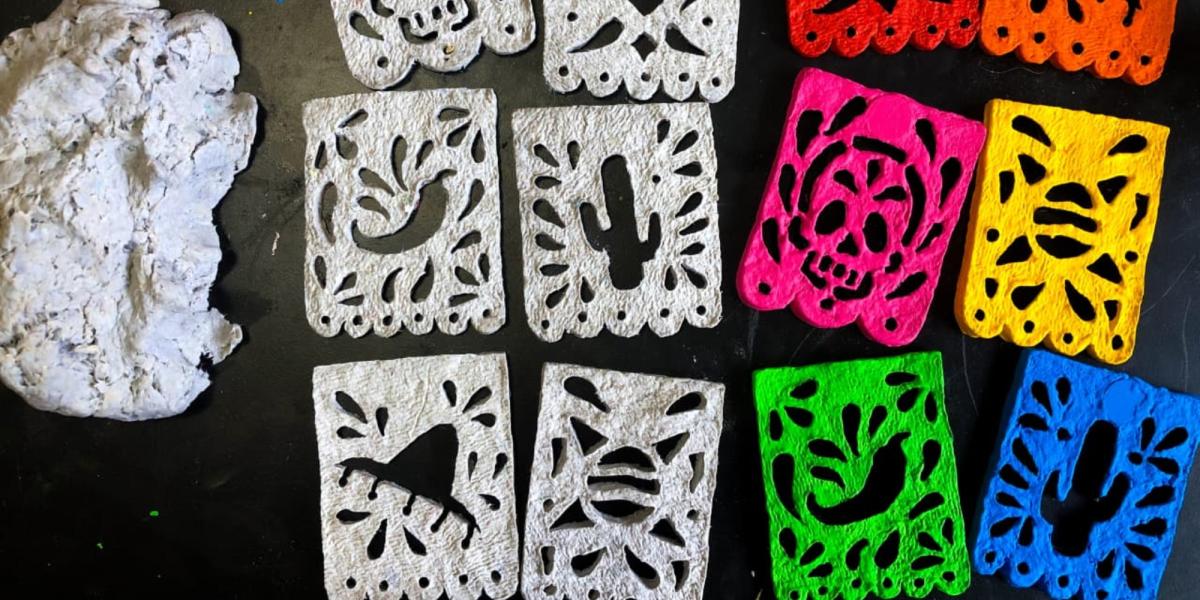
At the end of the school year, families throw away used notebooks and books to welcome new material, but to prevent these waste from ending up in the trash, there is a artisanal process that gives them a new life and this is the cardboard.
Devany Gutiérrez, founder of Cartonería Mexicana, comments that they use this material to create decorative pieces made of paper and cardboard, which are perfect for this Day of the Dead season, since he has taken out skulls, dogs and confetti.
“I started 13 years ago. I started working in the carton shop thanks to my mother, who started taking cardboard workshops. I helped him make the pieces and at that time I was 15 or 16 years old. I studied and helped him, but he paid me,” he says.
In Mexico, the workforce of artisan workers is made up of 6.24 million people, of which 74.6% are men and 25.4% are womenaccording to Data México.
Crafts from a family business
Mexican Cartonería is popular on social networks, as it shows the process or the designs of your creations, But behind the process, Devany Gutiérrez comments that everything occurs in Cuautepec Barrio Alto, in the Gustavo A. Madero mayor’s office in Mexico City.
“The workshop is in the house, it is an adapted room,” he comments. In this sense, the business is made up of four family members, who divide the work when it comes to several orders or if it involves larger figures, such as a four-meter opossum, which took a month to make.
Likewise, the main materials they use are paper, cardboard and paste, which, according to Devany Gutierrez, to obtain the material, he asks his neighbors and acquaintances to donate the notebooks, books and even boxes of cereal—especially when the school year ends.
“We have come to buy sheets in the places where they sell paper and PET, but better I take advantage of the ends of the school year”.
High sales season and the Day of the Dead
Cardboard can be adapted to any season, but it is most requested during Day of the Dead celebrationsin which people seek to decorate their altars with a more artisanal and colorful touch.
In this context, Devany states that this is a good sales seasonsince they request orders for small dogs and skulls, because they are easy to transport, because they measure from nine to 22 centimeters, being small pieces.
In addition to the orders they have, they also sell their items in the Popular Art Museum store and in the Hilos en nogada store, located in Polanco, where they do not work on commission, but rather both stores They buy the figures.
They start placing orders in the middle of the year, to be able to deliver it in September, because at the end of the national holidays, they set up the Day of the Dead thing. “They are large orders, approximately 300 pieces.”
Bargaining and rain: The challenges of cartonería
Although materials do not usually represent a large expense, what is invested is mostly the time it takes to make them. Devany Gutiérrez argues that they make the molds with plasticine and then cover it with four layers of paper, followed by drying and finally, adding the details with paper or paint.
Therefore, the preparation time for a small piece like the nine-centimeter skull takes a week to prepare; while a 40 centimeter dog takes a montheven though there are four people who collaborate.
However, a challenge that delays the operation is the drying time, because it is outdoors and because of that, they depend on the weather. “We need good sun to help us speed up this process and make it continuous. This cardboard making process is similar to when we make piñatas.”
On the other hand, the second challenge is deal with haggling, in which they have had cases in which they are questioned about prices and if they sell wholesale, they could have a discount, but Devany Gutiérrez comments that whether it is one or 20 pieces, the process is the same.
“Making a piece is not the same as making them in series (considering that there is a discount), because in the end there is fatigue, wear on hands, sight and body. Therefore, with a discount, there is a loss of work.”