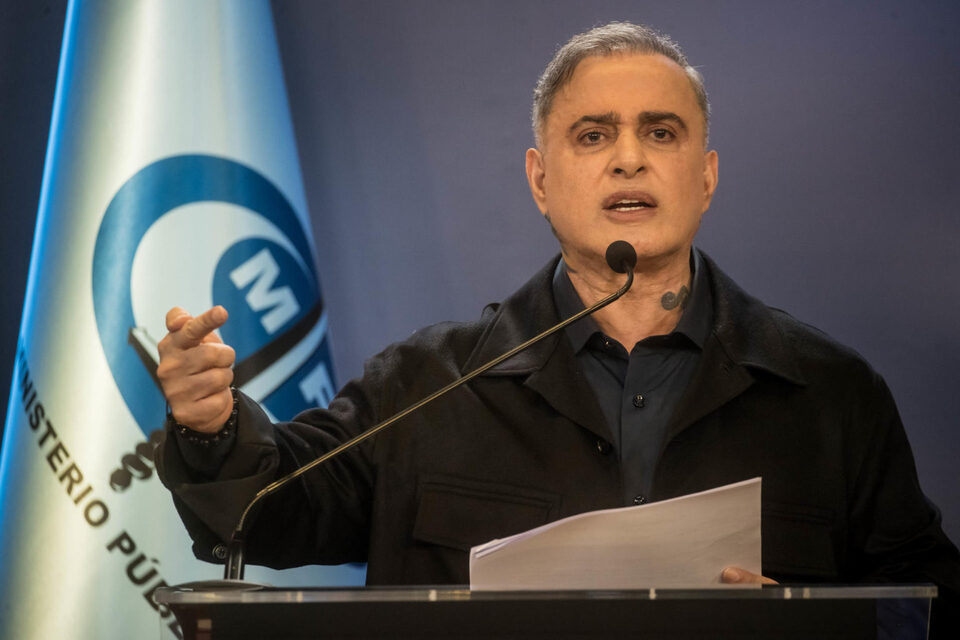
Tarek William Saab considers that the reconciliation promoted by the amnesty should equally benefit Nicolás Maduro and Cilia Flores
Attorney General Tarek William Saab defines the coming amnesty as the path to “real pacification” in Venezuela, which includes mass releases of political prisoners and leads to the United States’ gesture of releasing the deposed Nicolás Maduro.
Maduro was captured by US forces on January 3 during a military raid that included bombings of Caracas and other regions.
Delcy Rodríguez assumed power and a few days later began a first process of releasing political prisoners that preceded the announcement of a general amnesty. He also ordered the closure of El Helicoide, the feared prison that NGOs denounce as a torture center.
“No one expected this action from Dr. Delcy Rodríguez as acting president,” prosecutor Saab celebrates in an interview with AFP in his office in Caracas.
The second debate to approve an amnesty law was scheduled for Thursday in the National Assembly, but was postponed. The law first goes through a public consultation process in which jurists, opposition leaders and even relatives of political prisoners participated.
*Also read: AN defers discussion of the amnesty law due to discrepancies over beneficiaries
Saab also participated along with other members of the judiciary.
“It is a discussion where all sectors of Venezuelan society are participating in terms of this real pacification that gives us a new historical moment,” he says. “We deserve peace, for everything to be debated through dialogue.”
“Recidivism”
Behind the attorney general’s chair in his office is a presidential portrait of Maduro; Other photographs show him together with Hugo Chávez, Fidel Castro and the deposed ruler himself, accused of drug trafficking in New York.
The prosecutor has been accused of serving Chavismo.
It does not delve into post-approval scenarios of the law: who benefits, if it applies to opposition leaders such as María Corina Machado, Juan Guaidó or Edmundo González, or if the State will assume part of the responsibility.
He does defend that it covers both opponents and Chavistas.
Drafts of the amnesty project also cover the different crises throughout the 27 years of Chavista governments.
From the coup d’état against Chávez in 2002 and the oil strike that same year, to the protests against the government throughout all those years, which Saab describes as “embryos of civil war.”
“Attempted assassinations, invasions, maritime raids,” he lists. “Violent demonstrations with dozens, hundreds of dead, injured.”
He defends a “state policy of forgiveness” in the years of Chavismo, although the opposition and human rights activists denounce years of abuses, about which Saab avoids speaking out within the framework of the new law.
“There have been massive releases,” although he insists that the amnesty will not cover everyone. «Recidivism in punishable acts cannot continue to occur. If they are giving you grace measures to participate in political life in a healthy way, that must be respected,” he points out.
More than 400 people have been released on parole since January 8, when Rodríguez announced the release process, according to the NGO Foro Penal.
«Humanitarian gesture»
Saab has condemned from day one the capture of Maduro and his wife, Cilia Flores. He describes it as illegal and in violation of international law.
Both pleaded not guilty and are scheduled for a new hearing in March.
Saab considers that the reconciliation promoted by the amnesty should equally benefit Maduro and Flores.
“Within what this humanitarian, historic, unprecedented gesture of the amnesty law that covers all factors of the State implies, I would say, including as a message” that “when the hearing takes place in March, the freedom of Nicolás Maduro and Cilia Flores will be decreed.”
“We are reaching out,” says the prosecutor, and from this gesture “the international sanctions” against the country will be lifted.
*Journalism in Venezuela is carried out in a hostile environment for the press with dozens of legal instruments in place to punish the word, especially the laws “against hate”, “against fascism” and “against the blockade.” This content was written taking into consideration the threats and limits that, consequently, have been imposed on the dissemination of information from within the country.
Post Views: 83