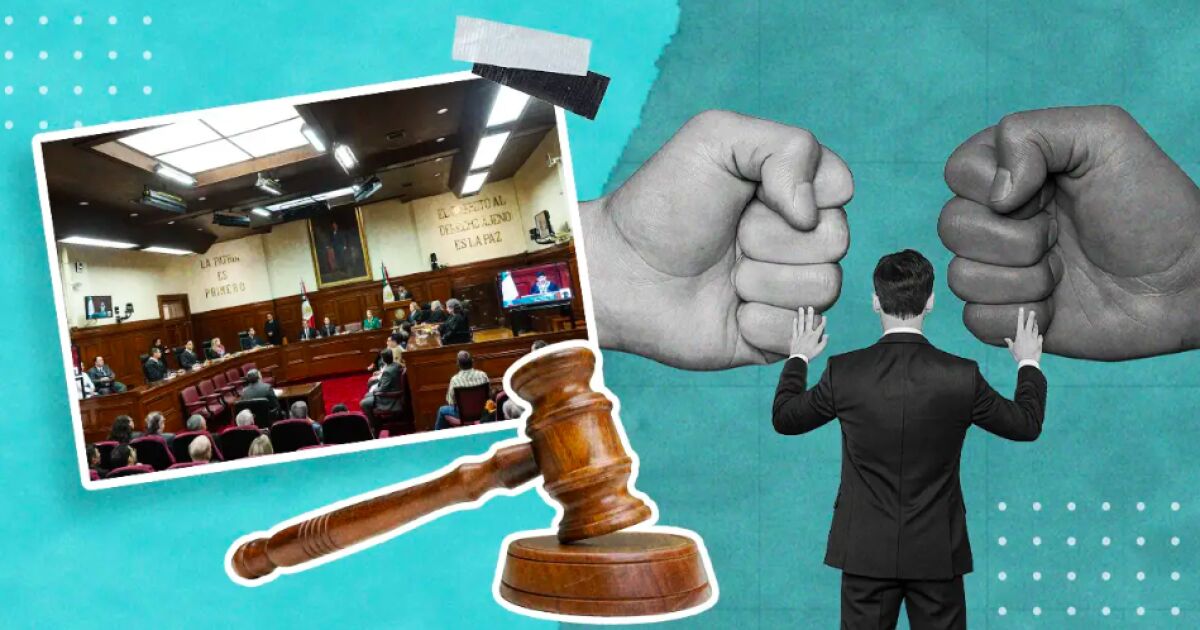
The director of the Law degree at Tec de Monterrey, Fabiola Martínez, comments that the issue of conciliation and mediation has gained relevance in the face of the Reform of the Judiciary due to the “suspicions” of how conflicts will be resolved in the judicial system due to the entry of new judges.
“The purpose is for a third party to resolve the conflict without it reaching a State agency and that this can speed up the process, it is resolved in less time.”
Fabiola Martínez, academic at Tec de Monterrey.
The conciliation
Former judges and magistrates who have finished their duties have already begun to specialize in judicial conciliation and mediation, which are alternative methods to resolve conflicts or legal controversies, but without going to court.
“They are public and well-known facts, it is documented that many courses and conferences are already being prepared to become arbitrators, to generate arbitration, private justice, to be mediators in which the laws allow us to no longer go to court,” mentions the presiding judge of the Federal Court of Administrative Justice, Zulema Mosri.
The former candidate for minister of the Supreme Court of Justice of the Nation (SCJN) regrets that citizens are being encouraged to no longer go to public jurisdictional institutions and instead turn to private justice.
However, he maintains that it is also “good” because it will allow the courts to be depressurized, since conflicts will be resolved more quickly, in addition to being cheaper in terms of time and money.
“You don’t get into the dynamic of, let’s say, carrying out the procedures, the hassle involved in seeing if the person goes, you have to give money to the actuary to go and notify. You eliminate many issues and it is cheaper even in terms of time and money,” he says.
One of the former judges who is already preparing to be a conciliator and mediator is Martha Magaña, who during 2024 It gained relevance by granting suspensions to stop the discussion of the Reform of the Judiciary.
“I think it is a very viable and very good option (conciliation and mediation) for people, because it prevents you from going to court with all that that implies: paying for a lawyer or going to an advisor for as long as this lasts,” says Magaña.
The former judge explains that conciliation is so that citizens do not reach a trial that may take time or even fall into the hands of an inexperienced judge.
“This is to avoid reaching the courts because we are seeing that people (the judges) do not have experience and everything that that implies. We are seeing endless videos with basic aspects that they do not handle, imagine everything that happens in writing and that we cannot see,” he points out.
Martha Magaña considers that cases in conciliation and mediation will increase given the panorama of inexperienced judgesand points out that in the United States alone 93% of matters go to mediation and are resolved there.
“There will be an impressive watershed in how before people went to trial and how they will now resolve it in mediation. It will be important.”
Martha Magaña, former judge of the fifth district in Morelos.
He mentions that the advantage that former judges have in specializing in these alternative methods is that they have resolved matters for years and know the bases of the Law, which gives them, he assures, “an extra” so that citizens have the confidence to approach them.
Meanwhile, the former magistrate Julia García, who also specializes in the use of these alternative mechanisms, mentions that in scenarios where the new judges are “improvised and inexperienced” profiles, conciliation and mediation will be a viable alternative for citizens.
“Let people know that there are these viable options, let them investigate so that they do not have to reach, unfortunately, these scenarios, where justice is not taken seriously, where it is trivialized and where justice is administered by people who do not have, to begin with, a commitment, because even if they did not know, they would have to start studying,” he comments.
García, who worked for more than 30 years in jurisdictional functions, took up this specialization in conciliation and mediation because he considers it a different way to continue contributing to justice, but now through more flexible mechanisms.
However, there is not only mediation and conciliation as alternative mechanisms, there is also “Compliance”, which is self-regulation and self-control to verify that companies comply with all regulations so as not to go to trial.
In this case there is the former judge Roberto Posán Tornerowho also left the Judiciary with the constitutional reform, created an office that focuses on corporate criminal law, where he works with “Criminal Compliance.”
Posán Tornero, who handled cases such as that of Armando Escárcega “El Patrón”, identified as the alleged mastermind of the attack against journalist Ciro Gómez Leyva, explains that they provide advice to companies to modify their internal statutes in order to prevent and detect possible crimes, such as fraud, corruption, and thus avoid reaching trials.
“Compliance is a corporate shield so that your company does not commit crimes. The intention is that no matter reaches the Judiciary, because it is already weak and has partisan interests (…) It is like a kind of audit that you do to the company and you see what are the areas in which crimes can be incurred,” he mentions.