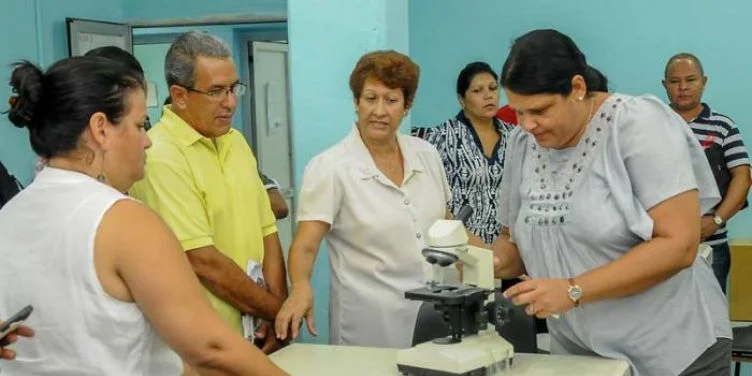
This is Mario Pérez Márquez, who was director of the School of Art Instructors (EIA) in Havana for 13 years.
MIAMI, United States. – Mario Pérez Márquez, who for years was director of the “Eduardo García Delgado” School of Art Instructors (EIA), in Havana, currently resides in Las Vegas (Nevada) after having entered the United States through the southern border in 2022 and obtaining permanent residence under the protection of the Cuban Adjustment Lawaccording to complaints from former students and activists collected by Martí News.
The case has generated controversy due to the public profile of the former official within the cultural and ideological framework of the Cuban State. According to a note published on the official portal CubartePérez Márquez “directed the School of Art Instructors in Havana for 13 years,” a “mission” that was entrusted to him by Fidel Castro himself, according to the same medium.
Meanwhile, in an interview published by Rebel Radio In June 2008, Pérez Márquez himself, then presented as director of the EIA “Eduardo García Delgado”, defended the instructor program created by Castro: “I think that comrade Fidel’s idea of including the figure of the art instructor in the national education system has been excellent,” he said on that occasion.
In another text from 2011, in this case from the newspaper Rebel Youththe official was described as a figure valued by “the student body.” Four years later, the official organ of the Communist Party of Cuba, Granma, reported that the “teacher and methodologist” Mario Pérez Márquez had received the “Honorary Member Distinction” of the José Martí Brigade of Art Instructors.
However, the official narrative contrasts with testimonies from former students spread on social networks and cited by Martí News. The independent journalist Adelth Bonne Gamboa, who said he had studied under his direction, described him as a “despot and tyrant” and assured: “He was a fervent anti-imperialist, critical of the United States in everything. Faithful to Fidel Castro, who he said was his friend and look where he is today. He quickly forgot the things he wanted to teach us.”
In the same testimony, Bonne Gamboa, who until a few days ago he was a collaborator of CubaNetrecounted collective punishments that he attributed to the school’s internal discipline: “I never forget when he forced us to sing the Hymn at less than 3 degrees, knowing that we had a singing test. We murmur the Hymn from the cold, and as punishment he left us without a pass for the weekend.”
Martí News It also indicates that “dozens of comments” from former students supported similar experiences and that some even remembered that “a painting of Fidel Castro” hung in the official’s office. The media also noted that Pérez Márquez would have deleted posts on social networks that linked him to Castroism or showed political symbols.
The former official follows more than a dozen former soldiers, prosecutors, repressors, leaders of the Union of Young Communists (UJC) and the Communist Party of Cuba (PCC) who have entered the United States and have received or requested permanent residence in the North American country.
Among them, stand out Jorge Luis Vega García (Veguita)former lieutenant colonel of the Ministry of the Interior and former head of the Agüica and Canaleta prisons, whom several former political prisoners accuse of systematic torture and abuse; and former judge Melody González Pedraza, beneficiary of the parole humanitarian, deported to the island after more than a year in prison in the United States due to his role in the conviction of four young people due to pressure from State Security in Villa Clara.