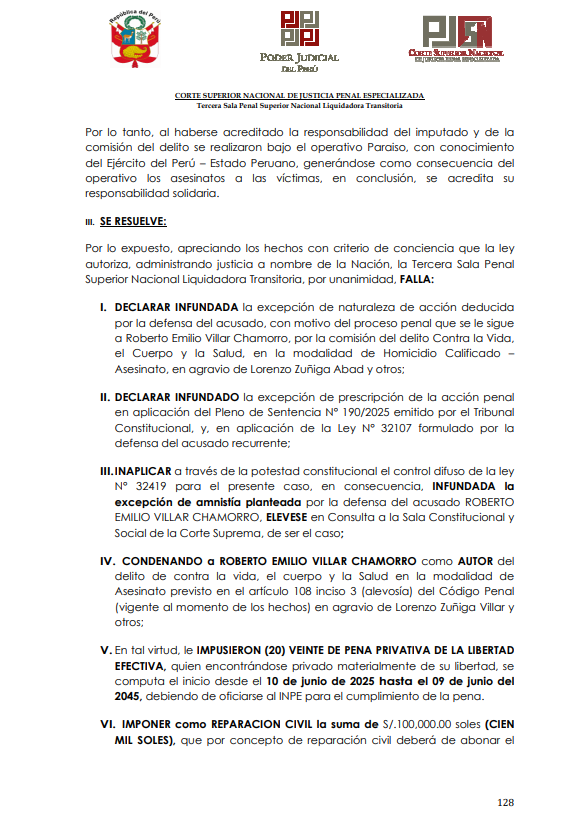
Despite the laws passed by the Congress that seek to generate impunity, the Judiciary imposed a sentence of 20 years of effective prison against the retired Army officer, Roberto Villar Chamorro, for the crime of malicious murder that he committed in 1994 to the detriment of eight people in Huánuco. The convicted man, years later, was also a member of the Chavín de Huántar group.
The crimes against these civilians occurred on March 28 and 31, 1994, during the internal armed conflict, in the Cayumba Chico hamlet, in the province of Leoncio Prado, according to what the Second Superior Prosecutor’s Office Specialized in Human Rights and Against Terrorism of Huánuco was able to verify. At that time, Roberto Villar Chamorro He served as an Army captain and head of the military operation ‘Paraíso’.
YOU CAN SEE: Elections 2026: six parties propose changing the name of the MIMP and its merger with other ministries
According to the investigation, the convicted He commanded a patrol of the counterinsurgency base No. 313 of Tingo Maríawith which they murdered eight people with shots and knives, including two minors aged 6 and 14 and an elderly adult.
During the trial, the senior prosecutor Rosario Quico Palomino confirmed the guilt of the convicted person taking into account the testimonies collected and the expertise found that They indicated that the retired Army officer, Roberto Villar Chamorro, ordered the arrest arbitrary treatment of the victims and their subsequent execution.
Due to this situation, the former member of the Chavín de Huántar group, whose age is 60 years old, will have to pay civil reparation of 100,000 soles in favor of the relatives of the victims who were murdered more than 30 years ago.
A long process
This case began in November 1994 when the Prosecutor’s Office filed a complaint against the Army officer, Roberto Villar Chamorro, for the crime against life, body and health (murder) to the detriment of eight people. He did so before the Leoncio Prado Criminal Court, in Tingo María.
However, there was no progress until May 2006 when the process was declared complex. One year later, in July 2007, It was decided to understand the Peruvian State as a civilly responsible third party. Later, the file was submitted to the National Criminal Chamber. Thus, in February 2009, the Prosecutor’s Office accused Villar Chamorro of the crime of murder to the detriment of eight people, requesting a sentence of 20 years in effective prison. That same year it went to oral trial and in November 2011 the soldier was declared a contumacious prisoner.
The case was only activated in June 2025 when Roberto Villar Chamorro was arrested in Chorrillos and transferred to a prison. A month later, the process was changed from complex to simple and Preventive detention was set for 9 months until March 10, 2026. However, the sentence of the Third Criminal Chamber came out before the scheduled date.
Rospigliosi attack
As mentioned at the beginning, this condemnation occurs in the midst of a constant attack by the Congressespecially Fuerza Popular, against the Judiciary. The acting president of Parliament, Fernando Rospigliosi, It aims for judges to comply with the laws that generate impunity by allowing the statute of limitations for crimes against humanity in which military personnel prosecuted and sentenced for human rights violations are involved.
Last Tuesday, Rospigliosi questioned the sentence against Villar Chamorro. “Congress dictates the laws, the Executive promulgates them and the Judiciary has the obligation to apply them. The Judiciary does not legislate. What we are seeing is a flagrant disregard for the law, the Constitution and the principle of separation of powers,” said the candidate for senator.
But that’s not all. Days before, Rospigliosi entered a virtual hearing with the clear objective ofwanting to intimidate judges who prosecute Army soldiersaccused of murdering more than 30 farmers from the Ayacucho community of Cayara in 1988.
“Last week, a panel of prevaricating judges sentenced an Army colonel to 20 years in prison for fighting terrorism in 1994, others for the same in 1988, and did not apply law 32107 to the sailors of El Frontón. We must sweep away the judicial system!” stated the former anti-Fujimorista.
Response from the president of the PJ
This position was rejected by the president of the Judiciary, Janet Tello, who sent a firm message to theCongress of the Republicin the midst of the questions directed at the judges who decided to disapply laws approved by theParliamentthrough diffuse control, protected by theConstitution.
During the opening ceremony of the 2026 Judicial Year, Tello Gilardi affirmed that the institution he directs does not act in favor of political interests and ruled out that the judges’ decision to apply diffuse control, constitute malfeasance, crime or any political interference, because they are protected by the law and the Magna Carta.
“In safeguarding judicial independence, I must also face the unfair qualifiers that the judges who did not apply the laws that they considered unconstitutional continue to receive from the political power; that is, who fulfilled the duty of carrying out the diffuse control imposed on them by the Political Constitution. (…) “The Judiciary is not an appendix of any political, economic or factual power,” he responded.