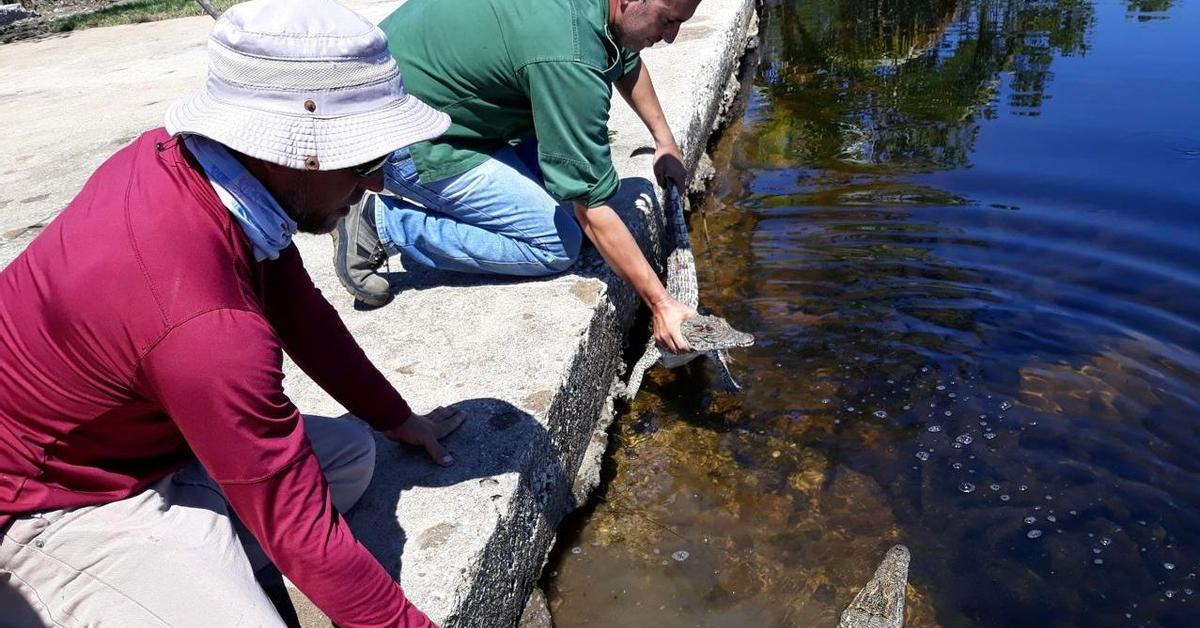
Havana/Like so many other sectors in crisis on the island, the loss of biodiversity has proven to be another sensitive issue that attracts, for regime’s satisfaction, international aids. If the species are also endemic, it is likely that the resources and funds allocated are greater. This is the case of Cuban crocodile, whose protection has promoted a fundraising of the United Nations Development Program (UNDP).
The campaign, called See you in a while, crocodile –A word game with the expression in English See you late, aligator– It will begin next October and is aimed at guaranteeing “the survival of the Cuban crocodile”, which is “threatened by human action on the ecosystem, climate change and other factors.”
According to UNDP’s official page, “donations will make it possible to acquire and place satellite labels to monitor their displacements, as well as develop educational activities that reinforce their protection in local communities.”
The program details that the labels will allow studying their movement patterns, habitat use and activity areas, which will facilitate the planning of actions to preserve the ecosystem. They will also help identify adequate sites to release crosides raised in captivity, which would increase their probabilities of survival.
The initiative will also seek to strengthen collaboration with local communities, promoting educational activities that integrate the residents of the Ciénaga de Zapata in the protection of the ecosystem. “With your support, we can closely follow Cuban crocodiles in their natural habitat and better understand how to protect them,” the campaign finishes.
The initiative will also seek to strengthen collaboration with local communities, promoting educational activities
The project with the leadership of two specialists: the biologist Etiam Pérez and veterinarian Gustavo Sosa, who, according to UNDP, accumulate years of experience working with crocodiles. Specialists will be in charge of placing satellite labels and coordinating research, education and conservation actions that can be carried out thanks to the contributions of donors.
With luck, the funds will help improve the quality of life of the species and to extend the project, the result of an alliance between the group of specialists in Cocodrilos de Cuba (GECC), the company for the conservation of the Ciénaga de Zapata, the Antonio Núñez Jiménez Foundation for nature and man (FANJ), and the representation of UNDP in Cuba. The activities also have the support of the Global Biofin initiative, coordinated in the country by the Ministry of Science, Technology and Environment.
Cuban crocodiles are not only a unique species of the island, but their ecosystem, near the beaches of the Matancera southern coast and several tourist enclaves – the hatchery itself is one of them – has exposed them to constant human contact. Under more or less precarious conditions, crocodiles are raised in Zapata Ciénaga, where national and international tourists can visit them, and can even prove their meat – a luxury that foreigners can be paid mostly.
But Cuban crocodile is not the only endemic species at risk that the State receives funds and aid. In the east of the country, the snails known as polymites are at risk due to climate change, the loss of habitat and, above all, to the illegal traffic of their shells, coveted by their natural beauty and their colors. A Conservation study Between the University of Oriente and the British University of Nottingham tries to prevent its disappearance.
According to Cubadebatewhich quotes a BBC report, sales of polymites shells from the United Kingdom have been found on the Internet for more than $ 200, despite the fact that its extraction from Cuba without permission is illegal, according to the Convention on International Trade of Threatened Species (CITES), he says.
Among the most threatened, add the official newspaper, is the variety Sulphurosaof green tones with blue, orange and yellow bands. “Its beauty attracts people who collect and trade with shells. The same thing that makes them interesting as scientists, is what is also putting them in danger,” explains Angus Davison, a geneticist at the University of Nottingham, involved in a conservation project.
Of the approximately 36,700 species cataloged in Cuba, 35% are in danger of extinction
The collaboration, also led by the conservation biologist Bernardo Reyes-Tur, seeks to understand the genetic evolution of these species and preserve their diversity. While in Nottingham genetic research develops, in Cuba we work “in a hot weather to try to raise snails in captivity”, a process still in an experimental phase, but that specialists believe that it is on the right track.
Cuba faces one Biodiversity loss crisis Alarming: Of the approximately 36,700 cataloged species, 35% are in danger of extinction, and it is estimated that up to 75% of mammals could disappear. Plants also suffer severely: 580 plant species are critical, along with 16 amphibian species. In addition, 70% of amphibians, of which there are 71 species identified (94% endemic) on the island, are threatened
This deterioration is mainly due to illegal hunting, intensive agriculture, mining, deforestation and pollution, which has eroded natural habitats and drastically reduced local fauna. However, the attention of the State also plays an essential part in a context of economic crisis and in which tourist enjoyment on the protection of natural reserves is prioritized.
The official data themselves confirm the disability and lack of state resources to protect endangered species. In the Ciénaga de Zapata, they have come to admit, the bodies of rangers are insufficient
In 2020, 14ymedio published a article about social indifference to the silent environmental crisis that Cuba lives. Then this newspaper denounced the depredation of the polymites for use in crafts and illegal trafficking, despite being protected.