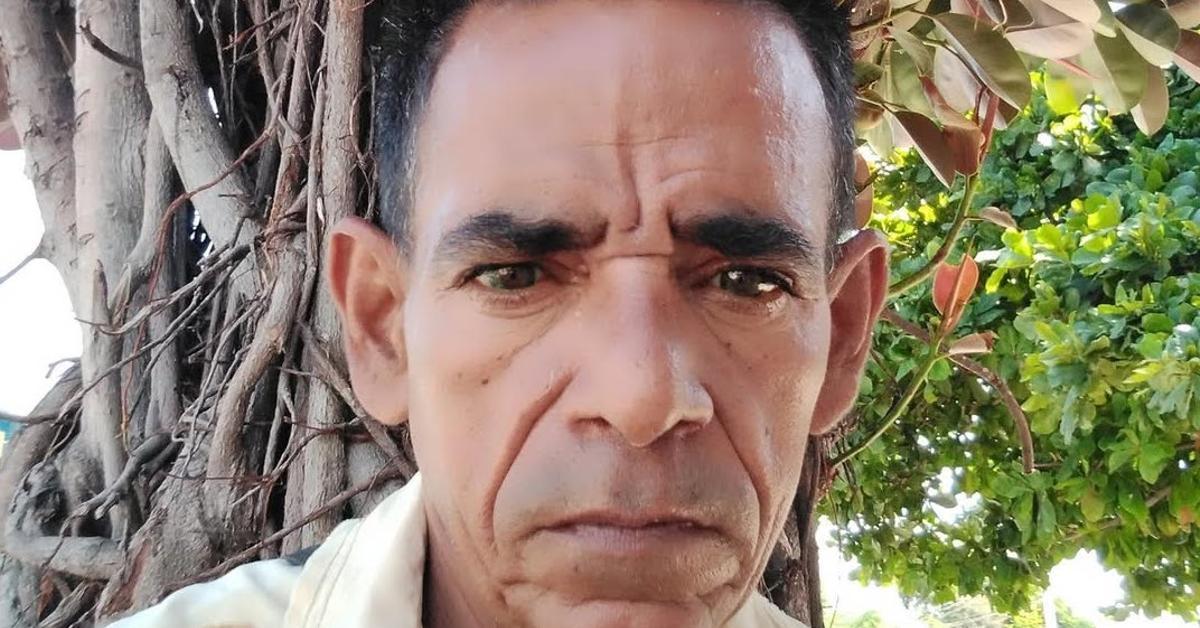
Madrid/Four years and six months in prison received Julio César Duke of Estrarre Ferrer, 56, for the crimes of “disobedience” and “attack.” The case announced this Tuesday the Cuban Observatory of Human Rights (OCDH), which denounces that “the entire judicial process has been full of human rights violations.”
This is the father of the also political prison Dairon Duke of Estrada Aguilera, also sentenced to four and a half years in prison for the crimes of “propagation of epidemics” and “attack” after participating in the demonstrations of July 11, 2021. On September 2, OCDH himself launched A call in your social networks for the “serious situation” of both on the island.
Dairon, they reported, “it is going through an alarming situation: it has been isolated in prison in symptoms of tuberculosis and brutally beaten by the penitentiary police”, and his father “has started a protest strike from prison to claim a decent treatment for his son.”
“The sentence is a farce, although at the same time reveals the illegal and disproportionate action of the political police officer”
The organization, which had access to judgment Against Julio César – filmed on August 18 – shows that this “is a farce, although at the same time reveals the illegal and disproportionate action of the political police officer who attacked Duke of Estrada Ferrer.” Thus, it stands out from the story of the “proven facts” that the arrest of man, on September 5 of last year, occurred for filming an agglomeration to buy liquefied gas in a Santiago neighborhood.
These “actions”, collect the legal document, “were warned by the operational officer of the counterintelligence Mario Raciel Soulary Garcés, who in compliance with his labor powers identified himself before this as a military, required it to stop recording and to keep the cell phone, before which the prosecuted, although he did not keep the phone, changed the position in which he had it.”
When asking for the officer to give him the identity card, Duke of Estrada refused, “while began to utter obscene words and generate an alteration of the order to avoid the delivery of the requested card.” The sentence calls this “mismatch”, for which the agent forced him to accompany him “to the industrial market nestled in the area and before the refusal of this to move, he took it through the forearm area and transferred it to the interior of the referred market.”
The OCDH denies that it is true what the sentence indicates, that is, that Duke of Estrad would end up “a strong blow to the face with the use of her hands” to the state security agent, at which time it is between them “a struggle in the middle of which the accused projected his cell phone against the ground, an action that led to the military to apply a combative technique of neutralization in the middle of which the prosecuted The one that the officer brought both arms to the back and in which the defendant began to perform sudden movements with his arms to the sides to prevent him from neutralizing him, thus managing to let go of the grip that the officer had made. ”
For the organization, based in Madrid, it is a “manipulation” in the narration that presents the “repressive combatant” as a victim, “when it really was this one who violently grabbed Duke of Estrada and snatched the phone.”
“This constitutes arbitrary detention and disproportionate use of force”
It also questions the attitude of agent Soulary Garcés, who identifies “as a military.” According to international standards, the Observatory says, “military forces should not be used for public security tasks that correspond to the Civil Police, unless there are exceptional and clearly defined circumstances, such as national security, and always under strict civil control.” And then: “Filming a row to buy liquefied gas does not qualify as a threat to national security.”
Having required it “to stop recording and to keep the cell phone,” the OCDH continues, “directly restricts freedom of expression and information, a fundamental right enshrined in article 19 of the International Covenant on Civil and Political Rights, of which Cuba is a signatory.” The officer, also indicates, “does not present a valid legal basis to stop the citizen and demand their identification.”
Nor an alleged negative of Duke of Estrada to deliver his card or utter “obscene words” would justify the use of force, says the NGO. “This constitutes arbitrary detention and disproportionate use of force.”
In summary, the OCDH proves that the action of the State Security Agent “does not conform to international human rights standards”, and recalls that “former sentences of the little guarantee Supreme Court have collected in appeal that proceeds to acquit the accused of crimes against administration and jurisdiction when: the reaction of the accused is a direct consequence of the evil, abusive, violent, violent and/or illegal legality and the greatest possible success the functions of the administration it represents ”.