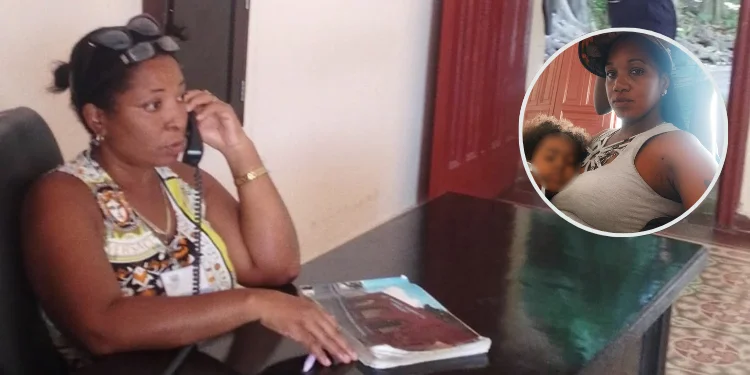
Yosleydis Rodríguez is denouncing the lack of electricity, the state abandonment and the indifference of the authorities before their family situation.
Miami, United States. – The Cuban Yosleydis Rodríguez Rodríguez is starring in “at this time” (around 1:30 in the afternoon) a protest at the headquarters of the Provincial Government of Camagüey to demand living conditions of life for their children, according to He reported on Facebook Cuban journalist José Luis Tan Estrada, who also transcribed the textual statements offered by women.
“Here I am, ready for everything, in the provincial government,” said the woman, who said she had a young son and another with Down syndrome who suffered a crisis the previous night due to prolonged darkness caused by an electricity cut.
“All of security [del Estado]: Here I am, and I am not going to move from here until they give me an answer. It is a disrespect. Since yesterday at 3:00 in the afternoon there is no current in the Güernica, ”Rodríguez denounced.
“I know there are situations with the current, but put a schedule, put a schedule!, To be able to do things. Without water, without current, the food spoiling … it is already good for lack of respect,” he claimed.
He also questioned the passivity of the government officials while she hoped to be treated: “For my children I do anything, and from here I do not move until they do not care, because the girls [las funcionarias] From the government they are lunch. I have arrived here 45 minutes. Of course, food with current. What[s] Does the people matter? ”
“I am tired, stubborn (…). It is the counterrevolution what they are doing, and it is internal. They are gradually killing us. Put a schedule! It is already good already!” He demanded.
The woman concluded her complaint ensuring that she does not fear her action: “You know, I am in the government. I do not hide, I give my face.”
Cuban mothers protests: an increasing phenomenon
Yosleydis Rodríguez Rodríguez’s protest, still in progress, adds to a series of demonstrations headed by Cuban mothers in recent years, who have become visible protagonists of resistance to the regime.
On July 20, several mothers in the Havana Municipality of Rule They closed a street to report that they had been without drinking water for more than four months. “We closed the street because we have no water,” said one of the protesters, while another added: “Four months without water, and it is always a drool and disrespect.” According to the newspaper 14ymediothe authorities sent a tank truck after the protest began.
Cuban mothers have historically been protagonists in social struggles against state repression. An emblematic example is that of the Blanco ladies, a collective founded in 2003 after black spring. Initially led by Laura Pollán and then by Berta Soler, these women demanded the release of their relatives political prisoners and faced arbitrary arrests, harassment and police violence.
Another outstanding figure is Aymara Nieto, APACU activist and mother of three girls, sentenced to five years and four months in prison. His case has been denounced by the UN arbitrary working group.
Mothers of protesters detained after the social outbreak of July 11, 2021 have also raised their voice. Marta Perdomo, Barbara Farrat and Migdalia Gutiérrez have demanded the freedom of their children, and have been harassed by state security.
In 2023, Habanera Amelia Calzadilla became a symbol of resistance after a public complaint that went viral in networks. “My message for any other father or mother is that we cannot be indolent seeing how our children are suffering because of others,” he said in An interview with Cubanet. The subsequent repression forced his family into exile.
Social networks have also served as collective articulation platforms. Campaigns like #Milkparalosniñoscubanosarising in Facebook groups, they reflect the despair of mothers who cannot feed their children. “My four -year -old boy was 1:00 am and was crying for milk,” a user wrote.
Some mothers have brought their claims directly to the doors of power. Last April, a group of women protested in front of the residence of Miguel Díaz-Canel. “We are not doing anything wrong, just claiming our rights,” said one of them, Nidia Noriega Rodríguez.
In October 2022, another mother planted himself in a street in Havana Vieja with her sick son. “I’m not going to shout homeland and life so that they don’t say later. Despair led me to this. I am put,” he said while I was repressed by the police.
(Development news)