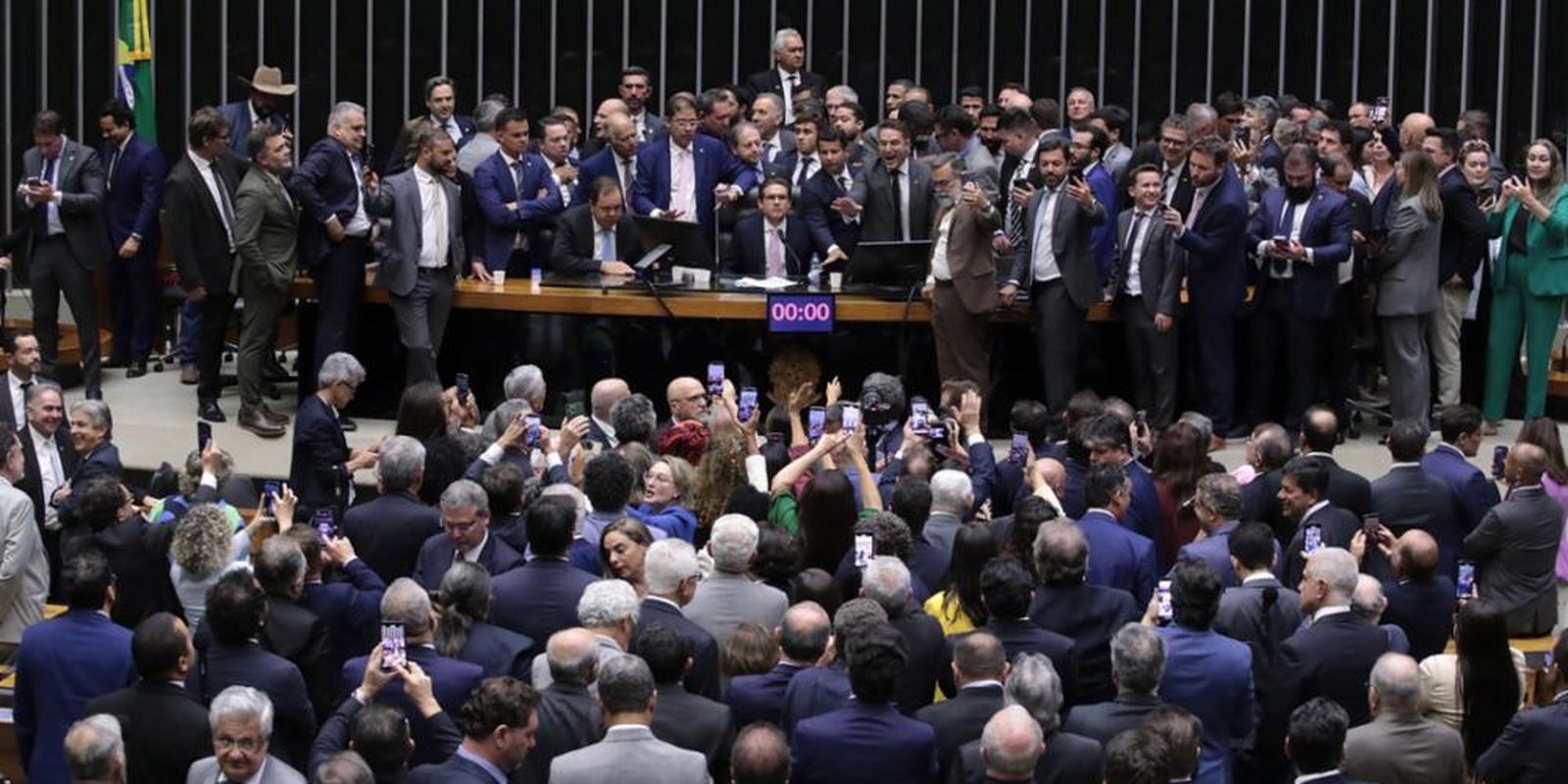
THE OCCUPATION OF DIRECTORS From the House and Senate for the opposition this week it constitutes a breach of parliamentary decorum and suggests the practice of the crime of prevarication, which is when a public servant delays, or fails to practice, improperly, acts that are obligations of his position. The evaluation is from jurists consulted by Brazil agency.
For the Professor of Constitutional Law Henderson Fürst, the riot extrapolated the limits of freedom of expression and parliamentary action, In addition to being possible to frame this action in the crime of prevarication, according to article 319 of the Penal Code.
“This was not a legitimate act of acting for a parliamentarian in the debate of democratic ideas for the country. Even one can consider a prevarication. The crime of prevarication is its own civil servant crime. Parliamentarians appear as civil servants and they delay conducting the exercise of their obligations for particular interest or third parties,” he said.
Article 5 of the Code of Ethics of the House of Representativesin item 1, it states that it is against decorum “disturbing the order of sessions of the House of Representatives or commission meetings”.
This week, deputies and opposition senators stayed overnight in the plenary of the House and Senate To maintain the occupation of the directors of the houses, making it impossible to resume legislative work. They protested against the house arrest of former President Jair Bolsonaro and asked to be based on the general and unrestricted amnesty to the convicts of a coup attempt in the trial of the coup plot, as well as the impeachment of the Supreme Court Minister (STF) Alexandre de Moraes.
The expert in public and electoral law Flávio Henrique Costa Pereira stated that, even if the agenda is legitimate, prevent the legislative work escapes from the attributions of the parliamentary.
“It is not legitimate that you do this manifestation by preventing the free exercise of the activities of the Legislative Power. The way they did, they prevented the House sessions from occurring in the form and times that were determined,” explained the lawyer.
For Flávio Henrique, however, the action did not represent an attack on democracy, as the ruling leaders argue, who compared the riot of opposition to a new January 8, 2023, when coup protesters invaded and depredated public buildings in Brasilia. The expert evaluates that this time the agenda is legitimate in requesting legislative changes.
“This is part of the theory of brakes and counterweights. Legislative power can act so that any excesses of the judiciary can be contained. The most legitimate instrument is to change the legislation. Not a few times in Brazil this has happened,” added the jurist.
Asked by the press if the opposition would not have been exceeded, Senator Tereza Cristina (PP-MS), leader of the ruralist bench, replied that the action was necessary.
“Sometimes you need to be heard, draw attention to something. No one here is happy with this situation, but we had to make a gesture for us to be heard and this dialogue was resumed,” explained the parliamentarian after vacant the Senate’s board of directors.
Ethics Council
On Wednesday, the mayor, Deputy Hugo Motta (Republicans-PB), threatened with precautionary suspension of his mandate, for up to six months, “any conduct that is intended to prevent or hinder legislative activities.”
PT, PSB and PSOL parties entered this Thursday (7), with actions on the House Ethics Council against five PL deputies that prevented work this week.
Professor Henderson Fürst recalls that, ultimately, the conclusion that the action configured, or not, breakdown of decorum is exclusively to other deputies through the Ethics Council.
“Although the breakdown of decorum does not represent a crime, it is a parliamentary illicit. However, this illicit needs to be recognized by other pairs,” Fürst said, adding that this protest of the opposition could not be protected by parliamentary immunity.
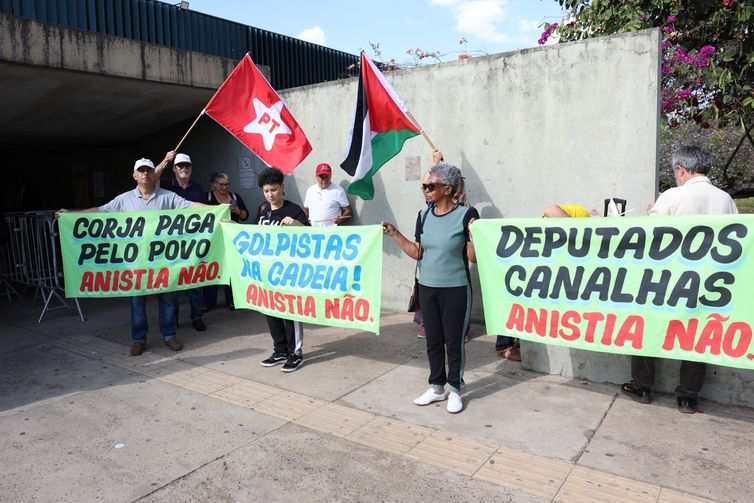
Protesters participated in this week of act against opposition parliamentarians in front of the Annex of the Chamber of Deputies. Photo: Valter Campanato/Agência Brasil
Sovereignty
Analysts also evaluated the actions of Deputy Eduardo Bolsonaro (PL-SP) who requests sanctions against public authorities responsible for the trial of the coup plot, as well as conditioning the end of the United States tariffs against Brazil the approval of the amnesty bill to convicts for attempted coup.
For the Professor of Constitutional Law Henderson Fürst, the parliamentary’s actions may be framed in article 359-I of the Penal Code, provided for in the Democracy Defense Law (14.197/2021).
The device says it is a crime “negotiating with foreign government or group, or its agents, in order to cause typical acts of war against the country or invade it.”
“We have this in literature on the subject. One of the typical acts of war is precisely the financial strangulation. We have embargoes against Palestine, Russia, Venezuela, and so on,” said Henderson.
The White House justified that the taxation of 50% against part of Brazilian imports was motivated by the trial of the coup plot STF.
For the expert in public and electoral law Flávio Henrique Costa Pereira, Eduardo Bolsonaro’s actions could not yet be framed as an attack on democracy from Law 14.197. On the other hand, it recognizes that it can be framed in the crime of obstruction of the judicial process, according to article 2 of Law 12.850/2013.
“He is trying to interfere with the judicial process. As a parliamentarian, he injured the Code of Ethics and would fit the process of canceling the mandate. His action is unconstitutional because the parliamentarian’s duty, in the first place, is to defend our Constitution. And when this requests an intervention of a third party he is submitting the sovereignty of our country to a foreign state,” he said.
Deputy Eduardo, claiming political persecution, moved to the United States, where he began defending sanctions against the STF ministers and has supported Trump’s tariff against the Brazilian economy.
The Workers Party (PT) in the House has requested the revocation of the PL parliamentary mandate due to its actions in the US in favor of tariff against Brazil and sanctions against authorities of the judiciary.