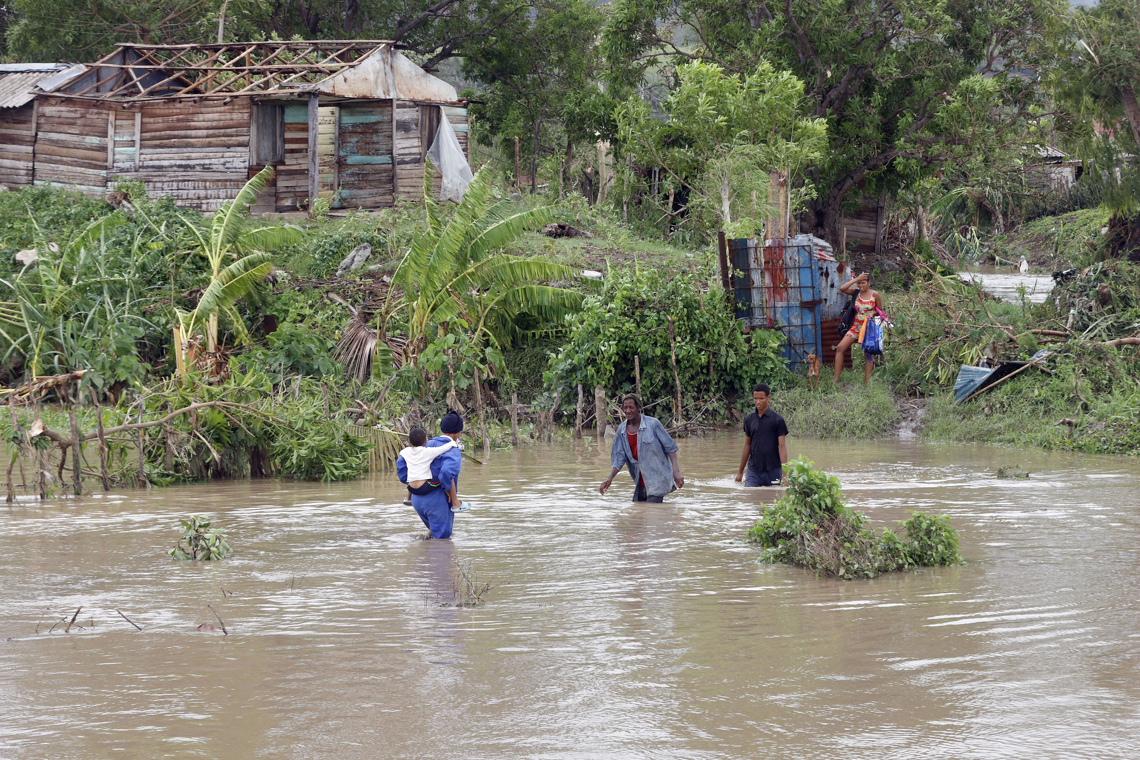
The powerful Hurricane Melissa It wreaked destruction this Wednesday as it passed through eastern Cuba, leaving millions of people without electricity and cut off from communication, flooded and isolated municipalities, collapsed homes, flooded crops and extensive material damage.
At the moment the Civil Defense has no record of fatalities or missing persons, although rescuers had not yet reached many highly affected rural and mountainous areas, mainly due to the intense rains, which have caused multiple rivers and dams to overflow, sudden floods and landslides.
According to the Institute of Meteorology (Insmet), in just 15 hours Melissa left up to 400 millimeters of water (or liters per square meter) in six locations, between 200 and 300 millimeters in 12 locations and more than 100 millimeters in 72 locations.
President Miguel Díaz-Canel spoke of “extensive damage” in a “very complex early morning,” but the authorities had not yet released a preliminary assessment of damage from Melissa, the first hurricane to make landfall on the island this year.
Díaz-Canel assured before the National Defense Council – the highest body for disaster management – that “there is no doubt that the most complicated thing is the floods caused by the rain” and that the country has not yet lowered the alarm level because the rainfall continued in some points.
In Granma, for example, “all the rivers have gone out of their banks,” said the first secretary of the Communist Party of Cuba (PCC) in this province, Yudelkis Ortiz, 50 people have already had to be rescued and other operations are underway.
In the Holguín town of Cueto, around thirty homes remained under water. Among the municipalities with flooded areas are some of the largest cities in the eastern third, such as Santiago de Cuba, Bayamo, Baracoa and Holguín, and dozens of others of smaller size.
Mainly, given the forecast of intense rains, some 735 thousand people were evacuated or protected in the six provinces in cyclone alarm (Granma, Santiago de Cuba, Guantánamo, Holguín, Las Tunas and Camagüey). This figure represents more than 7.5% of the national population and almost 18% of the inhabitants of those provinces.
Infrastructure and crops
The Minister of Energy and Mines, Vicente de la O Levy, explained that the two thermoelectric plants in the region did not suffer damage and that they could be reconnected to the National Electric System (SEN) when the multiple distribution lines are fixed due to the fall of trees and electric poles, something that will take a few days.
This situation must be added to the chronic generation problems derived from the energy crisis that the country is suffering, which in the east – where some 3.5 million people reside – causes blackouts of 20 hours a day in large regions.
There are also other public infrastructures affected by Melissa, such as hospitals, educational centers of all levels and roads.
Damage to telecommunications is high, mainly due to the breakage of the optical fiber. Thus, 75% of mobile lines in the eastern region currently do not have service, according to the Ministry of Telecommunications.
According to the state company Etecsa, which operates under a monopoly regime, 92% of the radio bases (telecommunication antennas) in Guantánamo have been damaged, along with 88% in Granma, 86% in Santiago de Cuba, 78% in Holguín and 59% in Las Tunas.
The field has also suffered under Melissa. Among the items with the greatest losses are coffee, bananas, corn and some vegetables, an area with important consequences in a country with food security problems and shortages of basic products due to the serious crisis it is suffering.
Melissa made landfall in Cuba at 3:10 local time (7:10 GMT) as a category 3 hurricane (out of 5) on the Saffir-Simpson scale in the Santiago municipality of Guamá and left seven hours later in Banes, Holguín, as a category 2, weakened by the collision with the mountains of the region.
The hurricane had just devastated Jamaica as one of the largest cyclones recorded in the Atlantic and hours after leaving Cuba, heading northeast towards the Bahamas, it was downgraded to category 1.