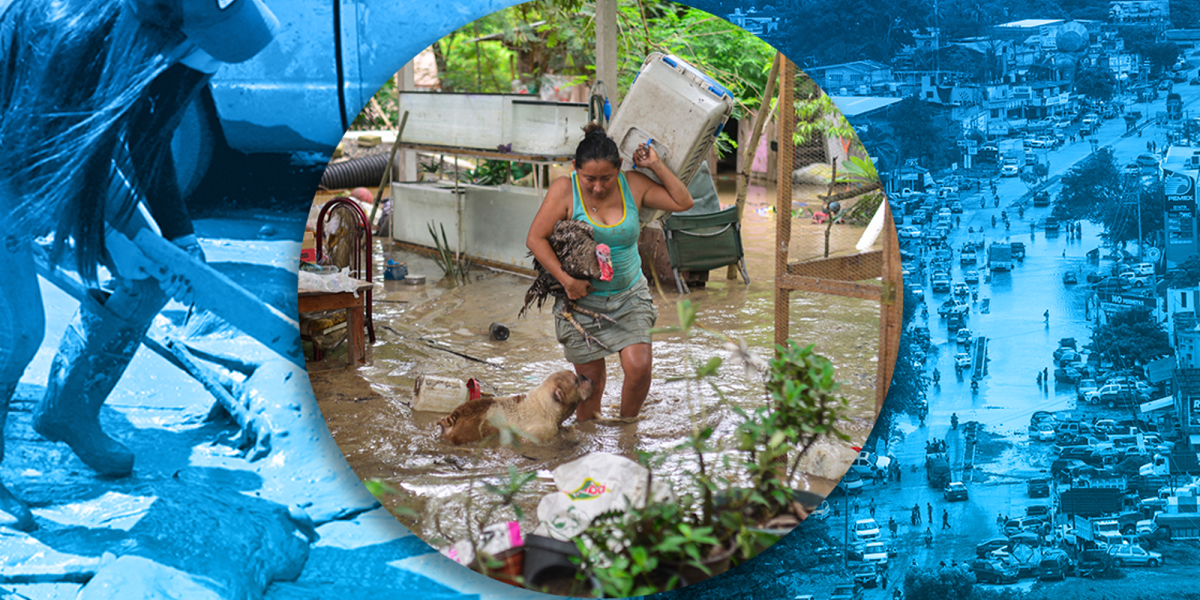
The severe rains in the first half of October passed in the north of Veracruz provoked large material losses in the agricultural, livestock, commercial and business sectors.
According to the National Coordination of Civil Protection, 40 Veracruz municipalities were affected by floods.
Only in Poza Rica, Álamo, Tuxpan, Cazones, Papantla and Gutiérrez Zamora, which were the most affected, more than 10,000 commercial and business establishments, both formal and informal, They resulted in different degrees of damage, according to some estimates cited by the researcher at El Colegio de Veracruz, Edgar Sandoval Pérez.
These are around 25% of the 40,000 economic units that operated in those places until before the floods and range from small workshops and bakeries to agricultural packing houses and fishing cooperatives.
According to data from the National Statistical Directory of Economic Units (Denue) From Inegi, in those six Veracruz municipalities there are 30,778 economic units: Poza Rica, 11,124; Tuxpan, 6,448; Papantla, 5,350; Alamo, 3,743; Gutiérrez Zamora, 2,694 and Cazones, 1,419.
In Alamo, the Canaco Servitur It is estimated that, in the center of the municipal seat of that place, around 3,500 commercial establishments were affected.
Iván Garcés Gómez, delegate of the organization in that municipality indicates that 90% of the establishments report damages of different magnitudes.
The delicate thing about the matter is that the economic cycles that support thousands of families in the Huasteca Alta, Huasteca Baja and Totonaca regions of the Veracruz entity were interrupted, highlights Edgar Sandoval Pérez.
According to him also academic at the University of Veracruzanaeach municipality has a different vocation and therein also lies the complexity, both of its impact and its recovery.
Tuxpan depends largely on port trade and tourist services; Poza Rica, from the energy sector and its supply network; Poplar, citrus and agroindustrial processing; Dogfish, fishing and coastal tourism; Papantla, of vanilla and rural ecotourism and Gutiérrez Zamora, of livestock and regional trade.
The first impacts began to be observed in the rise in prices of some products, mainly citrus fruits, fruits and vegetables, says the academic.
Products like banana and jalapeno pepper recorded increases of up to 25%.
“The loss of crops due to flooding and soil contamination, aggravated by the fuel spill in areas of Poza Rica and Cazones, has generated a focused inflationary effect: more expensive food in regions where family income has fallen. In practice, this means a double blow for the population: less work and more expensive to live,” he indicates.
The The only sectors that remain active are the hotel and food sectors, for the people who have come to support the affected population.
The state government reported that to support the families and merchants who were affected, it will apply the Support the Word program as part of the economic recovery plan.
The objective is to support entrepreneurs, micro and small business owners who lost their work tools or merchandise.
“We have the Support for the Word program for small and medium-sized entrepreneurs; now we are going to channel the remaining resources, along with what the Ministry of Finance and Planning provides, to support those who lost everything. There are cases like in Álamo, where the water flooded all the businesses and families need a boost to start again, said the governor, Rocío Nahle.
According to the president, in parallel, the federal government, through the Ministry of Welfare, will grant 50,000 pesos per affected commercial premises.
Meanwhile, the Ministry of Economy will implement a coordinated strategy with the business chambers to promote the reactivation of micro, small and medium-sized businesses.
Cattle raising
More than 4,600 head of cattle have been reported as damaged
Until now There are no official estimates of damage to livestockHowever, it is possible to have an idea of the magnitude of the losses in the sector with the accident reports from members of the National Confederation of Livestock Organizations (CNOG).
According to Helio Serrato Pérez, Treasurer of the Insurance Funds From that organization, consulted by this newspaper, until mid-week it had received 620 reports of 6,350 damaged heads and 1,200 damaged livestock facilities in Veracruz, Hidalgo, Puebla, Querétaro and San Luis Potosí.
Specifically in Veracruz, 4,668 heads had been reported damaged, mainly cattle, and around 900 livestock facilities.
Although since 2019 the federal government eliminated budget items to support livestock insurancethe CNOG continued to operate with remnants to support that organization’s producers registered until 2019.
The way it operates is that first the organization is notified (the report is drawn up), then an investigation is carried out to verify that there was indeed an accident and then the financial support for lost head is made effective. The compensation is around 9,000 pesos per injured animal.
The organization estimates that Compensations of between 20 million and 27 million pesos will be granted in the five states due to accidents.
Agriculture
More than 66,000 hectares remained to be harvested in the agricultural districts of Álamo and Tuxpan
Local or federal authorities have not disclosed the number of damaged cultivated hectares; However, it is possible to get an idea of the number of plots that could have been affected by consulting the data from the Agri-Food and Fisheries Information Service of the Secretariat of Agriculture and Rural Development (Sader), specifically the number of hectares that were pending harvesting when the floods occurred and the reports of damage to farmers in the area.
Carlos Castañeda Garcés, president of the Chamber of Commerce and Campo Veracruzano, It is estimated that in some cases 90% of the crops in those areas were damaged.
Only in the agricultural districts of Álamo and Tuxpan, which are located in the area most affected by the rains, as of September 30, that is, a week before the heavy rains and floods, 66,460 hectares of various products had yet to be harvested.
Only in the agricultural district of Tuxpan, made up of the municipalities of Cazones de Herrera, Cerro Azul, Coatzintla, Tamiahua, Castillo de Teayo, Álamo Temapache, Tepetzintla, Tihuatlán and Tuxpan, of the 41,092 hectares planted with corn for grain, as of September 30, that is, eight days before the rains began that turned the region into a disaster zone, 14,341 They were yet to be harvested.
In that area, the harvest also remained to be harvested in 1,097 hectares planted with oranges and 240 hectares cultivated with grapefruit.
In that area, a production of 40,355 tons of corn for grain; one million 271,814 tons of oranges, 13,740 tons of bananas and 11,775 tons of beans.
26,751 hectares of corn had already been harvested; 81,301 hectares con orange; 1,625 hectares with grapefruit and 1,286 hectares with banana.
Veracruz is the main orange producer in Mexico. Throughout the state, 172,511 hectares were planted with this citrus fruit this year and 164,315 hectares had already been harvested. State production was expected to be two million 416,606 tons.
In the agricultural district of Pánuco, 36,265 hectares of corn for grain, 10,150 of soybeans and 2,558 of sorghum for grain remained to be harvested. Of the other crops, the area planted by each does not exceed 700 hectares.
The Pánuco agricultural district is made up of the municipalities of Naranjos, Amatlán, Benito Juárez, Citlaltépetl, Chalma, Chiconamel, Chicontepec, Chinampa de Gorostiza, Chontla, Ixcatepec, Ozuluama de Mascareñas, Pánuco, Platón Sánchez, Tamalín, Tampico Alto, Tancoco, Tantima, Tantoyuca, Tempoal and El Higo.
Pemex pipeline spill adds to the disaster
To the disaster caused by the floods in the area, were added the damages caused by the hydrocarbon spill that occurred on October 16 past the Pemex pipeline that runs from Poza-Rica to Ciudad Madero, Tamaulipas.
The spill occurred at kilometer 46+935 of the 30-inch oil pipeline. Pemex reported on October 23 that, in terms of containment, the Works have been 100% completed.
With the objective of preventing the crude oil from reaching populated areas and containing its dispersion along the channel, 94 thick and medium-sized marine containment barriers were installed from the point of origin of the spill.
These actions extended along 35 kilometers of the Tuxpan River; Additionally, in the eight kilometers that connect with the Pantepec River to the first bridge in the center of Tuxpan, 467 oleophilic cords were installed.
Until that day, more than a million liters of hydrocarbon had been recovered in seven strategic points.
The intake of the Veracruz State Water Commission in the town of El Xúchitl, a critical point for the water supply to the municipality of Tuxpan, located four kilometers downstream from ground zero.
In this regard, Luis Montero Irigoyen, spokesperson for Canacintra Gulf of Veracruz regionindicates that nearly 180,000 liters of hydrocarbons were dumped into the Pantepec River, which is the main tributary of the northern part of the state.
In addition, an unquantified number of orchards and crop areas were affected.
Although the river has an extension of around 130 kilometers, the ecological damage occurred in a stretch of between 10 and 20 kilometers.
Just one liter of hydrocarbon can contaminate one cubic meter of water; It is estimated that nearly 1,000 million liters of water were affected.
Various communities are supplied with drinking water from the Pantepec River and it is used for the agricultural sector. It is not known how many bodies of water are contaminated.
Reactivation will require budget and coordination
For him researcher at El Colegio de Veracruz, Edgar Sandoval Pérez, The economic reactivation of the state after this disaster requires coordinating reliable censuses, based on field evidence, that allow prioritizing support not only by number of victims, but by productive impact.
In his opinion, the recovery must start from a territorial approach: first restore the activities that generate employment, cash flow and local chains.
In 2024, losses due to disasters caused by rains and floods were estimated at 2,820 million pesos, mainly due to the scourge of Hurricane Nadine; those of 2023 at 988 million and those of 2022 at 2,599 million.
Sandoval Pérez recalls that after the passage of Hurricane Grace, in 2021, in Veracruz, direct incentives to citrus producers in the north of the state managed to recover 60% of production in one year.
That lesson must be taken up again now, but with a more comprehensive vision. Is It is essential to incorporate soft microcredits, temporary exemptions from state and municipal rights, and inter-institutional coordination between the state and federal governments and local business chambers to channel support without duplication or dispersion.
It is also time to rethink productive infrastructure. The industrial parks and logistics zones of Poza Rica and Tuxpan could become poles of reactivation through tax incentives and temporary employment programs.
According to the academic, in the rural sector, a strategy for soil restitution and cleaning of contaminated canals is urgently needed, financed with federal resources and technical support from the National Institute of Ecology.
In his opinion, the reconstruction cost It could range between 6,500 and 14,000 million pesos.