In the midst of one of the largest crises of citizen insecurity that the country is experiencing, the Inter-American Court of Human Rights (IAC Court) Not only has it been attacked by the Government and Congress, but Now it is being used as a strategy to win votes by various political parties that will participate in the next elections on April 12.
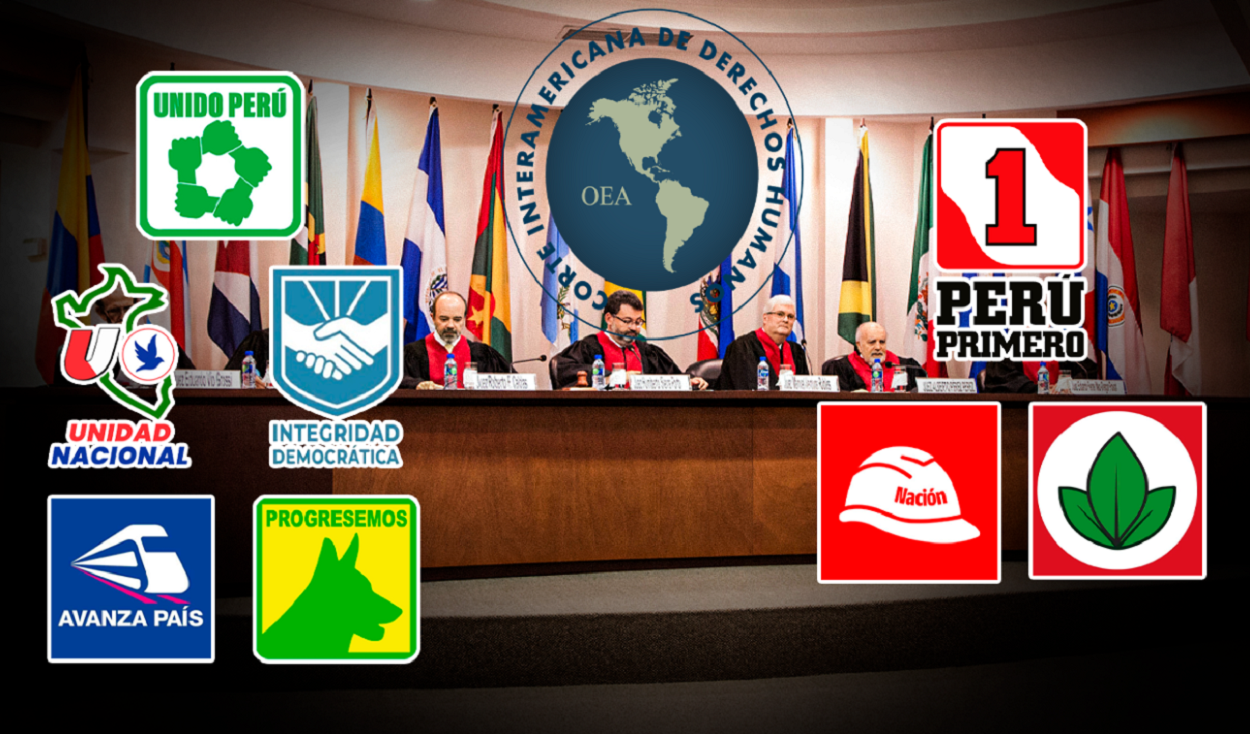
Through a review of the government plans that were presented by the 36 political groups authorized before the National Elections Jury (JNE), The Republic It has been able to detect that five of them offer reforms, a referendum and even the withdrawal of the Inter-American Court; while three others undertake to guarantee Peru’s adherence to the rulings of this international court.
YOU CAN SEE: CAL demands constitutional guarantees to preserve special Lava Jato and Cuellos Blancos teams
In the first group are Advance Country, Let’s Progress, National Unity, United Peru and Democratic Integrity that present themselves as right-wing options; while in the second they appear Now Nation, Peru First and We Will Win who have a leftist tendency. The other 28 political groups in the electoral race avoided making statements in their roadmaps and offered other proposals to combat the worrying crime.
In favor of the exit
The most radical are Avanza País and Progresemos, which have José Williams and Paul Jaimes as presidential candidates, respectively. In their government plans, both parties promise that they will begin the process of leaving our country from the Inter-American Human Rights System, whose main bodies are the Inter-American Commission on Human Rights (IACHR) and the Inter-American Court. The purpose, according to these parties, is to “recover national sovereignty” and restore the death penalty for cases of hitmen, organized crimerape of minors, terrorism, among other serious crimes.
According to lawyer Paul Jaimes’ party, the criminal system faces limitations due to supranational jurisdiction. “As a first act, I will present the complaint of withdrawal of the jurisdiction of the Inter-American Court that “It’s not enough,” says the candidate who maintains, in a tendentious manner, that in Peru maximum security prisons cannot be built, nor forced labor implemented, nor prisoners exported to prisons like El Salvador because the Inter-American Court prohibits it.
Former military man José Williams, for his part, as a congressman, has expressed his disagreement with some reports from the Inter-American Court. whom he has called biased and interfering with national sovereignty. Now his party responds that the decision will be made to leave that supranational body because it is a presidential prerogative and because severe sanctions are needed. The death penalty will come after constitutional modifications.
Populist and irresponsible
In the opinion of the internationalist Francisco Belaúnde, these proposals are part of an ideological offensive against everything that multilateralism represents. “These groups consider that organizations, such as the IACHR or the Inter-American Courthave been dominated by the left and threaten the sovereignty of the countrieswhich is absurd because Peru voluntarily chose to be part of the Inter-American Human Rights System,” he maintains.
For Julissa Mantilla, former president of the IACHR, it is irresponsible and populist that the parties are offering these proposals in government plans. “Those who propose have no idea what the Inter-American Human Rights System is. And they do it only to deceive and abuse those people who can understand that tomorrow we will leave the System when that is not true. “It is populism and abuse at the same time,” he said.
Mantilla explains that, once a State decides to denounce the American Convention on Human Rights, a year must pass for it to be effective. Meanwhile, the IACHR and the Inter-American Court continue to have jurisdiction in the cases that come before them.
“It seems very serious to me that those politicians, who are public officials, blame the Inter-American Court for the fact that, due to its responsibility, it cannot put an end to the contract killing or punish the criminals. That is false, the Court has nothing to do with it. Rather, they should promote the repeal of the pro-crime laws that they approved,” he says.
It also warns that, even if Peru withdraws from the powers of the IACHR and the Inter-American Court, the death penalty cannot be applied because our country has freely signed other international agreements.
“An important aspect is that Peru is also part of the United Nations Universal System that prohibits the death penalty. It is also part of the United Nations Covenant on Civil and Political Rights that prevents this measure. So what do we do? Will we also leave the UN (United Nations Organization)?”, questions the former president of the IACHR, who suggests voters not to be fooled by so many proposals of this type.
They ask for review
In addition to Avanza País and Progresemos, the electoral alliance Unidad Nacional, which has legislator Roberto Chiabra as its presidential candidate, shows a critical stance towards the Inter-American Court. “We consider that this jurisdictional body has become disproportionately politicized and, therefore, biased in many of its decisions due to ideological or political considerations of its members,” he noted in his government plan.
However, National Unity does not propose a solution, but rather promises that it will promote within the OAS (Organization of American States) the relevant debate on the actions of the Inter-American Court and will lead the necessary reforms that must be introduced as a continental jurisdictional body.
The Democratic Integrity Party, whose presidential candidate is Wolfgang Grozo, also follows this line by proposing the constitutional review of adherence to the Inter-American Human Rights System. Meanwhile, Perú Unidos, which has Charlie Carrasco as its presidential candidate, proposes that the withdrawal of the American Convention on Human Rights, the death penalty and the constitutional change be submitted to a referendum so that the people can decide.
YOU CAN SEE: Congresswoman Kira Alcarraz is denounced for attacking the SAT inspector
In the opinion of the internationalist Francisco Belaúnde, these proposals are part of an ideological offensive against everything that multilateralism represents. “These groups consider that organizations, such as the IACHR or the Inter-American Court, have been dominated by the left and that they threaten the sovereignty of the countries, which is absurd because Peru voluntarily chose to be part of the Inter-American Human Rights System,” he maintains.
Against departure
From the front berm, the Now Nation party, whose presidential candidate is Alfonso López Chau, committed to guarantee compliance with the decisions of the Inter-American Court, for which it will adopt necessary measures to adapt the institutions and the national legal framework to the demands of the international system for the protection of human rights.
“A system and competent jurisdictional bodies will be created to execute decisions of the Inter-American Court of Human Rights. The goal is that 100% of the rulings of the Inter-American Court are carried out,” reads the Ahora Nación government plan.
In the case of the Venceremos electoral alliance, which has Ronald Atencio as its candidate, it proposes preventing the departure of the Inter-American Court and restoring Peru’s commitment to the Inter-American Human Rights System.
Meanwhile, Perú Primero, whose presidential candidate Mario Vizcarra is in trouble before the JNE, offers to reconfirm Peru’s membership and participation in the Inter-American Commission on Human Rights and the Inter-American Court of Human Rights, in compliance with the obligations assumed by the State in the American Convention on Human Rights.
“We are going to suppress the initiative of the previous Government (of Dina Boluarte) to evaluate Peru’s withdrawal from the Inter-American Commission and Court of Human Rights. Peru’s international credibility must be recovered through a democratic foreign policy, respectful of international law and human rights,” reads its government plan for 2031.
Executive and Congress
This theme has also been used by the Executive and Congress. In August of last year, then-president Dina Boluarte announced her position of installing a multi-sector commission to evaluate the permanence of our country in the Inter-American Human Rights System. Months prior to that announcement, the Ministry of Justice had held at least 23 working groups to restore the death penalty against child abusers.
At that time, Congress was also considering putting into debate the insistence approval of a norm that creates a high-level commission to evaluate Peru’s continuity in the aforementioned System.
These actions were carried out amid the disagreements that the Executive and Congress had with the IACHR because the latter had indicated, in one of its reports, that serious human rights violations had been recorded during the 2022 and 2023 protests.
The current president José Jerí was no stranger to the issue. When he was president of Congress, in September 2025, he was in favor of the withdrawal of the Inter-American Court. “We are going to defend the laws approved in cases in which the rule that grants amnesty to soldiers and police who fought against terrorism is not being applied,” he said.
If Peru were to leave the Inter-American System, Mantilla and Belaúnde agree that our country would be at the level of Venezuela, Nicaragua and Cuba, which are dictatorial regimes. “Organized crime is fought with police intelligence. We cannot leave the Inter-American Court because it would affect the victims,” they respond with concern.