The mining strike in Boyacá completes four days since its launch. On August 4, miners and peasants began a mobilization to call the government to review the Tax, energy and environmental policies that are not only impacting the sector, but also to the department.
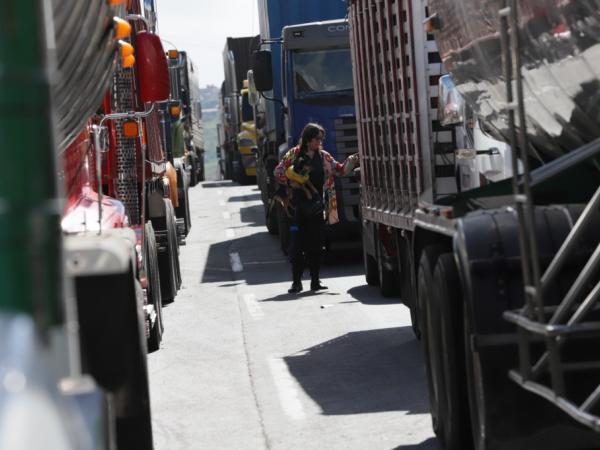
The blockages, active in the main and secondary roads of the region, have resulted in mobility effects, fuel and food supply, and in millionaire losses for some productive sectors.
The government has been advancing negotiations to achieve an agreement and define a package of Short, medium and long term solutions that solve the needs that motivated the protest. These are some of the advances and updates that have been recorded.
(More news: Mining unemployment in Boyacá and Cundinamarca leaves millionaire transport losses)
Minute by minute
4:00 pm: The governor of Cundinamarca, Jorge Emilio Rey, announced that a unified command post (PMU) is developed to evaluate the conditions of public order and security within the framework of the blockages that are presented in national and departmental roads by the mining sector.
Five blockages remain active in the department, located in Languazaque, Villapinzón, Tausa, Ubaté and Guachetá.
We develop a unified command post (PMU) to evaluate the conditions of public order and security within the framework of the blockages that are presented in national and departmental roads by the mining sector.
In Cundinamarca we have five active blockages, located … pic.twitter.com/uhgjvsyj5z
– Jorge Emilio Rey Ángel (@jorgeemiliorey) August 7, 2025
3:19 PM: Governor Amaya announced the installation of the dialogue table.
“We will help in everything that is necessary to reach an agreement that allows lifting unemployment, and above all, real solutions can be guaranteed to the problem of the coal mining sector in Boyacá,” explained.
12:00 pm: The governor, Carlos Amaya, said that from the morning a negotiating table is being developed and the parties are close to reaching an agreement.
“We continue working and are helping us by opening periodically to be able to decongest, not to miss the food and that people can pass”he said.
10:40 am: In dialogue with ‘La W’, Colonel Germán Gómez, director of Transit and Transportation of the National Police, confirmed that there are currently 11 points with total closure on the roads that connect to Boyacá and Cundinamarca with Bogotá.
The most affected routes have been the Bogotá – Tunja and the corridor by Chiquinquirá, generating alterations to cargo transport and other vehicles.
Mining unemployment
AFP
8:14 am: Port operators warned that coal exports and coqué from the Barranquilla port zone face difficulties following the unemployment that takes place in Boyacá, Cundinamarca and Norte de Santander. This following the blockages that remain active at some key points for transportation.
“The main affectation is that coal and that coke that is not coming, which is pending to load, from Boyacá mainly, and that has not been able to reach the port area,” Lucas Ariza, director of Asoportuaria.
7:48 am: After the meeting of the Unified Command Post (PMU), the governor of Boyacá, Carlos Amaya, reported that an intermittent step was opened in the municipality of Paipa. He also indicated that, for the moment, there are no food or damaged milk.
“We hope to dedicate our effort to dialogue and agreement to reach agreements that allow the lifting of unemployment.”he said.

Mining unemployment
AFP
6:00 am: The Interior Ministry reported that an agreement was reached with the miners of San Pablo de Borbur to make a stepped lifting of the blockages present in the municipalities of the West of Boyacá.
The portfolio reported that its materialization will be subject to the revision of the progress of the 10 commitments signed at the dialogue table.
Portfolio