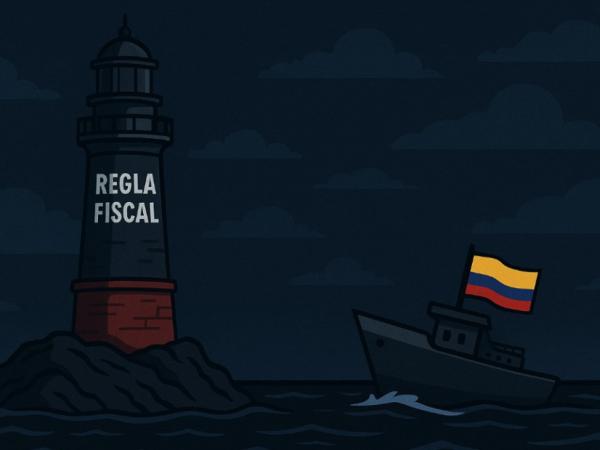
Colombia’s qualification remains under pressure and the message that comes from Fitch Ratings is as direct as worrying; while the erosion of fiscal discipline and the suspension of the fiscal rule keep the Red light on risk and mine ratings the trust of investors.
This is one of the conclusions of the recent portfolio talk with Richard Francis, co -director of sovereign grades of the Americas for the firm, who warns that the country faces a loss of credibility difficult to reverse in the short term, to the point that today is the factor that weighs the most in the negative perspective that accompanies the qualification.
See here: The United States accuses President Petro for his ‘incendiary rhetoric’
Francis was clear about his concern about the way Colombia has managed its accounts in recent years and although it recognizes that public debt still remains slightly below 60% of GDP, He maintains that it is a situation more attributable to “luck” than to structural decisions.
“It is more luck in the context of the strength of the weight, which helps a lot especially in the debt situation, but also, to a lesser extent, in the fiscal deficit. A strong currency implies that external interest payments are lower in pesos, and that generates a double relief,” he said.
Richard Francis, co -director of sovereign grades of the Americas for Fitch Ratings.
Courtesy – API
A little luck
Despite the latter, for Fitch there is a cocktail of factors explains why trust has weakened and why the country’s note remains under threat, starting with the fiscal rule, a framework that for years was seen as an anchor of credibility in Colombian macroeconomic management and is now drifting.
The Petro government decision to suspend it, united to three consecutive years without fulfilling deficit goals, generated what Francis describes as a loss of discipline that undermines the confidence of investors and multilateral organizations. In its criteria, it is not so much the specific number of the deficit that worries, but the sign that there is no political will of correction.
Also read: Concerts and events in Bogotá: They give permission to Luis Alfonso’s festival and deny others
In fact, Fitch projects that the central government deficit will close about 7.2% this year to 7.3% of GDP, a level above what the executive himself anticipates, although still far from the most pessimistic stage of 8% that some analysts foresee; While for Francis, even with the lowest data, the photo remains alarming, because what is needed to stabilize the debt is an adjustment close to 3% of GDP, an effort of unpublished magnitude in the recent history of the country.
“I consider that the context would improve if there were a more favorable business environment. However, with the tax reforms it usually happens that the government ends up increasing the burden on the corporate sector, while it is very difficult to raise taxes to natural persons, although Colombia has one of the lowest rates in the region. Technically it would be easy to do it, but politically it is complex. In addition, the work front adds an extra degree of difficulty in the country,” he said.
Take care of the situation
Among the risks to take care of, Franciso focused on the dollar and said that if he reached $ 5,000 levels, the panorama would be completely different and the debt would jump well above 60% of GDP and the interest service would become much heavier; making it clear that the current margin does not obey A deliberate tax adjustment, but to exchange conditions that could change at any time.
In parallel, Fitch cautiously observes the monetary policy and the performance of inflation; Taking into account that he adjusted his inflation projection for this year at 4.6%, higher than initially planned, and believes that this limits the possibilities of cuts in the reference interest rate.
It may interest you: Protests and siege in the Andi building: this is the security balance in the area
In this way, Richard Francis explains that the Bank of the Republic faces a dilemma in which on the one hand, inflation yields more slowly than expected and on the other, tax risks raise concern about sustainability. Under these conditions, it considers that significant cuts are unlikely and anticipates that the casual cycle will be slower than expected, also conditioned on the minimum salary trajectory, which is discussed with two -digit increase figures.
Likewise, he referred to the Flexible Credit Line with the International Monetary Fund, a mechanism that Colombia has used as support in times of tension and its diagnosis is not very encouraging, since it is very difficult for the IMF to renew the LCF while the country maintains deficits close to 7% and suspend the fiscal rule.

Colombia must reduce public spending as soon as possible, according to experts.
Chatgpt image
On the other hand, although he recognizes that part of the loss of credibility was already reflected in the investment grade reduction announced a few months ago, he insists that current inertia reinforces the perception of fragility, warning that “It is not only the level of the deficit, but the will and the ability to correct it that generates doubts.”
Additional risks
Beyond the fiscal figures, the qualifier observes additional risks that can influence the country’s note, as is the case of the rigidity of public spending, compared to which they recalled that the latest approved reforms, such as pension and transfers, have made the fiscal structure more inflexible, subtracting margin for future adjustments.
Other news: Labor reform could also affect unions
That rigidity, added to the political decision not to cut the budget, further reduces options Of maneuver and in the vision of Fitch, Colombia is running out of tools to respond to its imbalances; While the panorama is complicated with the political environment, since the uncertainty about the 2026 elections also weighs, because the candidate platforms are not yet clear and Fitch does not expect to have that information before the beginning of next year.
Finally, on the external front, Francis warns that the fall in oil prices is a latent risk for Colombia and that although the current account deficit still remains at manageable levels, about 2.5% of GDP, the trend points to the rise and could approach 3.2% next year.

Colombia must reduce public spending as soon as possible, according to experts.
Chatgpt image
If 4% or 5% exceed, he says, he would begin to turn on serious alarms, especially in a context of high fiscal deficits, since that scenario of “twin deficits” would be particularly harmful to trust and, therefore, for qualification.
In the end, Francis makes it clear that the margin of maneuver is in the hands of the next government, which must undertake a strong and credible adjustment to avoid greater deterioration. Meanwhile, Fitch will continue to closely observe the outcome of the budget, the evolution of debt and fiscal policy signs; While the greatest challenge will be to convince markets that your sovereign note will not continue to fall.
Daniel Hernández Naranjo
Portfolio journalist